

46
Activity Patterns
digestion
glandular leaf ... - - - - - arthropod prey
~~ nectar feeders ~
digestion
ant mimic
blood sucking
sap sucking
insect carrion feeders
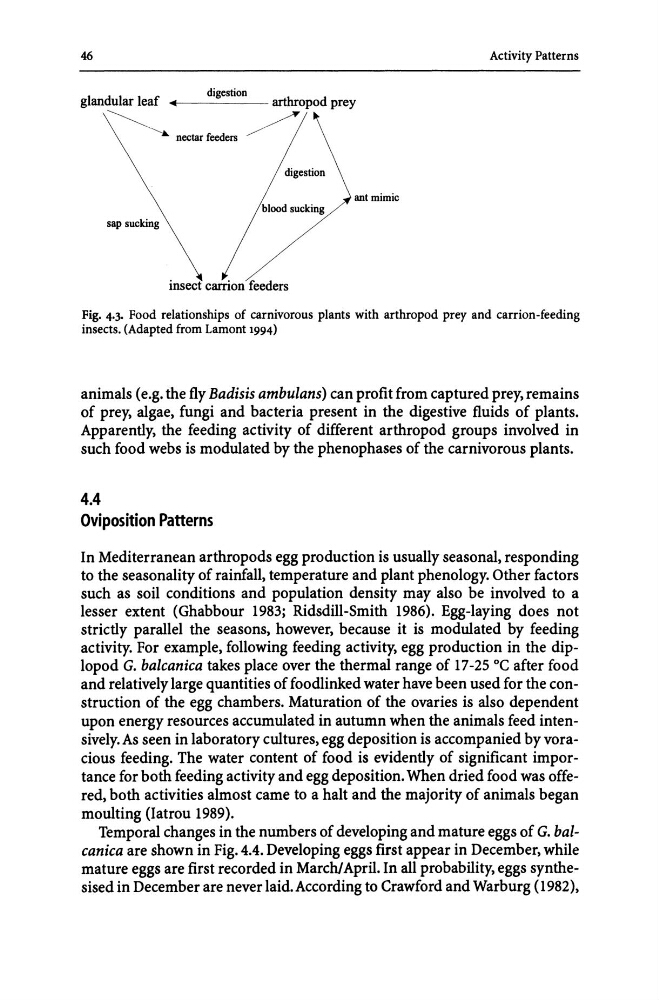
Fig. 4.3. Food relationships of carnivorous plants with arthropod prey and carrion-feeding
insects. (Adapted from Lamont 1994)
animals (e.g. the fly Badisis ambulans) can profit from captured prey, remains
of prey, algae, fungi and bacteria present in the digestive fluids of plants.
Apparently, the feeding activity of different arthropod groups involved in
such food webs is modulated by the phenophases of the carnivorous plants.
4.4
Oviposition Patterns
In Mediterranean arthropods egg production is usually seasonal, responding
to the seasonality of rainfall, temperature and plant phenology. Other factors
such as soil conditions and population density may also be involved to a
lesser extent (Ghabbour 1983; Ridsdill-Smith 1986). Egg-laying does not
strictly parallel the seasons, however, because it is modulated by feeding
activity. For example, following feeding activity, egg production in the diplopod G. balcanica takes place over the thermal range of 17-25 DC after food
and relatively large quantities of foodlinked water have been used for the construction of the egg chambers. Maturation of the ovaries is also dependent
upon energy resources accumulated in autumn when the animals feed intensively. As seen in laboratory cultures, egg deposition is accompanied by voracious feeding. The water content of food is evidently of significant importance for both feeding activity and egg deposition. When dried food was offered, both activities almost came to a halt and the majority of animals began
moulting (Iatrou 1989).
Temporal changes in the numbers of developing and mature eggs of G. balcanica are shown in Fig. 4.4. Developing eggs first appear in December, while
mature eggs are first recorded in Marchi April. In all probability, eggs synthesised in December are never laid. According to Crawford and Warburg (1982),
Activity Patterns
digestion
glandular leaf ... - - - - - arthropod prey
~~ nectar feeders ~
digestion
ant mimic
blood sucking
sap sucking
insect carrion feeders
Fig. 4.3. Food relationships of carnivorous plants with arthropod prey and carrion-feeding
insects. (Adapted from Lamont 1994)
animals (e.g. the fly Badisis ambulans) can profit from captured prey, remains
of prey, algae, fungi and bacteria present in the digestive fluids of plants.
Apparently, the feeding activity of different arthropod groups involved in
such food webs is modulated by the phenophases of the carnivorous plants.
4.4
Oviposition Patterns
In Mediterranean arthropods egg production is usually seasonal, responding
to the seasonality of rainfall, temperature and plant phenology. Other factors
such as soil conditions and population density may also be involved to a
lesser extent (Ghabbour 1983; Ridsdill-Smith 1986). Egg-laying does not
strictly parallel the seasons, however, because it is modulated by feeding
activity. For example, following feeding activity, egg production in the diplopod G. balcanica takes place over the thermal range of 17-25 DC after food
and relatively large quantities of foodlinked water have been used for the construction of the egg chambers. Maturation of the ovaries is also dependent
upon energy resources accumulated in autumn when the animals feed intensively. As seen in laboratory cultures, egg deposition is accompanied by voracious feeding. The water content of food is evidently of significant importance for both feeding activity and egg deposition. When dried food was offered, both activities almost came to a halt and the majority of animals began
moulting (Iatrou 1989).
Temporal changes in the numbers of developing and mature eggs of G. balcanica are shown in Fig. 4.4. Developing eggs first appear in December, while
mature eggs are first recorded in Marchi April. In all probability, eggs synthesised in December are never laid. According to Crawford and Warburg (1982),