

Feeding Activity
45
18
15
O~---------k=4---------------------I 8 ~ H = i } k r ~ .1 ~ I 8 ~
~
z ~ ~ ~ ~ ~ ~ ~ ~ ~ ~
z
TIme (months)
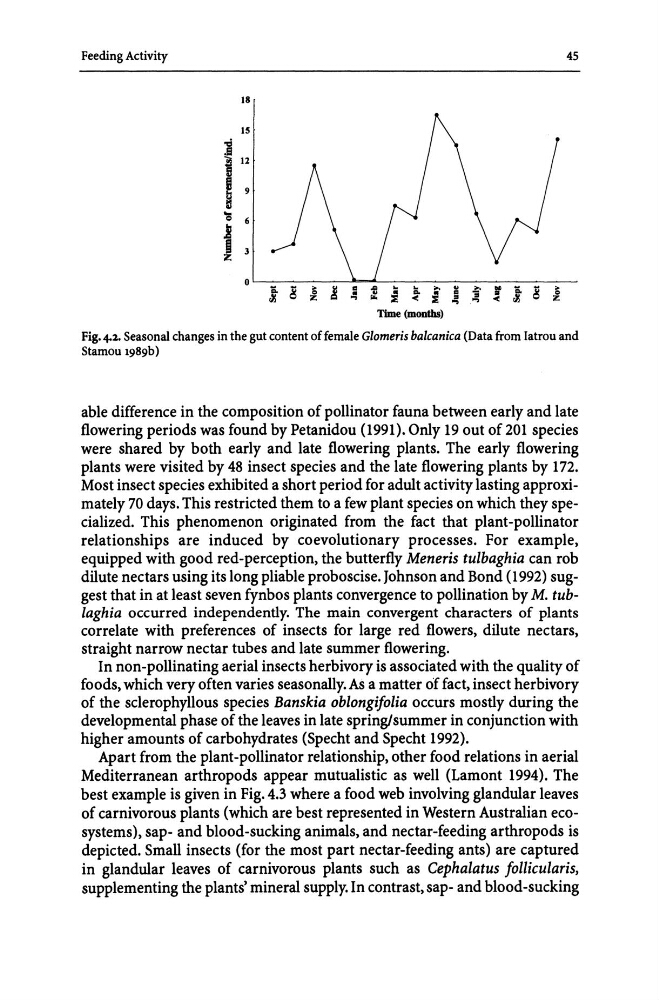
Fig. 42. Seasonal changes in the gut content of female Glomeris balcanica (Data from Iatrou and
Stamou 1989b)
able difference in the composition of pollinator fauna between early and late
flowering periods was found by Petanidou (1991). Only 19 out of 201 species
were shared by both early and late flowering plants. The early flowering
plants were visited by 48 insect species and the late flowering plants by 172.
Most insect species exhibited a short period for adult activity lasting approximately 70 days. This restricted them to a few plant species on which they specialized. This phenomenon originated from the fact that plant-pollinator
relationships are induced by co evolutionary processes. For example,
equipped with good red-perception, the butterfly Meneris tulbaghia can rob
dilute nectars using its long pliable proboscise. Johnson and Bond (1992) suggest that in at least seven fynbos plants convergence to pollination by M. tublaghia occurred independently. The main convergent characters of plants
correlate with preferences of insects for large red flowers, dilute nectars,
straight narrow nectar tubes and late summer flowering.
In non-pollinating aerial insects herbivory is associated with the quality of
foods, which very often varies seasonally. As a matter of fact, insect herbivory
of the sclerophyllous species Banskia oblongifolia occurs mostly during the
developmental phase of the leaves in late spring/summer in conjunction with
higher amounts of carbohydrates (Specht and Specht 1992).
Apart from the plant-pollinator relationship, other food relations in aerial
Mediterranean arthropods appear mutualistic as well (Lamont 1994). The
best example is given in Fig. 4.3 where a food web involving glandular leaves
of carnivorous plants (which are best represented in Western Australian ecosystems), sap- and blood-sucking animals, and nectar-feeding arthropods is
depicted. Small insects (for the most part nectar-feeding ants) are captured
in glandular leaves of carnivorous plants such as Cephalatus follicularis,
supplementing the plants' mineral supply. In contrast, sap- and blood-sucking
45
18
15
O~---------k=4---------------------I 8 ~ H = i } k r ~ .1 ~ I 8 ~
~
z ~ ~ ~ ~ ~ ~ ~ ~ ~ ~
z
TIme (months)
Fig. 42. Seasonal changes in the gut content of female Glomeris balcanica (Data from Iatrou and
Stamou 1989b)
able difference in the composition of pollinator fauna between early and late
flowering periods was found by Petanidou (1991). Only 19 out of 201 species
were shared by both early and late flowering plants. The early flowering
plants were visited by 48 insect species and the late flowering plants by 172.
Most insect species exhibited a short period for adult activity lasting approximately 70 days. This restricted them to a few plant species on which they specialized. This phenomenon originated from the fact that plant-pollinator
relationships are induced by co evolutionary processes. For example,
equipped with good red-perception, the butterfly Meneris tulbaghia can rob
dilute nectars using its long pliable proboscise. Johnson and Bond (1992) suggest that in at least seven fynbos plants convergence to pollination by M. tublaghia occurred independently. The main convergent characters of plants
correlate with preferences of insects for large red flowers, dilute nectars,
straight narrow nectar tubes and late summer flowering.
In non-pollinating aerial insects herbivory is associated with the quality of
foods, which very often varies seasonally. As a matter of fact, insect herbivory
of the sclerophyllous species Banskia oblongifolia occurs mostly during the
developmental phase of the leaves in late spring/summer in conjunction with
higher amounts of carbohydrates (Specht and Specht 1992).
Apart from the plant-pollinator relationship, other food relations in aerial
Mediterranean arthropods appear mutualistic as well (Lamont 1994). The
best example is given in Fig. 4.3 where a food web involving glandular leaves
of carnivorous plants (which are best represented in Western Australian ecosystems), sap- and blood-sucking animals, and nectar-feeding arthropods is
depicted. Small insects (for the most part nectar-feeding ants) are captured
in glandular leaves of carnivorous plants such as Cephalatus follicularis,
supplementing the plants' mineral supply. In contrast, sap- and blood-sucking