

36
Respiratory Metabolism
~
1
~
8
~
6
December
Q.
E
2
S?
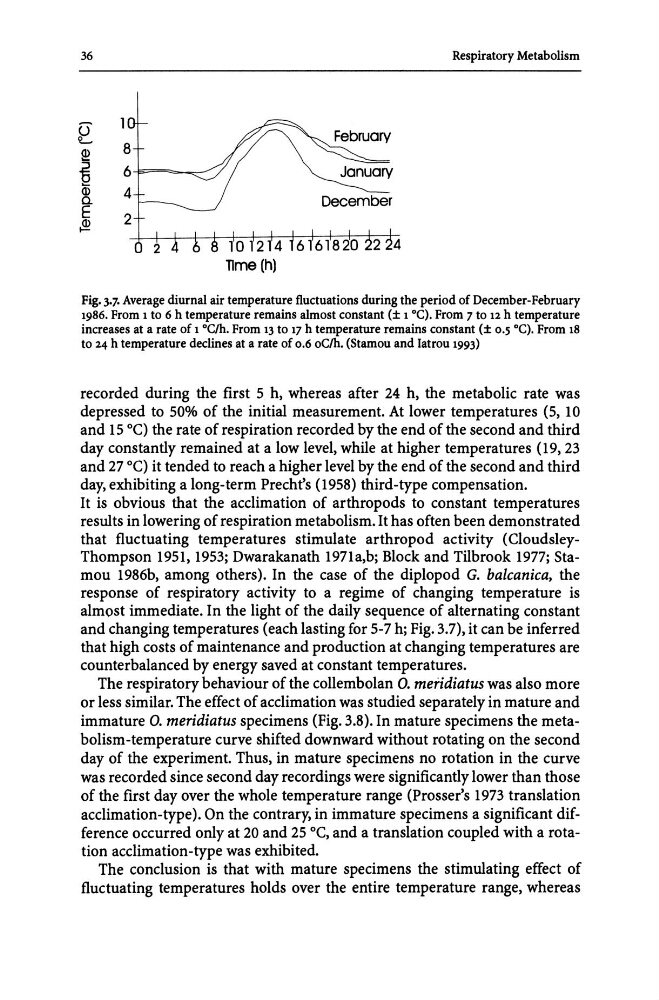
Fig. 3.7. Average diurnal air temperature fluctuations during the period of December-February
1986. From 1 to 6 h temperature remains almost constant (± 1 0C). From 7 to 12 h temperature
increases at a rate of 1 °C/h. From 13 to 17 h temperature remains constant (± 0.5 °C). From 18
to 24 h temperature declines at a rate of 0.6 oCIh. (Stamou and Iatrou 1993)
recorded during the first 5 h, whereas after 24 h, the metabolic rate was
depressed to 50% of the initial measurement. At lower temperatures (5, 10
and 15°C) the rate of respiration recorded by the end of the second and third
day constantly remained at a low level, while at higher temperatures (19,23
and 27°C) it tended to reach a higher level by the end of the second and third
day, exhibiting a long-term Precht's (1958) third-type compensation.
It is obvious that the acclimation of arthropods to constant temperatures
results in lowering of respiration metabolism. It has often been demonstrated
that fluctuating temperatures stimulate arthropod activity (CloudsleyThompson 1951, 1953; Dwarakanath 1971a,b; Block and Tilbrook 1977; Stamou 1986b, among others). In the case of the diplopod G. balcanica, the
response of respiratory activity to a regime of changing temperature is
almost immediate. In the light of the daily sequence of alternating constant
and changing temperatures (each lasting for 5-7 h; Fig. 3.7), it can be inferred
that high costs of maintenance and production at changing temperatures are
counterbalanced by energy saved at constant temperatures.
The respiratory behaviour of the collembolan O. meridiatus was also more
or less similar. The effect of acclimation was studied separately in mature and
immature O. meridiatus specimens (Fig. 3.8). In mature specimens the metabolism-temperature curve shifted downward without rotating on the second
day of the experiment. Thus, in mature specimens no rotation in the curve
was recorded since second day recordings were significantly lower than those
of the first day over the whole temperature range (Prosser's 1973 translation
acclimation-type). On the contrary, in immature specimens a significant difference occurred only at 20 and 25°C, and a translation coupled with a rotation acclimation-type was exhibited.
The conclusion is that with mature specimens the stimulating effect of
fluctuating temperatures holds over the entire temperature range, whereas
Respiratory Metabolism
~
1
~
8
~
6
December
Q.
E
2
S?
Fig. 3.7. Average diurnal air temperature fluctuations during the period of December-February
1986. From 1 to 6 h temperature remains almost constant (± 1 0C). From 7 to 12 h temperature
increases at a rate of 1 °C/h. From 13 to 17 h temperature remains constant (± 0.5 °C). From 18
to 24 h temperature declines at a rate of 0.6 oCIh. (Stamou and Iatrou 1993)
recorded during the first 5 h, whereas after 24 h, the metabolic rate was
depressed to 50% of the initial measurement. At lower temperatures (5, 10
and 15°C) the rate of respiration recorded by the end of the second and third
day constantly remained at a low level, while at higher temperatures (19,23
and 27°C) it tended to reach a higher level by the end of the second and third
day, exhibiting a long-term Precht's (1958) third-type compensation.
It is obvious that the acclimation of arthropods to constant temperatures
results in lowering of respiration metabolism. It has often been demonstrated
that fluctuating temperatures stimulate arthropod activity (CloudsleyThompson 1951, 1953; Dwarakanath 1971a,b; Block and Tilbrook 1977; Stamou 1986b, among others). In the case of the diplopod G. balcanica, the
response of respiratory activity to a regime of changing temperature is
almost immediate. In the light of the daily sequence of alternating constant
and changing temperatures (each lasting for 5-7 h; Fig. 3.7), it can be inferred
that high costs of maintenance and production at changing temperatures are
counterbalanced by energy saved at constant temperatures.
The respiratory behaviour of the collembolan O. meridiatus was also more
or less similar. The effect of acclimation was studied separately in mature and
immature O. meridiatus specimens (Fig. 3.8). In mature specimens the metabolism-temperature curve shifted downward without rotating on the second
day of the experiment. Thus, in mature specimens no rotation in the curve
was recorded since second day recordings were significantly lower than those
of the first day over the whole temperature range (Prosser's 1973 translation
acclimation-type). On the contrary, in immature specimens a significant difference occurred only at 20 and 25°C, and a translation coupled with a rotation acclimation-type was exhibited.
The conclusion is that with mature specimens the stimulating effect of
fluctuating temperatures holds over the entire temperature range, whereas