

Acclimation to Constant Temperature
37
(al
JO
25
---,
----_ ...
, , , , , ,
OT----r--~1~0----1~5--~2~0----~~--~JO
Temperature (oc)
(bl
20
,
--------.-=-- -_.
,
,
,
_0
OT----r--~1~0--~1~5--~2~0--~2~5--~JO
Temperature (oc)
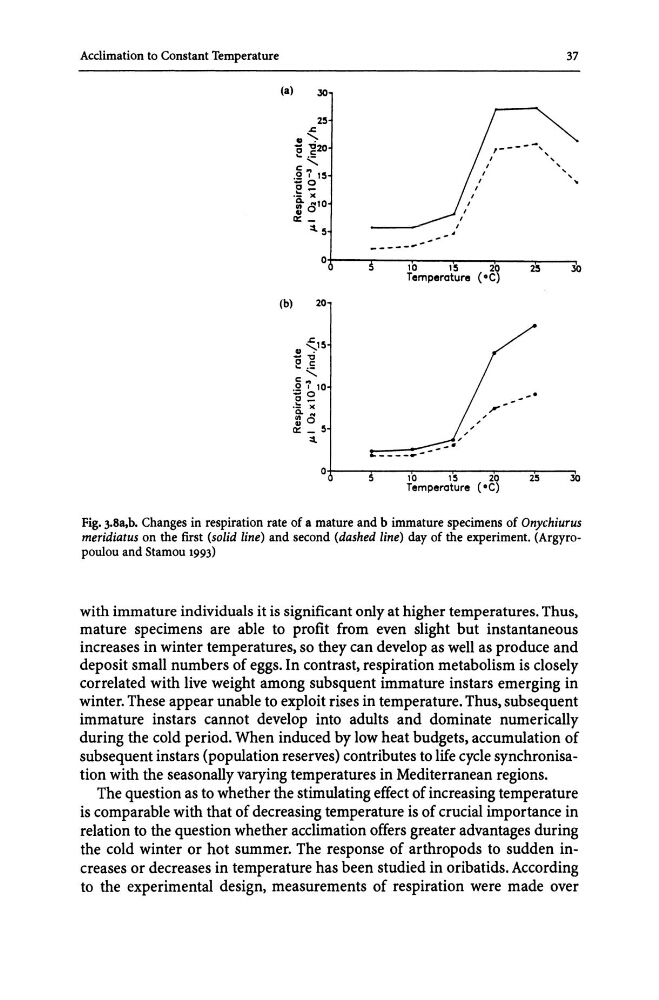
Fig. 3.8a,b. Changes in respiration rate of a mature and b immature specimens of Onychiurus
meridiatus on the first (solid line) and second (dashed line) day of the experiment. (Argyropoulou and Stamou 1993)
with immature individuals it is significant only at higher temperatures. Thus,
mature specimens are able to profit from even slight but instantaneous
increases in winter temperatures, so they can develop as well as produce and
deposit small numbers of eggs. In contrast, respiration metabolism is closely
correlated with live weight among subsquent immature instars emerging in
winter. These appear unable to exploit rises in temperature. Thus, subsequent
immature instars cannot develop into adults and dominate numerically
during the cold period. When induced by low heat budgets, accumulation of
subsequent instars (population reserves) contributes to life cycle synchronisation with the seasonally varying temperatures in Mediterranean regions.
The question as to whether the stimulating effect of increasing temperature
is comparable with that of decreasing temperature is of crucial importance in
relation to the question whether acclimation offers greater advantages during
the cold winter or hot summer. The response of arthropods to sudden increases or decreases in temperature has been studied in oribatids. According
to the experimental design, measurements of respiration were made over
37
(al
JO
25
---,
----_ ...
, , , , , ,
OT----r--~1~0----1~5--~2~0----~~--~JO
Temperature (oc)
(bl
20
,
--------.-=-- -_.
,
,
,
_0
OT----r--~1~0--~1~5--~2~0--~2~5--~JO
Temperature (oc)
Fig. 3.8a,b. Changes in respiration rate of a mature and b immature specimens of Onychiurus
meridiatus on the first (solid line) and second (dashed line) day of the experiment. (Argyropoulou and Stamou 1993)
with immature individuals it is significant only at higher temperatures. Thus,
mature specimens are able to profit from even slight but instantaneous
increases in winter temperatures, so they can develop as well as produce and
deposit small numbers of eggs. In contrast, respiration metabolism is closely
correlated with live weight among subsquent immature instars emerging in
winter. These appear unable to exploit rises in temperature. Thus, subsequent
immature instars cannot develop into adults and dominate numerically
during the cold period. When induced by low heat budgets, accumulation of
subsequent instars (population reserves) contributes to life cycle synchronisation with the seasonally varying temperatures in Mediterranean regions.
The question as to whether the stimulating effect of increasing temperature
is comparable with that of decreasing temperature is of crucial importance in
relation to the question whether acclimation offers greater advantages during
the cold winter or hot summer. The response of arthropods to sudden increases or decreases in temperature has been studied in oribatids. According
to the experimental design, measurements of respiration were made over