

8
Introduction
2nd Axis
Macedonia
Peloponese
Y1
1st Axis
Thessaly
0:tralGr~
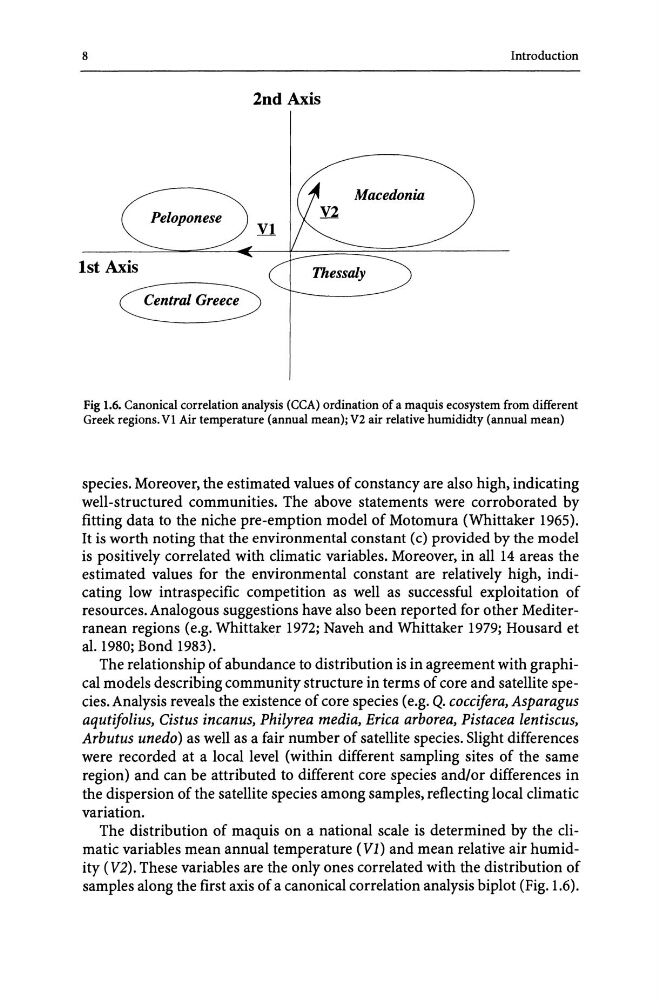
Fig 1.6. Canonical correlation analysis (CCA) ordination of a maquis ecosystem from different
Greek regions. VI Air temperature (annual mean); V2 air relative humididty (annual mean)
species. Moreover, the estimated values of constancy are also high, indicating
well-structured communities. The above statements were corroborated by
fitting data to the niche pre-emption model of Motomura (Whittaker 1965).
It is worth noting that the environmental constant (c) provided by the model
is positively correlated with climatic variables. Moreover, in all 14 areas the
estimated values for the environmental constant are relatively high, indicating low intraspecific competition as well as successful exploitation of
resources. Analogous suggestions have also been reported for other Mediterranean regions (e.g. Whittaker 1972; Naveh and Whittaker 1979; Housard et
al. 1980; Bond 1983).
The relationship of abundance to distribution is in agreement with graphical models describing community structure in terms of core and satellite species. Analysis reveals the existence of core species (e.g. Q. coccifera, Asparagus
aqutifolius, Cistus incanus, Philyrea media, Erica arborea, Pistacea lentiscus,
Arbutus unedo) as well as a fair number of satellite species. Slight differences
were recorded at a local level (within different sampling sites of the same
region) and can be attributed to different core species and/or differences in
the dispersion of the satellite species among samples, reflecting local climatic
variation.
The distribution of maquis on a national scale is determined by the climatic variables mean annual temperature (VI) and mean relative air humidity (V2). These variables are the only ones correlated with the distribution of
samples along the first axis of a canonical correlation analysis biplot (Fig. 1.6).
Introduction
2nd Axis
Macedonia
Peloponese
Y1
1st Axis
Thessaly
0:tralGr~
Fig 1.6. Canonical correlation analysis (CCA) ordination of a maquis ecosystem from different
Greek regions. VI Air temperature (annual mean); V2 air relative humididty (annual mean)
species. Moreover, the estimated values of constancy are also high, indicating
well-structured communities. The above statements were corroborated by
fitting data to the niche pre-emption model of Motomura (Whittaker 1965).
It is worth noting that the environmental constant (c) provided by the model
is positively correlated with climatic variables. Moreover, in all 14 areas the
estimated values for the environmental constant are relatively high, indicating low intraspecific competition as well as successful exploitation of
resources. Analogous suggestions have also been reported for other Mediterranean regions (e.g. Whittaker 1972; Naveh and Whittaker 1979; Housard et
al. 1980; Bond 1983).
The relationship of abundance to distribution is in agreement with graphical models describing community structure in terms of core and satellite species. Analysis reveals the existence of core species (e.g. Q. coccifera, Asparagus
aqutifolius, Cistus incanus, Philyrea media, Erica arborea, Pistacea lentiscus,
Arbutus unedo) as well as a fair number of satellite species. Slight differences
were recorded at a local level (within different sampling sites of the same
region) and can be attributed to different core species and/or differences in
the dispersion of the satellite species among samples, reflecting local climatic
variation.
The distribution of maquis on a national scale is determined by the climatic variables mean annual temperature (VI) and mean relative air humidity (V2). These variables are the only ones correlated with the distribution of
samples along the first axis of a canonical correlation analysis biplot (Fig. 1.6).