

Mediterranean -Type Ecosystem
7
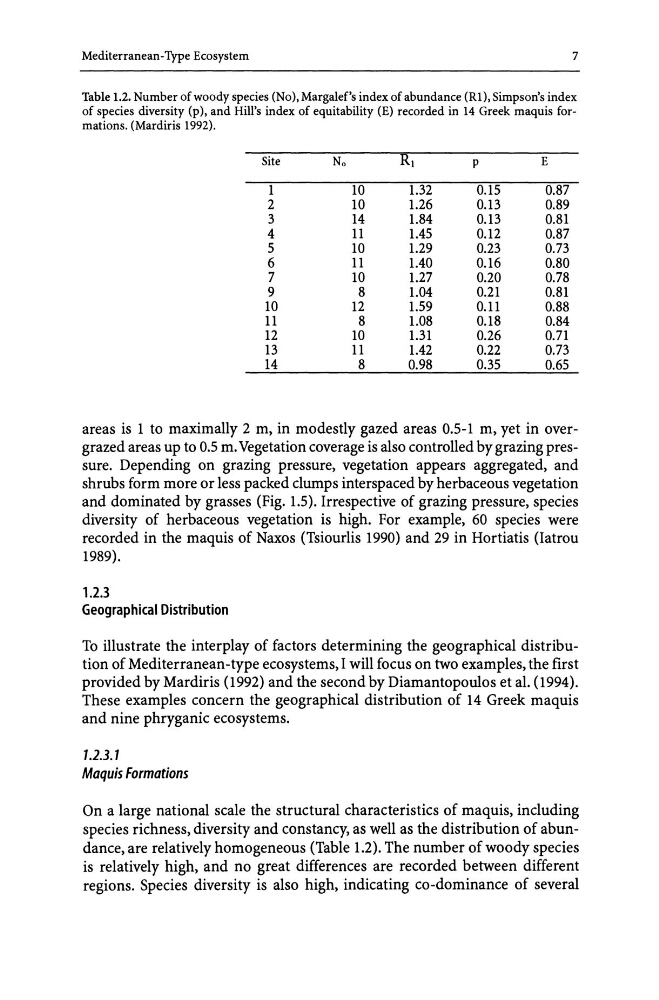
Table 1.2. Number of woody species (No), Margalef's index of abundance (R1), Simpson's index
of species diversity (p), and Hill's index of equitability (E) recorded in 14 Greek maquis formations. (Mardiris 1992).
Site
1
2
3
4
5
6
7
9
10
11
12
13
14
10
10
14
11
10
11
10
8
12
8
10
11
8
1.32
1.26
1.84
lAS
1.29
lAO
1.27
1.04
1.59
1.08
1.31
1.42
0.98
p
0.15
0.13
0.13
0.12
0.23
0.16
0.20
0.21
0.11
0.18
0.26
0.22
0.35
E
0.87
0.89
0.81
0.87
0.73
0.80
0.78
0.81
0.88
0.84
0.71
0.73
0.65
areas is 1 to maximally 2 m, in modestly gazed areas 0.5-1 m, yet in overgrazed areas up to 0.5 m. Vegetation coverage is also controlled by grazing pressure. Depending on grazing pressure, vegetation appears aggregated, and
shrubs form more or less packed clumps interspaced by herbaceous vegetation
and dominated by grasses (Fig. 1.5). Irrespective of grazing pressure, species
diversity of herbaceous vegetation is high. For example, 60 species were
recorded in the maquis of Naxos (Tsiourlis 1990) and 29 in Hortiatis (Iatrou
1989).
1.2.3
Geographical Distribution
To illustrate the interplay of factors determining the geographical distribution of Mediterranean-type ecosystems, I will focus on two examples, the first
provided by Mardiris (l992) and the second by Diamantopoulos et al. (l994).
These examples concern the geographical distribution of 14 Greek maquis
and nine phryganic ecosystems.
1.2.3.1
Maquis Formations
On a large national scale the structural characteristics of maquis, including
species richness, diversity and constancy, as well as the distribution of abundance, are relatively homogeneous (Table 1.2). The number of woody species
is relatively high, and no great differences are recorded between different
regions. Species diversity is also high, indicating co-dominance of several
7
Table 1.2. Number of woody species (No), Margalef's index of abundance (R1), Simpson's index
of species diversity (p), and Hill's index of equitability (E) recorded in 14 Greek maquis formations. (Mardiris 1992).
Site
1
2
3
4
5
6
7
9
10
11
12
13
14
10
10
14
11
10
11
10
8
12
8
10
11
8
1.32
1.26
1.84
lAS
1.29
lAO
1.27
1.04
1.59
1.08
1.31
1.42
0.98
p
0.15
0.13
0.13
0.12
0.23
0.16
0.20
0.21
0.11
0.18
0.26
0.22
0.35
E
0.87
0.89
0.81
0.87
0.73
0.80
0.78
0.81
0.88
0.84
0.71
0.73
0.65
areas is 1 to maximally 2 m, in modestly gazed areas 0.5-1 m, yet in overgrazed areas up to 0.5 m. Vegetation coverage is also controlled by grazing pressure. Depending on grazing pressure, vegetation appears aggregated, and
shrubs form more or less packed clumps interspaced by herbaceous vegetation
and dominated by grasses (Fig. 1.5). Irrespective of grazing pressure, species
diversity of herbaceous vegetation is high. For example, 60 species were
recorded in the maquis of Naxos (Tsiourlis 1990) and 29 in Hortiatis (Iatrou
1989).
1.2.3
Geographical Distribution
To illustrate the interplay of factors determining the geographical distribution of Mediterranean-type ecosystems, I will focus on two examples, the first
provided by Mardiris (l992) and the second by Diamantopoulos et al. (l994).
These examples concern the geographical distribution of 14 Greek maquis
and nine phryganic ecosystems.
1.2.3.1
Maquis Formations
On a large national scale the structural characteristics of maquis, including
species richness, diversity and constancy, as well as the distribution of abundance, are relatively homogeneous (Table 1.2). The number of woody species
is relatively high, and no great differences are recorded between different
regions. Species diversity is also high, indicating co-dominance of several