

Mediterranean -Type Ecosystem
9
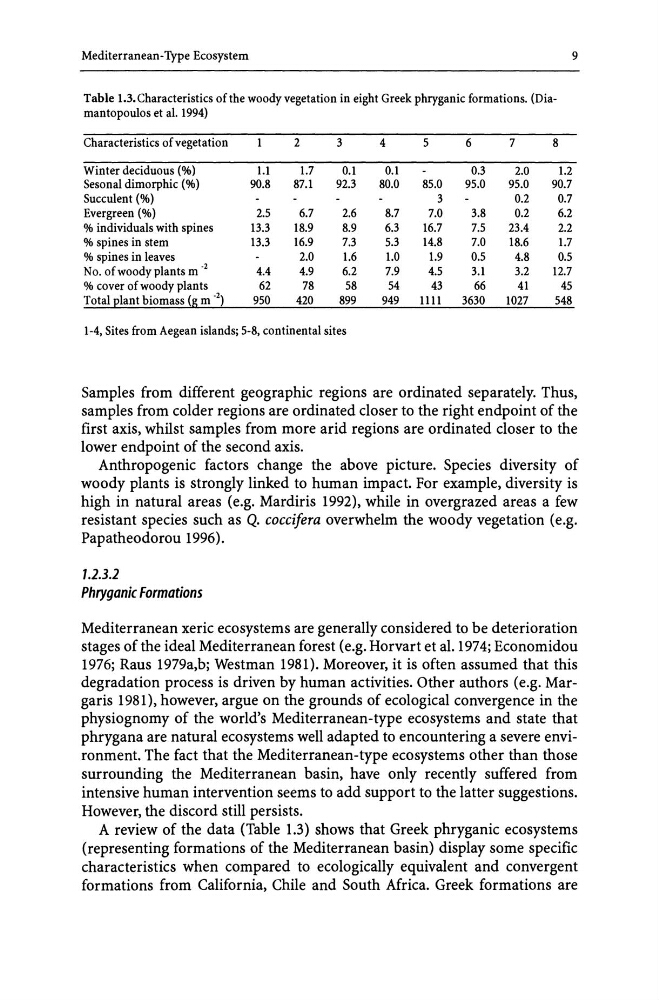
Table 1.3. Characteristics of the woody vegetation in eight Greek phryganic formations. (Diamanto poulos et al. 1994)
Characteristics of vegetation
2
3
4
5
6
7
8
Winter deciduous (%)
1.1
1.7
0.1
0.1
0.3
2.0
1.2
Sesonal dimorphic (%)
90.8
87.1
92.3
80.0
85.0
95.0
95.0
90.7
Succulent (%)
3
0.2
0.7
Evergreen (%)
2.5
6.7
2.6
8.7
7.0
3.8
0.2
6.2
% individuals with spines
13.3
18.9
8.9
6.3
16.7
7.5
23.4
2.2
% spines in stem
13.3
16.9
7.3
5.3
14.8
7.0
18.6
1.7
% spines in leaves
2.0
1.6
1.0
1.9
0.5
4.8
0.5
No. of woody plants m ·2
4.4
4.9
6.2
7.9
4.5
3.1
3.2
12.7
% cover of woody plants
62
78
58
54
43
66
41
45
Total £lant biomass (g m .2)
950
420
899
949
1111
3630
1027
548
1-4, Sites from Aegean islands; 5-8, continental sites
Samples from different geographic regions are ordinated separately. Thus,
samples from colder regions are ordinated closer to the right endpoint of the
first axis, whilst samples from more arid regions are ordinated closer to the
lower endpoint of the second axis.
Anthropogenic factors change the above picture. Species diversity of
woody plants is strongly linked to human impact. For example, diversity is
high in natural areas (e.g. Mardiris 1992), while in overgrazed areas a few
resistant species such as Q. coccifera overwhelm the woody vegetation (e.g.
Papatheodorou 1996).
1.2.3.2
Phryganic Formations
Mediterranean xeric ecosystems are generally considered to be deterioration
stages of the ideal Mediterranean forest (e.g. Horvart et al. 1974; Economidou
1976; Raus 1979a,b; Westman 1981). Moreover, it is often assumed that this
degradation process is driven by human activities. Other authors (e.g. Margaris 1981), however, argue on the grounds of ecological convergence in the
physiognomy of the world's Mediterranean-type ecosystems and state that
phrygana are natural ecosystems well adapted to encountering a severe environment. The fact that the Mediterranean-type ecosystems other than those
surrounding the Mediterranean basin, have only recently suffered from
intensive human intervention seems to add support to the latter suggestions.
However, the discord still persists.
A review of the data (Table 1.3) shows that Greek phryganic ecosystems
(representing formations of the Mediterranean basin) display some specific
characteristics when compared to ecologically equivalent and convergent
formations from California, Chile and South Africa. Greek formations are
9
Table 1.3. Characteristics of the woody vegetation in eight Greek phryganic formations. (Diamanto poulos et al. 1994)
Characteristics of vegetation
2
3
4
5
6
7
8
Winter deciduous (%)
1.1
1.7
0.1
0.1
0.3
2.0
1.2
Sesonal dimorphic (%)
90.8
87.1
92.3
80.0
85.0
95.0
95.0
90.7
Succulent (%)
3
0.2
0.7
Evergreen (%)
2.5
6.7
2.6
8.7
7.0
3.8
0.2
6.2
% individuals with spines
13.3
18.9
8.9
6.3
16.7
7.5
23.4
2.2
% spines in stem
13.3
16.9
7.3
5.3
14.8
7.0
18.6
1.7
% spines in leaves
2.0
1.6
1.0
1.9
0.5
4.8
0.5
No. of woody plants m ·2
4.4
4.9
6.2
7.9
4.5
3.1
3.2
12.7
% cover of woody plants
62
78
58
54
43
66
41
45
Total £lant biomass (g m .2)
950
420
899
949
1111
3630
1027
548
1-4, Sites from Aegean islands; 5-8, continental sites
Samples from different geographic regions are ordinated separately. Thus,
samples from colder regions are ordinated closer to the right endpoint of the
first axis, whilst samples from more arid regions are ordinated closer to the
lower endpoint of the second axis.
Anthropogenic factors change the above picture. Species diversity of
woody plants is strongly linked to human impact. For example, diversity is
high in natural areas (e.g. Mardiris 1992), while in overgrazed areas a few
resistant species such as Q. coccifera overwhelm the woody vegetation (e.g.
Papatheodorou 1996).
1.2.3.2
Phryganic Formations
Mediterranean xeric ecosystems are generally considered to be deterioration
stages of the ideal Mediterranean forest (e.g. Horvart et al. 1974; Economidou
1976; Raus 1979a,b; Westman 1981). Moreover, it is often assumed that this
degradation process is driven by human activities. Other authors (e.g. Margaris 1981), however, argue on the grounds of ecological convergence in the
physiognomy of the world's Mediterranean-type ecosystems and state that
phrygana are natural ecosystems well adapted to encountering a severe environment. The fact that the Mediterranean-type ecosystems other than those
surrounding the Mediterranean basin, have only recently suffered from
intensive human intervention seems to add support to the latter suggestions.
However, the discord still persists.
A review of the data (Table 1.3) shows that Greek phryganic ecosystems
(representing formations of the Mediterranean basin) display some specific
characteristics when compared to ecologically equivalent and convergent
formations from California, Chile and South Africa. Greek formations are