

The Biotic Correlates of Habitat Selection
113
50
VI
40
;;
:::l
..,
.;; 30
:a
.S
bO 20
c
:a ...
~ 10
'if.
0
5
10
15
20
Number of individuals per culture
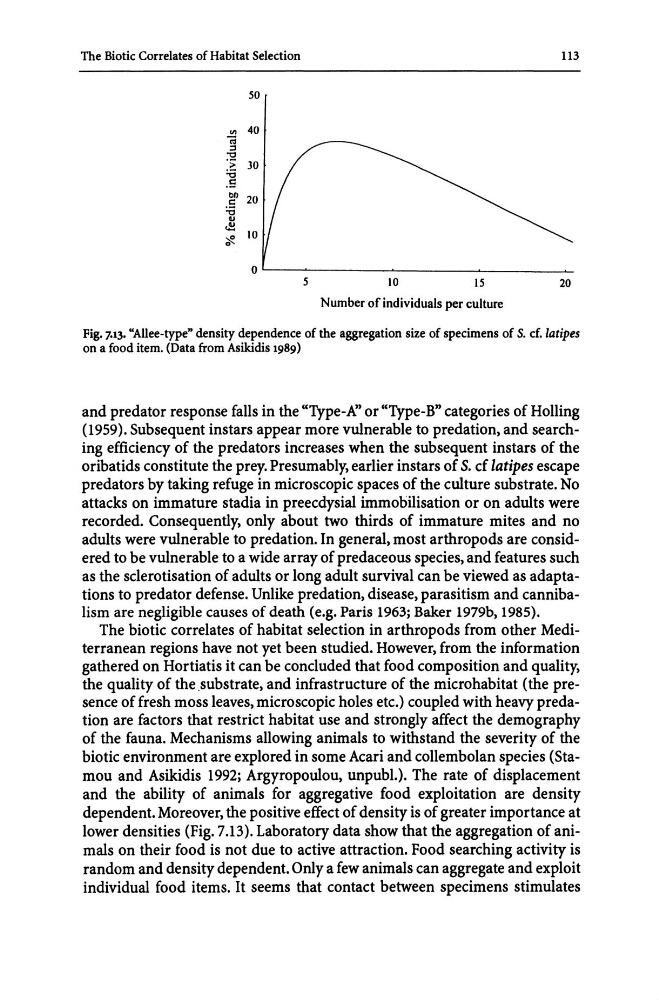
Fig. 7.13. "Allee-type" density dependence of the aggregation size of specimens of S. cf. latipes
on a food item. (Data from Asikidis 1989)
and predator response falls in the "Type-N' or "Type-B" categories of Holling
(1959). Subsequent instars appear more vulnerable to predation, and searching efficiency of the predators increases when the subsequent instars of the
oribatids constitute the prey. Presumably, earlier instars of S. cf latipes escape
predators by taking refuge in microscopic spaces of the culture substrate. No
attacks on immature stadia in preecdysial immobilisation or on adults were
recorded. Consequently, only about two thirds of immature mites and no
adults were vulnerable to predation. In general, most arthropods are considered to be vulnerable to a wide array of predaceous species, and features such
as the sclerotisation of adults or long adult survival can be viewed as adaptations to predator defense. Unlike predation, disease, parasitism and cannibalism are negligible causes of death (e.g. Paris 1963; Baker 1979b, 1985).
The biotic correlates of habitat selection in arthropods from other Mediterranean regions have not yet been studied. However, from the information
gathered on Hortiatis it can be concluded that food composition and quality,
the quality of the substrate, and infrastructure of the microhabitat (the presence of fresh moss leaves, microscopic holes etc.) coupled with heavy predation are factors that restrict habitat use and strongly affect the demography
of the fauna. Mechanisms allowing animals to withstand the severity of the
biotic environment are explored in some Acari and collembolan species (Stamou and Asikidis 1992; Argyropoulou, unpubl.). The rate of displacement
and the ability of animals for aggregative food exploitation are density
dependent. Moreover, the positive effect of density is of greater importance at
lower densities (Fig. 7.13). Laboratory data show that the aggregation of animals on their food is not due to active attraction. Food searching activity is
random and density dependent. Only a few animals can aggregate and exploit
individual food items. It seems that contact between specimens stimulates
113
50
VI
40
;;
:::l
..,
.;; 30
:a
.S
bO 20
c
:a ...
~ 10
'if.
0
5
10
15
20
Number of individuals per culture
Fig. 7.13. "Allee-type" density dependence of the aggregation size of specimens of S. cf. latipes
on a food item. (Data from Asikidis 1989)
and predator response falls in the "Type-N' or "Type-B" categories of Holling
(1959). Subsequent instars appear more vulnerable to predation, and searching efficiency of the predators increases when the subsequent instars of the
oribatids constitute the prey. Presumably, earlier instars of S. cf latipes escape
predators by taking refuge in microscopic spaces of the culture substrate. No
attacks on immature stadia in preecdysial immobilisation or on adults were
recorded. Consequently, only about two thirds of immature mites and no
adults were vulnerable to predation. In general, most arthropods are considered to be vulnerable to a wide array of predaceous species, and features such
as the sclerotisation of adults or long adult survival can be viewed as adaptations to predator defense. Unlike predation, disease, parasitism and cannibalism are negligible causes of death (e.g. Paris 1963; Baker 1979b, 1985).
The biotic correlates of habitat selection in arthropods from other Mediterranean regions have not yet been studied. However, from the information
gathered on Hortiatis it can be concluded that food composition and quality,
the quality of the substrate, and infrastructure of the microhabitat (the presence of fresh moss leaves, microscopic holes etc.) coupled with heavy predation are factors that restrict habitat use and strongly affect the demography
of the fauna. Mechanisms allowing animals to withstand the severity of the
biotic environment are explored in some Acari and collembolan species (Stamou and Asikidis 1992; Argyropoulou, unpubl.). The rate of displacement
and the ability of animals for aggregative food exploitation are density
dependent. Moreover, the positive effect of density is of greater importance at
lower densities (Fig. 7.13). Laboratory data show that the aggregation of animals on their food is not due to active attraction. Food searching activity is
random and density dependent. Only a few animals can aggregate and exploit
individual food items. It seems that contact between specimens stimulates