

114
Community Structure
60
'"
~
50
.:;: 40
;a
.S 30
bI)
.S
.D 20
.§
0 10
~
0 0
5
10
15
20
25
30
Number of individuals per culture
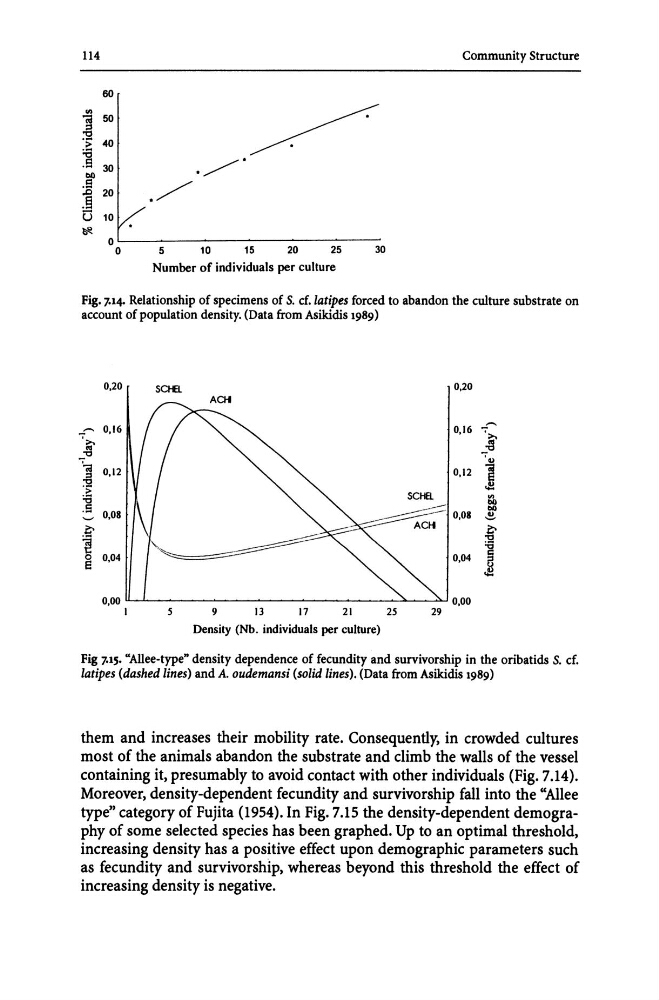
Fig. 7.14 Relationship of specimens of S. cf. latipes forced to abandon the culture substrate on
account of population density. (Data from Asikidis 1989)
0,20
SCHEl
0,20
0.16
0,16 '""'
'""'
)
~
_"0
..
'c;J 0.12
0,12
c;J
:§
]
.~
SCHEl
on
"0
bIl
.S
bIl
0,08
0,08 ~
.~
0
.:g
~
'-.,
~
"0
0
0,04
'~~~
0,04
8
e
~
0,00
0,00
I
9
13
17
21
25
29
Density (Nb. individuals per culture)
Fig 7.15. "Allee-type" density dependence of fecundity and survivorship in the oribatids S. cf.
latipes (dashed lines) and A. oudemansi (solid lines). (Data from Asikidis 1989)
them and increases their mobility rate. Consequently, in crowded cultures
most of the animals abandon the substrate and climb the walls of the vessel
containing it, presumably to avoid contact with other individuals (Fig. 7.14).
Moreover, density-dependent fecundity and survivorship fall into the "Allee
type" category of Fujita (1954). In Fig. 7.15 the density-dependent demography of some selected species has been graphed. Up to an optimal threshold,
increasing density has a positive effect upon demographic parameters such
as fecundity and survivorship, whereas beyond this threshold the effect of
increasing density is negative.
Community Structure
60
'"
~
50
.:;: 40
;a
.S 30
bI)
.S
.D 20
.§
0 10
~
0 0
5
10
15
20
25
30
Number of individuals per culture
Fig. 7.14 Relationship of specimens of S. cf. latipes forced to abandon the culture substrate on
account of population density. (Data from Asikidis 1989)
0,20
SCHEl
0,20
0.16
0,16 '""'
'""'
)
~
_"0
..
'c;J 0.12
0,12
c;J
:§
]
.~
SCHEl
on
"0
bIl
.S
bIl
0,08
0,08 ~
.~
0
.:g
~
'-.,
~
"0
0
0,04
'~~~
0,04
8
e
~
0,00
0,00
I
9
13
17
21
25
29
Density (Nb. individuals per culture)
Fig 7.15. "Allee-type" density dependence of fecundity and survivorship in the oribatids S. cf.
latipes (dashed lines) and A. oudemansi (solid lines). (Data from Asikidis 1989)
them and increases their mobility rate. Consequently, in crowded cultures
most of the animals abandon the substrate and climb the walls of the vessel
containing it, presumably to avoid contact with other individuals (Fig. 7.14).
Moreover, density-dependent fecundity and survivorship fall into the "Allee
type" category of Fujita (1954). In Fig. 7.15 the density-dependent demography of some selected species has been graphed. Up to an optimal threshold,
increasing density has a positive effect upon demographic parameters such
as fecundity and survivorship, whereas beyond this threshold the effect of
increasing density is negative.