

112
0.25
...
:a
t::
0
.~
VI
1ft.
i/··············· . . .
./
... ,
.................•........
,.../
................... .
.... ....... .
0L--0~-5L--1~0--1~5--20L-~2~5~3~0~3~5~4O~~~~~~·
Ti me (weeks)
100
80
60
40
20
0
' .
\\ ...........••...•••.
o 5 10 IS 20 25 30 35 40
Time (weeks)
Community Structure
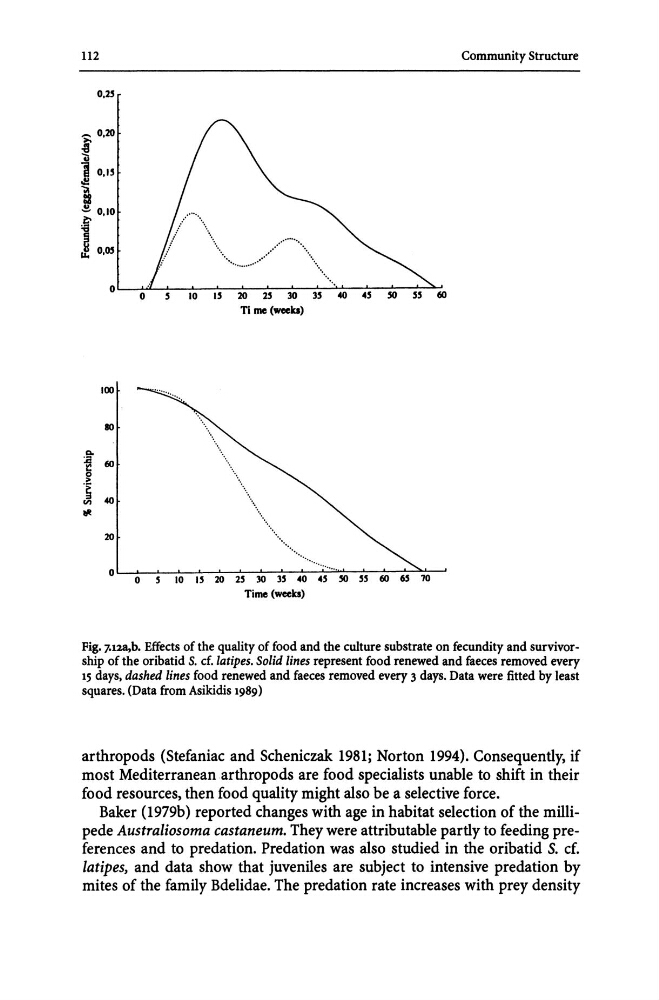
Fig. 7.128,b. Effects of the quality of food and the culture substrate on fecundity and survivorship of the oribatid S. cf. latipes. Solid lines represent food renewed and faeces removed every
15 days. dashed lines food renewed and faeces removed every 3 days. Data were fitted by least
squares. (Data from Asikidis 1989)
arthropods (Stefaniac and Scheniczak 1981; Norton 1994). Consequently, if
most Mediterranean arthropods are food specialists unable to shift in their
food resources, then food quality might also be a selective force.
Baker (I979b) reported changes with age in habitat selection of the millipede Australiosoma castaneum. They were attributable partly to feeding preferences and to predation. Predation was also studied in the oribatid S. cf.
latipes, and data show that juveniles are subject to intensive predation by
mites of the family Bdelidae. The predation rate increases with prey density
0.25
...
:a
t::
0
.~
VI
1ft.
i/··············· . . .
./
... ,
.................•........
,.../
................... .
.... ....... .
0L--0~-5L--1~0--1~5--20L-~2~5~3~0~3~5~4O~~~~~~·
Ti me (weeks)
100
80
60
40
20
0
' .
\\ ...........••...•••.
o 5 10 IS 20 25 30 35 40
Time (weeks)
Community Structure
Fig. 7.128,b. Effects of the quality of food and the culture substrate on fecundity and survivorship of the oribatid S. cf. latipes. Solid lines represent food renewed and faeces removed every
15 days. dashed lines food renewed and faeces removed every 3 days. Data were fitted by least
squares. (Data from Asikidis 1989)
arthropods (Stefaniac and Scheniczak 1981; Norton 1994). Consequently, if
most Mediterranean arthropods are food specialists unable to shift in their
food resources, then food quality might also be a selective force.
Baker (I979b) reported changes with age in habitat selection of the millipede Australiosoma castaneum. They were attributable partly to feeding preferences and to predation. Predation was also studied in the oribatid S. cf.
latipes, and data show that juveniles are subject to intensive predation by
mites of the family Bdelidae. The predation rate increases with prey density