

16 Searching for Internal Standard for Chemical Routine Analysis. . .
195
Table 16.3 Analytical precision by quantifying toxin concentrations by ISTD or
ESTD with and without the use of internal standards
No. of replicate
injections
% RSD
Toxin
Internal standard Sample size
ESTD ISTD
OA
DHO
10
89
2.7
3:5
DTX-1 DHO
12
117
3.1
3:9
YTX
DHO
6
4 6
8.8
8:8
PTX-2
Pent-PBI
4
4 0
8.5
9:2
Hep-PBI
10:0
Aza-1
Pent-PBI
1
1 0
2.3
2:5
Hep-PBI
10
52
2.7
4:8
An additional observation was made by subsequent injections after samples of
scallop which were influenced by matrix deposition in the analytical system. The
observed contamination means that the PTX-2 signal in the next sample or standard
was affected by ion suppression from the previous scallop extract. This suggests that
injections of organic solvent should be done after analysis of scallop extracts.
Precision
To demonstrate and compare the reproducibility of the two methods, naturally
contaminated samples and CRM-DSP Mus-b were analyzed. The samples were run
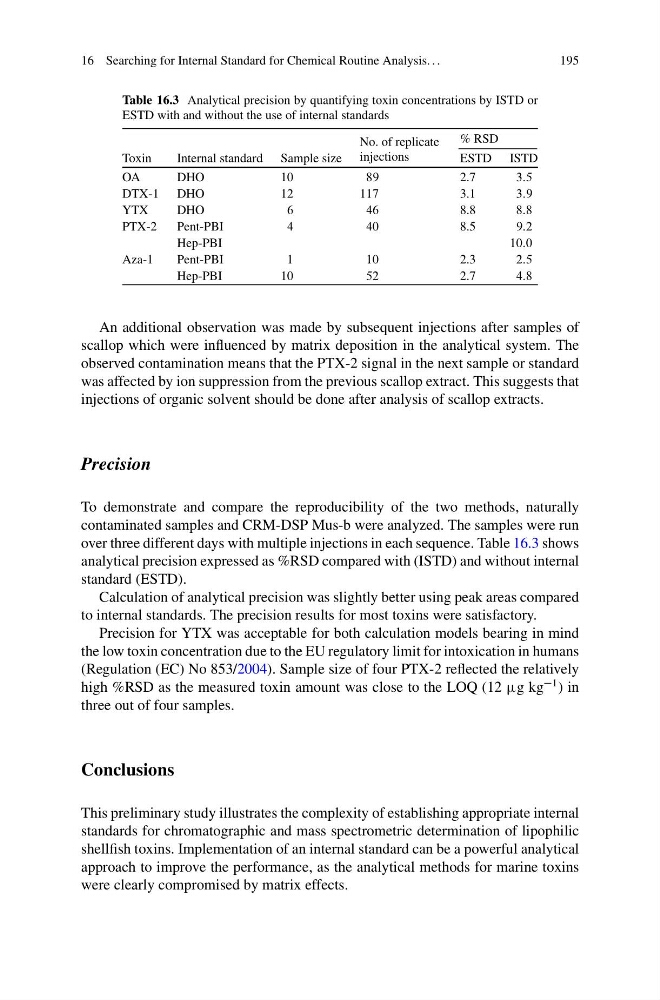
over three different days with multiple injections in each sequence. Table 16.3 shows
analytical precision expressed as %RSD compared with (ISTD) and without internal
standard (ESTD).
Calculation of analytical precision was slightly better using peak areas compared
to internal standards. The precision results for most toxins were satisfactory.
Precision for YTX was acceptable for both calculation models bearing in mind
the low toxin concentration due to the EU regulatory limit for intoxication in humans
(Regulation (EC) No 853/2004). Sample size of four PTX-2 reflected the relatively
high %RSD as the measured toxin amount was close to the LOQ (12 g kg
1 ) in
three out of four samples.
Conclusions
This preliminary study illustrates the complexity of establishing appropriate internal
standards for chromatographic and mass spectrometric determination of lipophilic
shellfish toxins. Implementation of an internal standard can be a powerful analytical
approach to improve the performance, as the analytical methods for marine toxins
were clearly compromised by matrix effects.
195
Table 16.3 Analytical precision by quantifying toxin concentrations by ISTD or
ESTD with and without the use of internal standards
No. of replicate
injections
% RSD
Toxin
Internal standard Sample size
ESTD ISTD
OA
DHO
10
89
2.7
3:5
DTX-1 DHO
12
117
3.1
3:9
YTX
DHO
6
4 6
8.8
8:8
PTX-2
Pent-PBI
4
4 0
8.5
9:2
Hep-PBI
10:0
Aza-1
Pent-PBI
1
1 0
2.3
2:5
Hep-PBI
10
52
2.7
4:8
An additional observation was made by subsequent injections after samples of
scallop which were influenced by matrix deposition in the analytical system. The
observed contamination means that the PTX-2 signal in the next sample or standard
was affected by ion suppression from the previous scallop extract. This suggests that
injections of organic solvent should be done after analysis of scallop extracts.
Precision
To demonstrate and compare the reproducibility of the two methods, naturally
contaminated samples and CRM-DSP Mus-b were analyzed. The samples were run
over three different days with multiple injections in each sequence. Table 16.3 shows
analytical precision expressed as %RSD compared with (ISTD) and without internal
standard (ESTD).
Calculation of analytical precision was slightly better using peak areas compared
to internal standards. The precision results for most toxins were satisfactory.
Precision for YTX was acceptable for both calculation models bearing in mind
the low toxin concentration due to the EU regulatory limit for intoxication in humans
(Regulation (EC) No 853/2004). Sample size of four PTX-2 reflected the relatively
high %RSD as the measured toxin amount was close to the LOQ (12 g kg
1 ) in
three out of four samples.
Conclusions
This preliminary study illustrates the complexity of establishing appropriate internal
standards for chromatographic and mass spectrometric determination of lipophilic
shellfish toxins. Implementation of an internal standard can be a powerful analytical
approach to improve the performance, as the analytical methods for marine toxins
were clearly compromised by matrix effects.