

150
R.T. Vinarao et al.
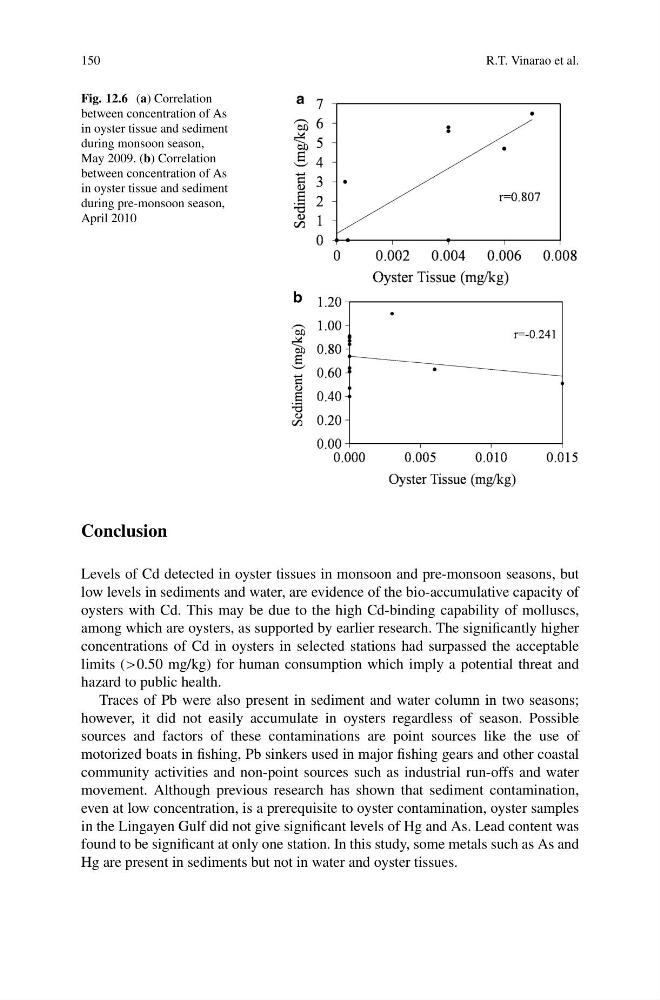
Fig. 12.6 (a) Correlation
between concentration of As
in oyster tissue and sediment
during monsoon season,
May 2009. (b) Correlation
between concentration of As
in oyster tissue and sediment
during pre-monsoon season,
April 2010
Conclusion
Levels of Cd detected in oyster tissues in monsoon and pre-monsoon seasons, but
low levels in sediments and water, are evidence of the bio-accumulative capacity of
oysters with Cd. This may be due to the high Cd-binding capability of molluscs,
among which are oysters, as supported by earlier research. The significantly higher
concentrations of Cd in oysters in selected stations had surpassed the acceptable
limits (>0.50 mg/kg) for human consumption which imply a potential threat and
hazard to public health.
Traces of Pb were also present in sediment and water column in two seasons;
however, it did not easily accumulate in oysters regardless of season. Possible
sources and factors of these contaminations are point sources like the use of
motorized boats in fishing, Pb sinkers used in major fishing gears and other coastal
community activities and non-point sources such as industrial run-offs and water
movement. Although previous research has shown that sediment contamination,
even at low concentration, is a prerequisite to oyster contamination, oyster samples
in the Lingayen Gulf did not give significant levels of Hg and As. Lead content was
found to be significant at only one station. In this study, some metals such as As and
Hg are present in sediments but not in water and oyster tissues.
R.T. Vinarao et al.
Fig. 12.6 (a) Correlation
between concentration of As
in oyster tissue and sediment
during monsoon season,
May 2009. (b) Correlation
between concentration of As
in oyster tissue and sediment
during pre-monsoon season,
April 2010
Conclusion
Levels of Cd detected in oyster tissues in monsoon and pre-monsoon seasons, but
low levels in sediments and water, are evidence of the bio-accumulative capacity of
oysters with Cd. This may be due to the high Cd-binding capability of molluscs,
among which are oysters, as supported by earlier research. The significantly higher
concentrations of Cd in oysters in selected stations had surpassed the acceptable
limits (>0.50 mg/kg) for human consumption which imply a potential threat and
hazard to public health.
Traces of Pb were also present in sediment and water column in two seasons;
however, it did not easily accumulate in oysters regardless of season. Possible
sources and factors of these contaminations are point sources like the use of
motorized boats in fishing, Pb sinkers used in major fishing gears and other coastal
community activities and non-point sources such as industrial run-offs and water
movement. Although previous research has shown that sediment contamination,
even at low concentration, is a prerequisite to oyster contamination, oyster samples
in the Lingayen Gulf did not give significant levels of Hg and As. Lead content was
found to be significant at only one station. In this study, some metals such as As and
Hg are present in sediments but not in water and oyster tissues.