

12 Distribution of Cd, Pb, As and Hg in Oyster Tissue, Sediment and Water. . .
149
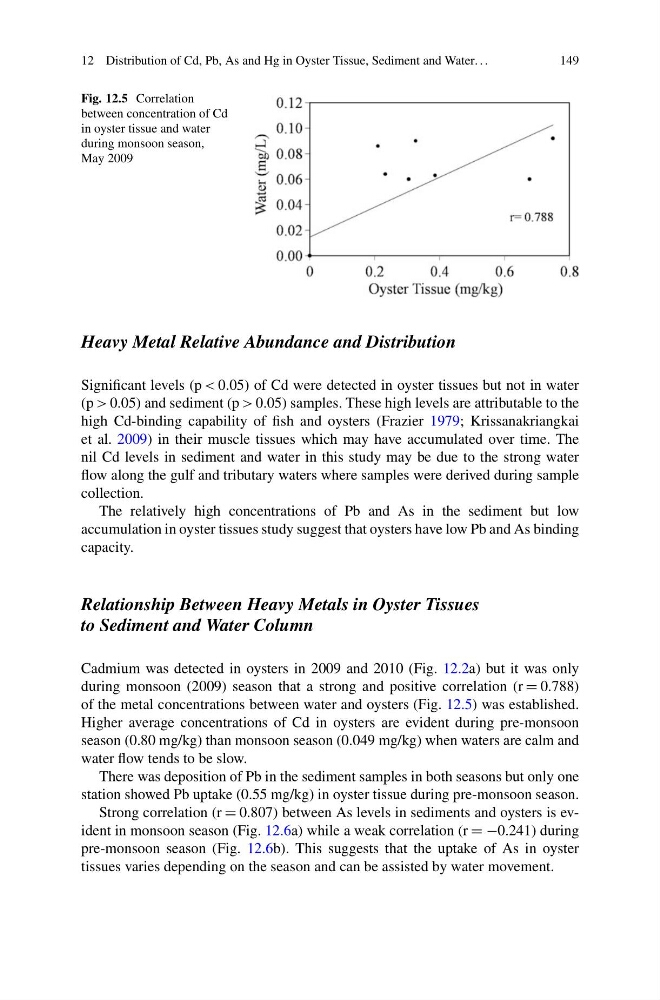
Fig. 12.5 Correlation
between concentration of Cd
in oyster tissue and water
during monsoon season,
May 2009
Heavy Metal Relative Abundance and Distribution
Significant levels (p < 0.05) of Cd were detected in oyster tissues but not in water
(p > 0.05) and sediment (p > 0.05) samples. These high levels are attributable to the
high Cd-binding capability of fish and oysters (Frazier 1979; Krissanakriangkai
et al. 2009) in their muscle tissues which may have accumulated over time. The
nil Cd levels in sediment and water in this study may be due to the strong water
flow along the gulf and tributary waters where samples were derived during sample
collection.
The relatively high concentrations of Pb and As in the sediment but low
accumulation in oyster tissues study suggest that oysters have low Pb and As binding
capacity.
Relationship Between Heavy Metals in Oyster Tissues
to Sediment and Water Column
Cadmium was detected in oysters in 2009 and 2010 (Fig. 12.2a) but it was only
during monsoon (2009) season that a strong and positive correlation (r D 0.788)
of the metal concentrations between water and oysters (Fig. 12.5) was established.
Higher average concentrations of Cd in oysters are evident during pre-monsoon
season (0.80 mg/kg) than monsoon season (0.049 mg/kg) when waters are calm and
water flow tends to be slow.
There was deposition of Pb in the sediment samples in both seasons but only one
station showed Pb uptake (0.55 mg/kg) in oyster tissue during pre-monsoon season.
Strong correlation (r D 0.807) between As levels in sediments and oysters is evident in monsoon season (Fig. 12.6a) while a weak correlation (r D D0.241) during
pre-monsoon season (Fig. 12.6b). This suggests that the uptake of As in oyster
tissues varies depending on the season and can be assisted by water movement.
149
Fig. 12.5 Correlation
between concentration of Cd
in oyster tissue and water
during monsoon season,
May 2009
Heavy Metal Relative Abundance and Distribution
Significant levels (p < 0.05) of Cd were detected in oyster tissues but not in water
(p > 0.05) and sediment (p > 0.05) samples. These high levels are attributable to the
high Cd-binding capability of fish and oysters (Frazier 1979; Krissanakriangkai
et al. 2009) in their muscle tissues which may have accumulated over time. The
nil Cd levels in sediment and water in this study may be due to the strong water
flow along the gulf and tributary waters where samples were derived during sample
collection.
The relatively high concentrations of Pb and As in the sediment but low
accumulation in oyster tissues study suggest that oysters have low Pb and As binding
capacity.
Relationship Between Heavy Metals in Oyster Tissues
to Sediment and Water Column
Cadmium was detected in oysters in 2009 and 2010 (Fig. 12.2a) but it was only
during monsoon (2009) season that a strong and positive correlation (r D 0.788)
of the metal concentrations between water and oysters (Fig. 12.5) was established.
Higher average concentrations of Cd in oysters are evident during pre-monsoon
season (0.80 mg/kg) than monsoon season (0.049 mg/kg) when waters are calm and
water flow tends to be slow.
There was deposition of Pb in the sediment samples in both seasons but only one
station showed Pb uptake (0.55 mg/kg) in oyster tissue during pre-monsoon season.
Strong correlation (r D 0.807) between As levels in sediments and oysters is evident in monsoon season (Fig. 12.6a) while a weak correlation (r D D0.241) during
pre-monsoon season (Fig. 12.6b). This suggests that the uptake of As in oyster
tissues varies depending on the season and can be assisted by water movement.