

148
R.T. Vinarao et al.
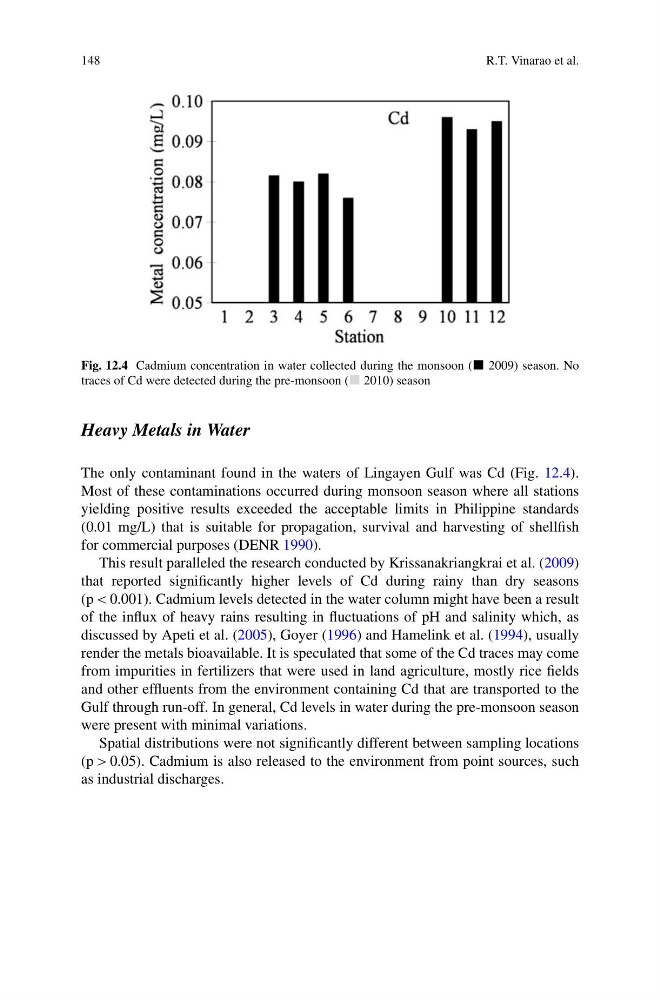
Fig. 12.4 Cadmium concentration in water collected during the monsoon ( 2009) season. No
traces of Cd were detected during the pre-monsoon ( 2010) season
Heavy Metals in Water
The only contaminant found in the waters of Lingayen Gulf was Cd (Fig. 12.4).
Most of these contaminations occurred during monsoon season where all stations
yielding positive results exceeded the acceptable limits in Philippine standards
(0.01 mg/L) that is suitable for propagation, survival and harvesting of shellfish
for commercial purposes (DENR 1990).
This result paralleled the research conducted by Krissanakriangkrai et al. (2009)
that reported significantly higher levels of Cd during rainy than dry seasons
(p < 0.001). Cadmium levels detected in the water column might have been a result
of the influx of heavy rains resulting in fluctuations of pH and salinity which, as
discussed by Apeti et al. (2005), Goyer (1996) and Hamelink et al. (1994), usually
render the metals bioavailable. It is speculated that some of the Cd traces may come
from impurities in fertilizers that were used in land agriculture, mostly rice fields
and other effluents from the environment containing Cd that are transported to the
Gulf through run-off. In general, Cd levels in water during the pre-monsoon season
were present with minimal variations.
Spatial distributions were not significantly different between sampling locations
(p > 0.05). Cadmium is also released to the environment from point sources, such
as industrial discharges.
R.T. Vinarao et al.
Fig. 12.4 Cadmium concentration in water collected during the monsoon ( 2009) season. No
traces of Cd were detected during the pre-monsoon ( 2010) season
Heavy Metals in Water
The only contaminant found in the waters of Lingayen Gulf was Cd (Fig. 12.4).
Most of these contaminations occurred during monsoon season where all stations
yielding positive results exceeded the acceptable limits in Philippine standards
(0.01 mg/L) that is suitable for propagation, survival and harvesting of shellfish
for commercial purposes (DENR 1990).
This result paralleled the research conducted by Krissanakriangkrai et al. (2009)
that reported significantly higher levels of Cd during rainy than dry seasons
(p < 0.001). Cadmium levels detected in the water column might have been a result
of the influx of heavy rains resulting in fluctuations of pH and salinity which, as
discussed by Apeti et al. (2005), Goyer (1996) and Hamelink et al. (1994), usually
render the metals bioavailable. It is speculated that some of the Cd traces may come
from impurities in fertilizers that were used in land agriculture, mostly rice fields
and other effluents from the environment containing Cd that are transported to the
Gulf through run-off. In general, Cd levels in water during the pre-monsoon season
were present with minimal variations.
Spatial distributions were not significantly different between sampling locations
(p > 0.05). Cadmium is also released to the environment from point sources, such
as industrial discharges.