

126
C. Picot et al.
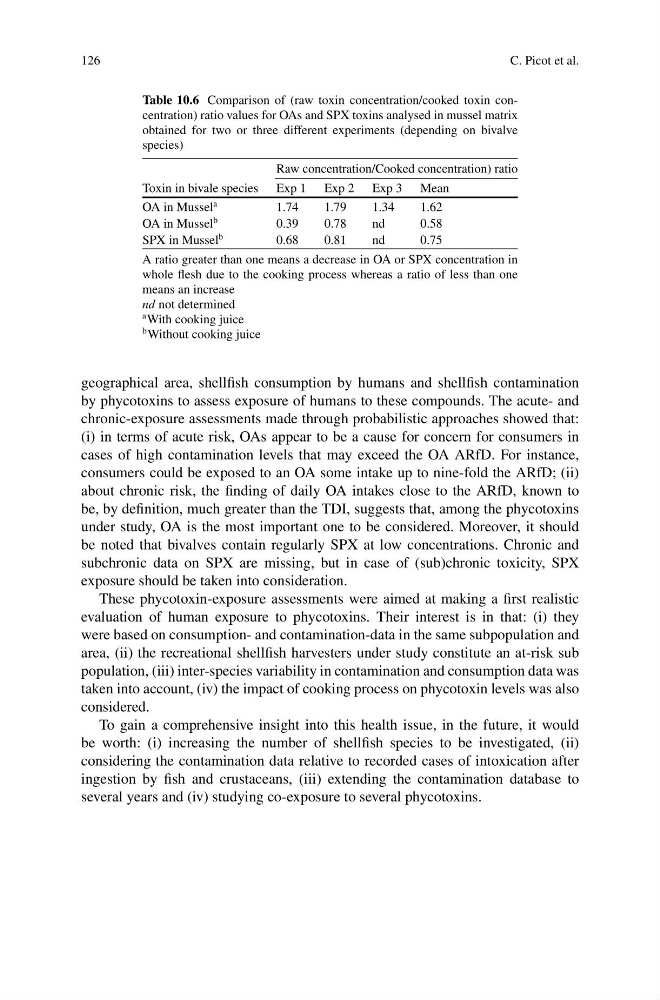
Table 10.6 Comparison of (raw toxin concentration/cooked toxin concentration) ratio values for OAs and SPX toxins analysed in mussel matrix
obtained for two or three different experiments (depending on bivalve
species)
Raw concentration/Cooked concentration) ratio
Toxin in bivale species Exp 1 Exp 2 Exp 3 Mean
OA in Mussel
a
1.74
1.79
1.34
1.62
OA in Mussel
b
0.39
0.78
nd
0.58
SPX in Mussel
b
0.68
0.81
nd
0.75
A ratio greater than one means a decrease in OA or SPX concentration in
whole flesh due to the cooking process whereas a ratio of less than one
means an increase
nd not determined
a With cooking juice
b Without cooking juice
geographical area, shellfish consumption by humans and shellfish contamination
by phycotoxins to assess exposure of humans to these compounds. The acute- and
chronic-exposure assessments made through probabilistic approaches showed that:
(i) in terms of acute risk, OAs appear to be a cause for concern for consumers in
cases of high contamination levels that may exceed the OA ARfD. For instance,
consumers could be exposed to an OA some intake up to nine-fold the ARfD; (ii)
about chronic risk, the finding of daily OA intakes close to the ARfD, known to
be, by definition, much greater than the TDI, suggests that, among the phycotoxins
under study, OA is the most important one to be considered. Moreover, it should
be noted that bivalves contain regularly SPX at low concentrations. Chronic and
subchronic data on SPX are missing, but in case of (sub)chronic toxicity, SPX
exposure should be taken into consideration.
These phycotoxin-exposure assessments were aimed at making a first realistic
evaluation of human exposure to phycotoxins. Their interest is in that: (i) they
were based on consumption- and contamination-data in the same subpopulation and
area, (ii) the recreational shellfish harvesters under study constitute an at-risk sub
population, (iii) inter-species variability in contamination and consumption data was
taken into account, (iv) the impact of cooking process on phycotoxin levels was also
considered.
To gain a comprehensive insight into this health issue, in the future, it would
be worth: (i) increasing the number of shellfish species to be investigated, (ii)
considering the contamination data relative to recorded cases of intoxication after
ingestion by fish and crustaceans, (iii) extending the contamination database to
several years and (iv) studying co-exposure to several phycotoxins.
C. Picot et al.
Table 10.6 Comparison of (raw toxin concentration/cooked toxin concentration) ratio values for OAs and SPX toxins analysed in mussel matrix
obtained for two or three different experiments (depending on bivalve
species)
Raw concentration/Cooked concentration) ratio
Toxin in bivale species Exp 1 Exp 2 Exp 3 Mean
OA in Mussel
a
1.74
1.79
1.34
1.62
OA in Mussel
b
0.39
0.78
nd
0.58
SPX in Mussel
b
0.68
0.81
nd
0.75
A ratio greater than one means a decrease in OA or SPX concentration in
whole flesh due to the cooking process whereas a ratio of less than one
means an increase
nd not determined
a With cooking juice
b Without cooking juice
geographical area, shellfish consumption by humans and shellfish contamination
by phycotoxins to assess exposure of humans to these compounds. The acute- and
chronic-exposure assessments made through probabilistic approaches showed that:
(i) in terms of acute risk, OAs appear to be a cause for concern for consumers in
cases of high contamination levels that may exceed the OA ARfD. For instance,
consumers could be exposed to an OA some intake up to nine-fold the ARfD; (ii)
about chronic risk, the finding of daily OA intakes close to the ARfD, known to
be, by definition, much greater than the TDI, suggests that, among the phycotoxins
under study, OA is the most important one to be considered. Moreover, it should
be noted that bivalves contain regularly SPX at low concentrations. Chronic and
subchronic data on SPX are missing, but in case of (sub)chronic toxicity, SPX
exposure should be taken into consideration.
These phycotoxin-exposure assessments were aimed at making a first realistic
evaluation of human exposure to phycotoxins. Their interest is in that: (i) they
were based on consumption- and contamination-data in the same subpopulation and
area, (ii) the recreational shellfish harvesters under study constitute an at-risk sub
population, (iii) inter-species variability in contamination and consumption data was
taken into account, (iv) the impact of cooking process on phycotoxin levels was also
considered.
To gain a comprehensive insight into this health issue, in the future, it would
be worth: (i) increasing the number of shellfish species to be investigated, (ii)
considering the contamination data relative to recorded cases of intoxication after
ingestion by fish and crustaceans, (iii) extending the contamination database to
several years and (iv) studying co-exposure to several phycotoxins.