

108
N. Arnich et al.
Table 9.3 Contribution of the shellfish consumption to the mean overall dietary exposure of the
French population to dioxins, PCBs and PAHs
Dioxins and
DL-PCBs
Non DL-PCBs
PAHs
(as sum of 4)
Adults
Mean dietary exposure
0.47 pg TEQ-OMS /
kg bw/day
1.83 ng/kg bw/day
1.5 ng/kg
bw/day
Shellfish contribution (%) 3.9
5.3
13
Children Mean dietary exposure
0.76 pg TEQ-OMS /
kg bw/day
2.84 ng/ kg bw/day 2.3 ng/kg
bw/day
Shellfish contribution (%) 1.3
2.0
4.2
Table 9.4 Contribution of shellfish consumption to the mean overall dietary exposure of the
French population to perfluoroalkylated substances (PFAs)
PFOA
PFOS
Other PFAs
Adults
Mean dietary exposure (ng/kg bw/day)
0:01
0.04
0.34–3.23
Shellfish contribution (%)
0:25
0.4
0.07–0.4
Children
Mean dietary exposure (ng/kg bw/day)
0:01
0.05
0.83–7.21
Shellfish contribution (%)
<0:1
0.1
0.02–0.08
Mercury in seafood is mainly present as methylmercury, an organic form of the
contaminant. But, even in this organic form, the contribution is very low (less than
1 % both for adults and children).
In all cases, the contribution to the overall dietary exposure is considered as
negligible. In terms of risk assessment and risk management, this low contribution
means that it is not relevant to set maximum regulatory levels for these contaminants
in shellfish.
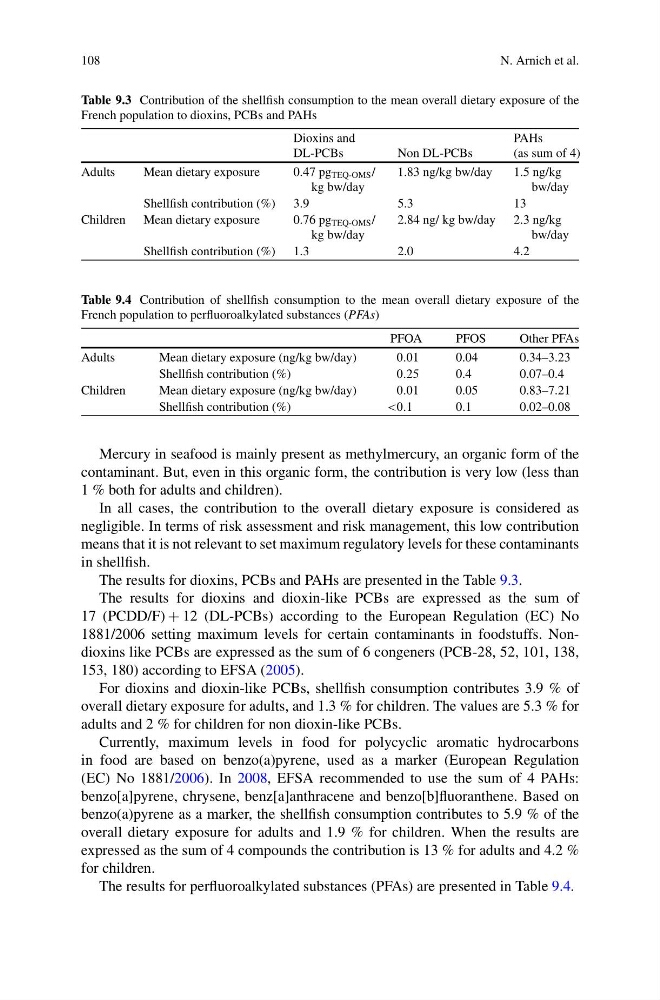
The results for dioxins, PCBs and PAHs are presented in the Table 9.3.
The results for dioxins and dioxin-like PCBs are expressed as the sum of
17 (PCDD/F) C 12 (DL-PCBs) according to the European Regulation (EC) No
1881/2006 setting maximum levels for certain contaminants in foodstuffs. Nondioxins like PCBs are expressed as the sum of 6 congeners (PCB-28, 52, 101, 138,
153, 180) according to EFSA (2005).
For dioxins and dioxin-like PCBs, shellfish consumption contributes 3.9 % of
overall dietary exposure for adults, and 1.3 % for children. The values are 5.3 % for
adults and 2 % for children for non dioxin-like PCBs.
Currently, maximum levels in food for polycyclic aromatic hydrocarbons
in food are based on benzo(a)pyrene, used as a marker (European Regulation
(EC) No 1881/2006). In 2008, EFSA recommended to use the sum of 4 PAHs:
benzo[a]pyrene, chrysene, benz[a]anthracene and benzo[b]fluoranthene. Based on
benzo(a)pyrene as a marker, the shellfish consumption contributes to 5.9 % of the
overall dietary exposure for adults and 1.9 % for children. When the results are
expressed as the sum of 4 compounds the contribution is 13 % for adults and 4.2 %
for children.
The results for perfluoroalkylated substances (PFAs) are presented in Table 9.4.
N. Arnich et al.
Table 9.3 Contribution of the shellfish consumption to the mean overall dietary exposure of the
French population to dioxins, PCBs and PAHs
Dioxins and
DL-PCBs
Non DL-PCBs
PAHs
(as sum of 4)
Adults
Mean dietary exposure
0.47 pg TEQ-OMS /
kg bw/day
1.83 ng/kg bw/day
1.5 ng/kg
bw/day
Shellfish contribution (%) 3.9
5.3
13
Children Mean dietary exposure
0.76 pg TEQ-OMS /
kg bw/day
2.84 ng/ kg bw/day 2.3 ng/kg
bw/day
Shellfish contribution (%) 1.3
2.0
4.2
Table 9.4 Contribution of shellfish consumption to the mean overall dietary exposure of the
French population to perfluoroalkylated substances (PFAs)
PFOA
PFOS
Other PFAs
Adults
Mean dietary exposure (ng/kg bw/day)
0:01
0.04
0.34–3.23
Shellfish contribution (%)
0:25
0.4
0.07–0.4
Children
Mean dietary exposure (ng/kg bw/day)
0:01
0.05
0.83–7.21
Shellfish contribution (%)
<0:1
0.1
0.02–0.08
Mercury in seafood is mainly present as methylmercury, an organic form of the
contaminant. But, even in this organic form, the contribution is very low (less than
1 % both for adults and children).
In all cases, the contribution to the overall dietary exposure is considered as
negligible. In terms of risk assessment and risk management, this low contribution
means that it is not relevant to set maximum regulatory levels for these contaminants
in shellfish.
The results for dioxins, PCBs and PAHs are presented in the Table 9.3.
The results for dioxins and dioxin-like PCBs are expressed as the sum of
17 (PCDD/F) C 12 (DL-PCBs) according to the European Regulation (EC) No
1881/2006 setting maximum levels for certain contaminants in foodstuffs. Nondioxins like PCBs are expressed as the sum of 6 congeners (PCB-28, 52, 101, 138,
153, 180) according to EFSA (2005).
For dioxins and dioxin-like PCBs, shellfish consumption contributes 3.9 % of
overall dietary exposure for adults, and 1.3 % for children. The values are 5.3 % for
adults and 2 % for children for non dioxin-like PCBs.
Currently, maximum levels in food for polycyclic aromatic hydrocarbons
in food are based on benzo(a)pyrene, used as a marker (European Regulation
(EC) No 1881/2006). In 2008, EFSA recommended to use the sum of 4 PAHs:
benzo[a]pyrene, chrysene, benz[a]anthracene and benzo[b]fluoranthene. Based on
benzo(a)pyrene as a marker, the shellfish consumption contributes to 5.9 % of the
overall dietary exposure for adults and 1.9 % for children. When the results are
expressed as the sum of 4 compounds the contribution is 13 % for adults and 4.2 %
for children.
The results for perfluoroalkylated substances (PFAs) are presented in Table 9.4.