

9 Contribution of Shellfish Consumption to the Dietary Exposure. . .
109
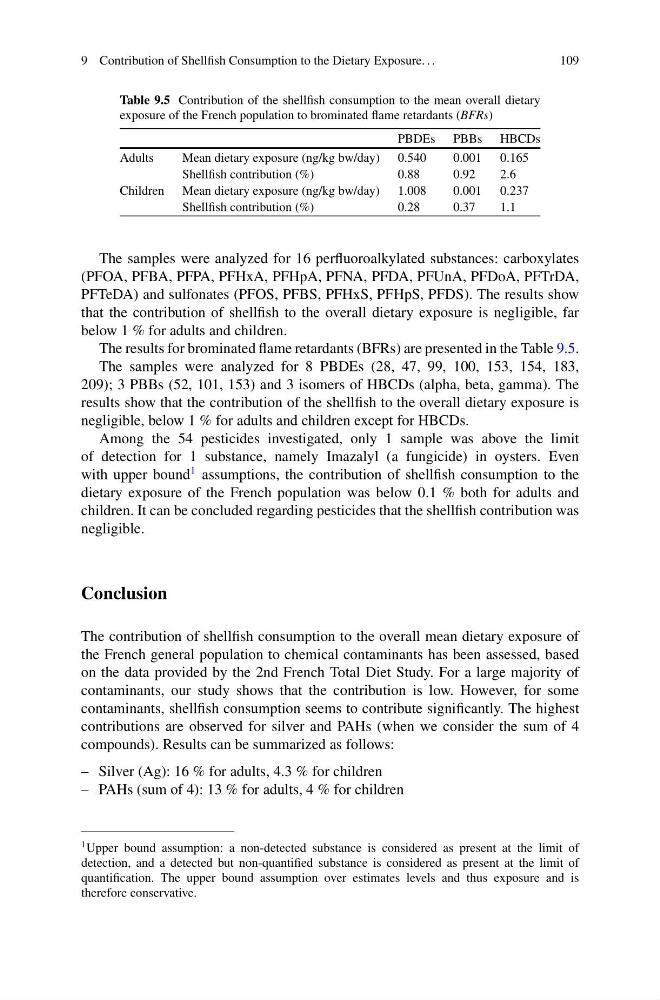
Table 9.5 Contribution of the shellfish consumption to the mean overall dietary
exposure of the French population to brominated flame retardants (BFRs)
PBDEs PBBs HBCDs
Adults
Mean dietary exposure (ng/kg bw/day) 0.540
0.001 0.165
Shellfish contribution (%)
0.88
0.92
2.6
Children Mean dietary exposure (ng/kg bw/day) 1.008
0.001 0.237
Shellfish contribution (%)
0.28
0.37
1.1
The samples were analyzed for 16 perfluoroalkylated substances: carboxylates
(PFOA, PFBA, PFPA, PFHxA, PFHpA, PFNA, PFDA, PFUnA, PFDoA, PFTrDA,
PFTeDA) and sulfonates (PFOS, PFBS, PFHxS, PFHpS, PFDS). The results show
that the contribution of shellfish to the overall dietary exposure is negligible, far
below 1 % for adults and children.
The results for brominated flame retardants (BFRs) are presented in the Table 9.5.
The samples were analyzed for 8 PBDEs (28, 47, 99, 100, 153, 154, 183,
209); 3 PBBs (52, 101, 153) and 3 isomers of HBCDs (alpha, beta, gamma). The
results show that the contribution of the shellfish to the overall dietary exposure is
negligible, below 1 % for adults and children except for HBCDs.
Among the 54 pesticides investigated, only 1 sample was above the limit
of detection for 1 substance, namely Imazalyl (a fungicide) in oysters. Even
with upper bound
1 assumptions, the contribution of shellfish consumption to the
dietary exposure of the French population was below 0.1 % both for adults and
children. It can be concluded regarding pesticides that the shellfish contribution was
negligible.
Conclusion
The contribution of shellfish consumption to the overall mean dietary exposure of
the French general population to chemical contaminants has been assessed, based
on the data provided by the 2nd French Total Diet Study. For a large majority of
contaminants, our study shows that the contribution is low. However, for some
contaminants, shellfish consumption seems to contribute significantly. The highest
contributions are observed for silver and PAHs (when we consider the sum of 4
compounds). Results can be summarized as follows:
– Silver (Ag): 16 % for adults, 4.3 % for children
– PAHs (sum of 4): 13 % for adults, 4 % for children
1 Upper bound assumption: a non-detected substance is considered as present at the limit of
detection, and a detected but non-quantified substance is considered as present at the limit of
quantification. The upper bound assumption over estimates levels and thus exposure and is
therefore conservative.
109
Table 9.5 Contribution of the shellfish consumption to the mean overall dietary
exposure of the French population to brominated flame retardants (BFRs)
PBDEs PBBs HBCDs
Adults
Mean dietary exposure (ng/kg bw/day) 0.540
0.001 0.165
Shellfish contribution (%)
0.88
0.92
2.6
Children Mean dietary exposure (ng/kg bw/day) 1.008
0.001 0.237
Shellfish contribution (%)
0.28
0.37
1.1
The samples were analyzed for 16 perfluoroalkylated substances: carboxylates
(PFOA, PFBA, PFPA, PFHxA, PFHpA, PFNA, PFDA, PFUnA, PFDoA, PFTrDA,
PFTeDA) and sulfonates (PFOS, PFBS, PFHxS, PFHpS, PFDS). The results show
that the contribution of shellfish to the overall dietary exposure is negligible, far
below 1 % for adults and children.
The results for brominated flame retardants (BFRs) are presented in the Table 9.5.
The samples were analyzed for 8 PBDEs (28, 47, 99, 100, 153, 154, 183,
209); 3 PBBs (52, 101, 153) and 3 isomers of HBCDs (alpha, beta, gamma). The
results show that the contribution of the shellfish to the overall dietary exposure is
negligible, below 1 % for adults and children except for HBCDs.
Among the 54 pesticides investigated, only 1 sample was above the limit
of detection for 1 substance, namely Imazalyl (a fungicide) in oysters. Even
with upper bound
1 assumptions, the contribution of shellfish consumption to the
dietary exposure of the French population was below 0.1 % both for adults and
children. It can be concluded regarding pesticides that the shellfish contribution was
negligible.
Conclusion
The contribution of shellfish consumption to the overall mean dietary exposure of
the French general population to chemical contaminants has been assessed, based
on the data provided by the 2nd French Total Diet Study. For a large majority of
contaminants, our study shows that the contribution is low. However, for some
contaminants, shellfish consumption seems to contribute significantly. The highest
contributions are observed for silver and PAHs (when we consider the sum of 4
compounds). Results can be summarized as follows:
– Silver (Ag): 16 % for adults, 4.3 % for children
– PAHs (sum of 4): 13 % for adults, 4 % for children
1 Upper bound assumption: a non-detected substance is considered as present at the limit of
detection, and a detected but non-quantified substance is considered as present at the limit of
quantification. The upper bound assumption over estimates levels and thus exposure and is
therefore conservative.