

8 Defining a Sampling Strategy for Okadaic Acid (OA) Toxins in Shellfish. . .
99
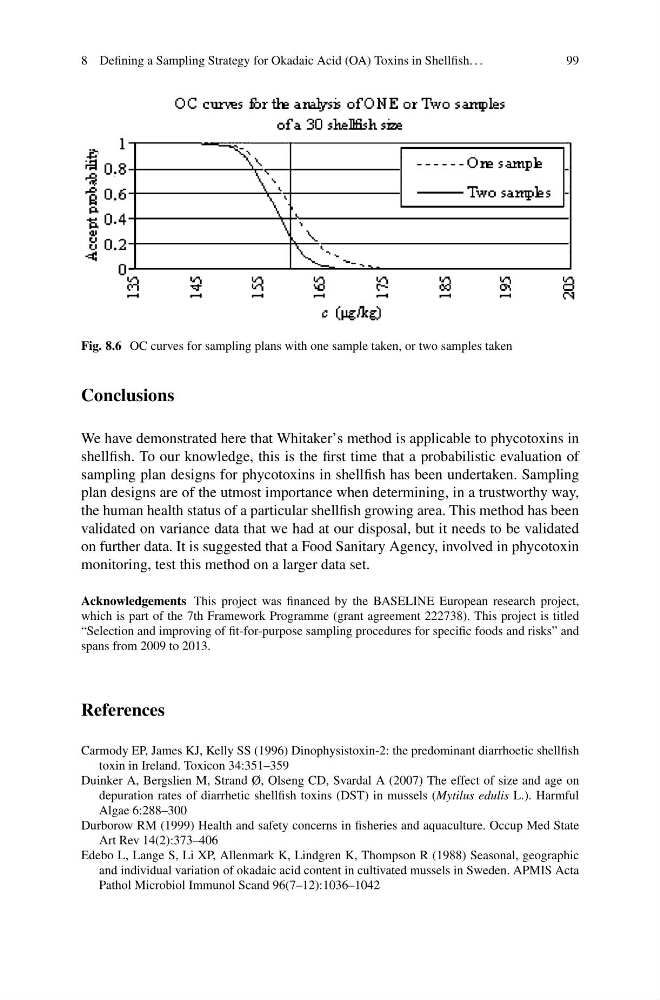
Fig. 8.6 OC curves for sampling plans with one sample taken, or two samples taken
Conclusions
We have demonstrated here that Whitaker’s method is applicable to phycotoxins in
shellfish. To our knowledge, this is the first time that a probabilistic evaluation of
sampling plan designs for phycotoxins in shellfish has been undertaken. Sampling
plan designs are of the utmost importance when determining, in a trustworthy way,
the human health status of a particular shellfish growing area. This method has been
validated on variance data that we had at our disposal, but it needs to be validated
on further data. It is suggested that a Food Sanitary Agency, involved in phycotoxin
monitoring, test this method on a larger data set.
Acknowledgements This project was financed by the BASELINE European research project,
which is part of the 7th Framework Programme (grant agreement 222738). This project is titled
“Selection and improving of fit-for-purpose sampling procedures for specific foods and risks” and
spans from 2009 to 2013.
References
Carmody EP, James KJ, Kelly SS (1996) Dinophysistoxin-2: the predominant diarrhoetic shellfish
toxin in Ireland. Toxicon 34:351–359
Duinker A, Bergslien M, Strand Ø, Olseng CD, Svardal A (2007) The effect of size and age on
depuration rates of diarrhetic shellfish toxins (DST) in mussels (Mytilus edulis L.). Harmful
Algae 6:288–300
Durborow RM (1999) Health and safety concerns in fisheries and aquaculture. Occup Med State
Art Rev 14(2):373–406
Edebo L, Lange S, Li XP, Allenmark K, Lindgren K, Thompson R (1988) Seasonal, geographic
and individual variation of okadaic acid content in cultivated mussels in Sweden. APMIS Acta
Pathol Microbiol Immunol Scand 96(7–12):1036–1042
99
Fig. 8.6 OC curves for sampling plans with one sample taken, or two samples taken
Conclusions
We have demonstrated here that Whitaker’s method is applicable to phycotoxins in
shellfish. To our knowledge, this is the first time that a probabilistic evaluation of
sampling plan designs for phycotoxins in shellfish has been undertaken. Sampling
plan designs are of the utmost importance when determining, in a trustworthy way,
the human health status of a particular shellfish growing area. This method has been
validated on variance data that we had at our disposal, but it needs to be validated
on further data. It is suggested that a Food Sanitary Agency, involved in phycotoxin
monitoring, test this method on a larger data set.
Acknowledgements This project was financed by the BASELINE European research project,
which is part of the 7th Framework Programme (grant agreement 222738). This project is titled
“Selection and improving of fit-for-purpose sampling procedures for specific foods and risks” and
spans from 2009 to 2013.
References
Carmody EP, James KJ, Kelly SS (1996) Dinophysistoxin-2: the predominant diarrhoetic shellfish
toxin in Ireland. Toxicon 34:351–359
Duinker A, Bergslien M, Strand Ø, Olseng CD, Svardal A (2007) The effect of size and age on
depuration rates of diarrhetic shellfish toxins (DST) in mussels (Mytilus edulis L.). Harmful
Algae 6:288–300
Durborow RM (1999) Health and safety concerns in fisheries and aquaculture. Occup Med State
Art Rev 14(2):373–406
Edebo L, Lange S, Li XP, Allenmark K, Lindgren K, Thompson R (1988) Seasonal, geographic
and individual variation of okadaic acid content in cultivated mussels in Sweden. APMIS Acta
Pathol Microbiol Immunol Scand 96(7–12):1036–1042