

Ingestion, Assimilation, and Overheads on Growth
75
60
,.-...,
:::a
u 40
20 .g
bO
..,
0
:1.
go
' - '
~
n
N
C.
.0
(/)
=
€
..,
0
20
10 a
a:l
~
-
-s:
(JQ
('j
co
-
'-'
0
0
0
10
20
30
40
Age (d)
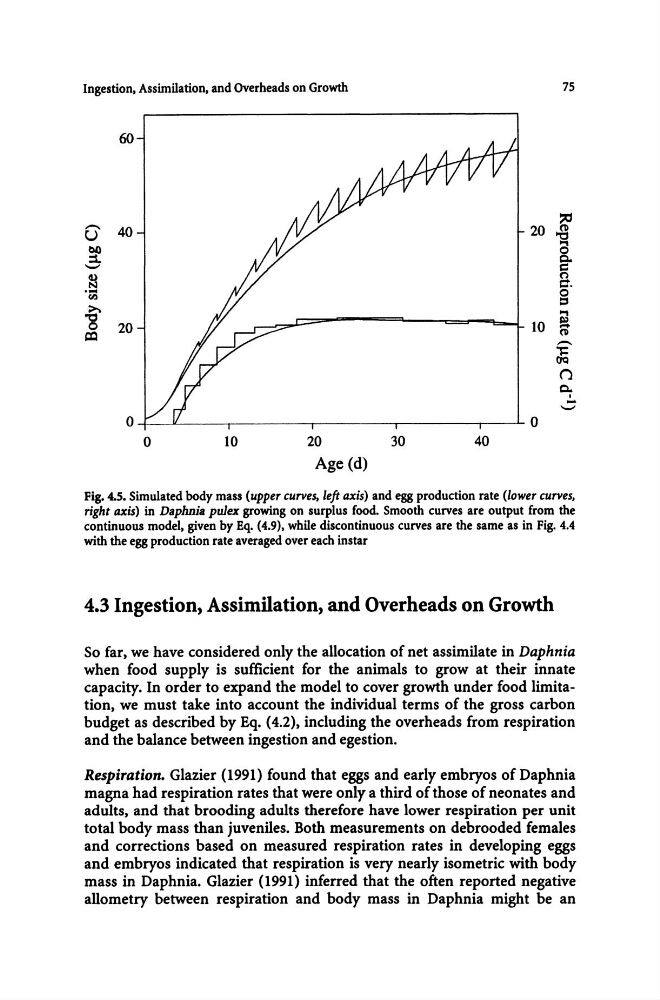
Fig. 4.5. Simulated body mass (upper curves, left axis) and egg production rate (lower curves,
right axis) in Daphnia pulex growing on surplus food. Smooth curves are output from the
continuous model, given by Eq. (4.9), while discontinuous curves are the same as in Fig. 4.4
with the egg production rate averaged over each instar
4.3 Ingestion, Assimilation, and Overheads on Growth
So far, we have considered only the allocation of net assimilate in Daphnia
when food supply is sufficient for the animals to grow at their innate
capacity. In order to expand the model to cover growth under food limitation, we must take into account the individual terms of the gross carbon
budget as described by Eq. (4.2), including the overheads from respiration
and the balance between ingestion and egestion.
Respiration. Glazier (1991) found that eggs and early embryos of Daphnia
magna had respiration rates that were only a third of those of neonates and
adults, and that brooding adults therefore have lower respiration per unit
total body mass than juveniles. Both measurements on debrooded females
and corrections based on measured respiration rates in developing eggs
and embryos indicated that respiration is very nearly isometric with body
mass in Daphnia. Glazier (1991) inferred that the often reported negative
allometry between respiration and body mass in Daphnia might be an
75
60
,.-...,
:::a
u 40
20 .g
bO
..,
0
:1.
go
' - '
~
n
N
C.
.0
(/)
=
€
..,
0
20
10 a
a:l
~
-
-s:
(JQ
('j
co
-
'-'
0
0
0
10
20
30
40
Age (d)
Fig. 4.5. Simulated body mass (upper curves, left axis) and egg production rate (lower curves,
right axis) in Daphnia pulex growing on surplus food. Smooth curves are output from the
continuous model, given by Eq. (4.9), while discontinuous curves are the same as in Fig. 4.4
with the egg production rate averaged over each instar
4.3 Ingestion, Assimilation, and Overheads on Growth
So far, we have considered only the allocation of net assimilate in Daphnia
when food supply is sufficient for the animals to grow at their innate
capacity. In order to expand the model to cover growth under food limitation, we must take into account the individual terms of the gross carbon
budget as described by Eq. (4.2), including the overheads from respiration
and the balance between ingestion and egestion.
Respiration. Glazier (1991) found that eggs and early embryos of Daphnia
magna had respiration rates that were only a third of those of neonates and
adults, and that brooding adults therefore have lower respiration per unit
total body mass than juveniles. Both measurements on debrooded females
and corrections based on measured respiration rates in developing eggs
and embryos indicated that respiration is very nearly isometric with body
mass in Daphnia. Glazier (1991) inferred that the often reported negative
allometry between respiration and body mass in Daphnia might be an