

74
Herbivores and Algae: Food Utilization, Growth and Reproduction ...
Fig. 4.4 also points out the importance of molt losses in determining the
growth pattern in Daphnia. Although the cost of molting might be small
compared to total production, it constitutes a major fraction of the growth
investment in adults. The setback created by molt losses gives a strong
retardation in adult body mass growth rate, which again is responsible for
the nearly constant production rate observed in adult Daphnia by Lynch et
al. (1986). Running the model without molt losses results in major deviations from the observed pattern. Body growth will proceed toward the
asymptotic body mass Be<> in Eq. (4.7), which is > 50% higher than observed.
At the same time net assimilation will decrease as a result of Eq. (4.7), such
that the egg production at the end of the simulation is reduced to < 5% of
the observed level.
A Continuous Approximation to the Growth History of Daphnia. The continuous-discrete nature of the model [Eqs. (4.3), (4.4)] represents a major
complication to its incorporation in a full population model. It is therefore
desirable to avoid the explicit modeling of instar transitions by approximating the present model with a fully continuous version. Due to the
differences in the exponents of the allometric relationships [Eqs. (4.5),
(4.6)], molt weight will increase faster with length than body weight, and
thus the molt will constitute an increasing fraction of body weight with
increasing size. On the other hand, instar duration will also increase with
increasing size, giving larger animals more time to build up the new molt.
Assuming that these two forces will work together in such a way that the
relative cost of molting will be independent of body mass leads to a particularly simple extension to Eq. (4.3), which can be written as
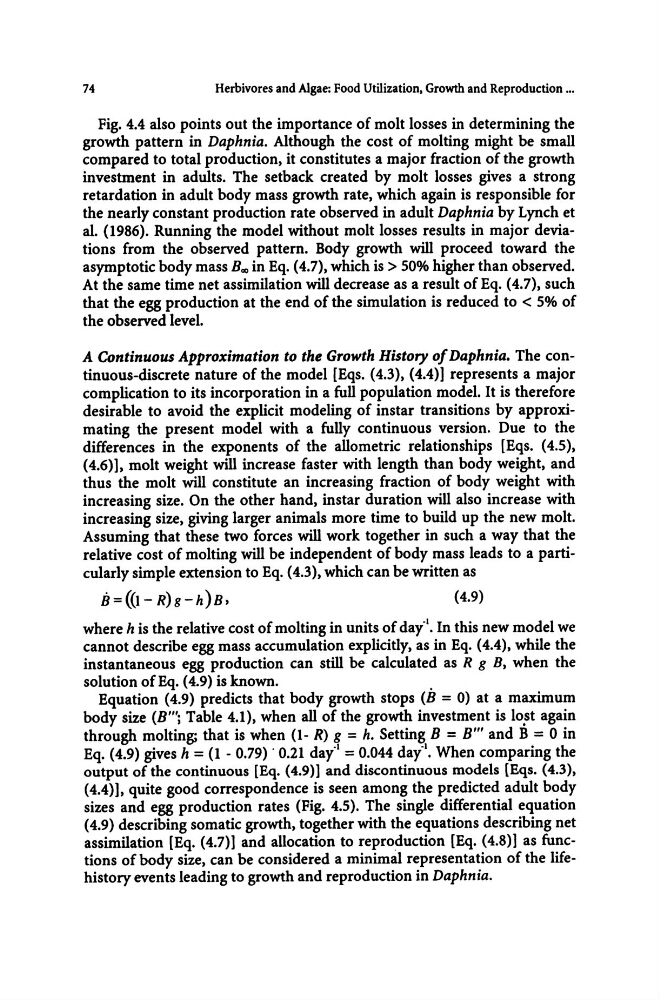
iJ=«l-R)g-h)B,
(4.9)
where h is the relative cost of molting in units of day"l. In this new model we
cannot describe egg mass accumulation explicitly, as in Eq. (4.4), while the
instantaneous egg production can still be calculated as R g B, when the
solution ofEq. (4.9) is known.
.
Equation (4.9) predicts that body growth stops (B = 0) at a maximum
body size (B"'; Table 4.1), when all of the growth investment is lo.st again
through molting; that is when (1- R) g = h. Setting B = B'" and B = 0 in
Eq. (4.9) gives h = (1 - 0.79) . 0.21 day"1 = 0.044 day"l. When comparing the
output of the continuous [Eq. (4.9)] and discontinuous models [Eqs. (4.3),
(4.4)], quite good correspondence is seen among the predicted adult body
sizes and egg production rates (Fig. 4.5). The single differential equation
(4.9) describing somatic growth, together with the equations describing net
assimilation [Eq. (4.7)] and allocation to reproduction [Eq. (4.8)] as functions of body size, can be considered a minimal representation of the lifehistory events leading to growth and reproduction in Daphnia.
Herbivores and Algae: Food Utilization, Growth and Reproduction ...
Fig. 4.4 also points out the importance of molt losses in determining the
growth pattern in Daphnia. Although the cost of molting might be small
compared to total production, it constitutes a major fraction of the growth
investment in adults. The setback created by molt losses gives a strong
retardation in adult body mass growth rate, which again is responsible for
the nearly constant production rate observed in adult Daphnia by Lynch et
al. (1986). Running the model without molt losses results in major deviations from the observed pattern. Body growth will proceed toward the
asymptotic body mass Be<> in Eq. (4.7), which is > 50% higher than observed.
At the same time net assimilation will decrease as a result of Eq. (4.7), such
that the egg production at the end of the simulation is reduced to < 5% of
the observed level.
A Continuous Approximation to the Growth History of Daphnia. The continuous-discrete nature of the model [Eqs. (4.3), (4.4)] represents a major
complication to its incorporation in a full population model. It is therefore
desirable to avoid the explicit modeling of instar transitions by approximating the present model with a fully continuous version. Due to the
differences in the exponents of the allometric relationships [Eqs. (4.5),
(4.6)], molt weight will increase faster with length than body weight, and
thus the molt will constitute an increasing fraction of body weight with
increasing size. On the other hand, instar duration will also increase with
increasing size, giving larger animals more time to build up the new molt.
Assuming that these two forces will work together in such a way that the
relative cost of molting will be independent of body mass leads to a particularly simple extension to Eq. (4.3), which can be written as
iJ=«l-R)g-h)B,
(4.9)
where h is the relative cost of molting in units of day"l. In this new model we
cannot describe egg mass accumulation explicitly, as in Eq. (4.4), while the
instantaneous egg production can still be calculated as R g B, when the
solution ofEq. (4.9) is known.
.
Equation (4.9) predicts that body growth stops (B = 0) at a maximum
body size (B"'; Table 4.1), when all of the growth investment is lo.st again
through molting; that is when (1- R) g = h. Setting B = B'" and B = 0 in
Eq. (4.9) gives h = (1 - 0.79) . 0.21 day"1 = 0.044 day"l. When comparing the
output of the continuous [Eq. (4.9)] and discontinuous models [Eqs. (4.3),
(4.4)], quite good correspondence is seen among the predicted adult body
sizes and egg production rates (Fig. 4.5). The single differential equation
(4.9) describing somatic growth, together with the equations describing net
assimilation [Eq. (4.7)] and allocation to reproduction [Eq. (4.8)] as functions of body size, can be considered a minimal representation of the lifehistory events leading to growth and reproduction in Daphnia.