

76
Herbivores and Algae: Food Utilization, Growth and Reproduction ...
artifact caused by the disproportionately low contribution of egg respiration in brooding adults, and that body-mass-independent specific respiration rates might be common phenomenon in small metazoans, as first
suggested by Zeuthen (1953).
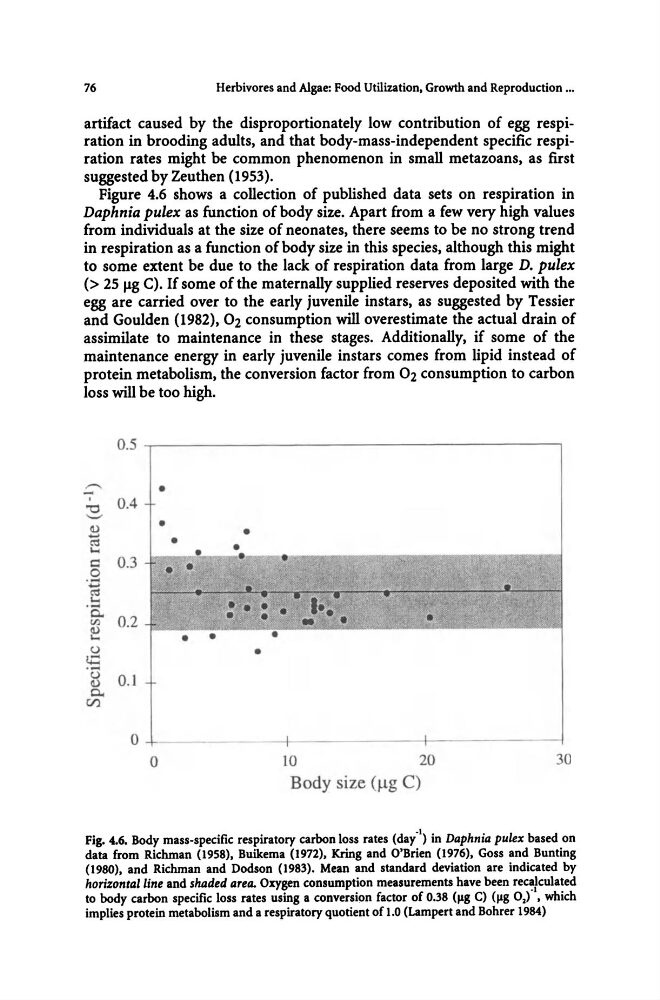
Figure 4.6 shows a collection of published data sets on respiration in
Daphnia pulex as function of body size. Apart from a few very high values
from individuals at the size of neonates, there seems to be no strong trend
in respiration as a function of body size in this species, although this might
to some extent be due to the lack of respiration data from large D. pulex
(> 25 flg C). If some of the maternally supplied reserves deposited with the
egg are carried over to the early juvenile instars, as suggested by Tessier
and Goulden (1982), 02 consumption will overestimate the actual drain of
assimilate to maintenance in these stages. Additionally, if some of the
maintenance energy in early juvenile instars comes from lipid instead of
protein metabolism, the conversion factor from 02 consumption to carbon
loss will be too high.
0.5
..•
- . 0.4
"0
-- Q.) •
....
•
(';j
•
' "'
c 0.3
•
0
.- ....
(';j
'"'
.- 0.. 0.2
Vl
Q.)
....
•
u
•
<;::
.- u 0.1
Q.)
0..
en
0
0
10
20
30
Body size (J..lg C)
Fig. 4.6. Body mass-specific respiratory carbon loss rates (day·l) in Daphnia pulex based on
data from Richman (1958), Buikema (1972), Kring and O'Brien (1976), Goss and Bunting
(1980), and Richman and Dodson (1983). Mean and standard deviation are indicated by
horizontal line and shaded area. Oxygen consumption measurements have been rec~culated
to body carbon specific loss rates using a conversion factor of 0.38 (J1g C) (J1g 0,) ,which
implies protein metabolism and a respiratory quotient of 1.0 (Lampert and Bohrer 1984)
Herbivores and Algae: Food Utilization, Growth and Reproduction ...
artifact caused by the disproportionately low contribution of egg respiration in brooding adults, and that body-mass-independent specific respiration rates might be common phenomenon in small metazoans, as first
suggested by Zeuthen (1953).
Figure 4.6 shows a collection of published data sets on respiration in
Daphnia pulex as function of body size. Apart from a few very high values
from individuals at the size of neonates, there seems to be no strong trend
in respiration as a function of body size in this species, although this might
to some extent be due to the lack of respiration data from large D. pulex
(> 25 flg C). If some of the maternally supplied reserves deposited with the
egg are carried over to the early juvenile instars, as suggested by Tessier
and Goulden (1982), 02 consumption will overestimate the actual drain of
assimilate to maintenance in these stages. Additionally, if some of the
maintenance energy in early juvenile instars comes from lipid instead of
protein metabolism, the conversion factor from 02 consumption to carbon
loss will be too high.
0.5
..•
- . 0.4
"0
-- Q.) •
....
•
(';j
•
' "'
c 0.3
•
0
.- ....
(';j
'"'
.- 0.. 0.2
Vl
Q.)
....
•
u
•
<;::
.- u 0.1
Q.)
0..
en
0
0
10
20
30
Body size (J..lg C)
Fig. 4.6. Body mass-specific respiratory carbon loss rates (day·l) in Daphnia pulex based on
data from Richman (1958), Buikema (1972), Kring and O'Brien (1976), Goss and Bunting
(1980), and Richman and Dodson (1983). Mean and standard deviation are indicated by
horizontal line and shaded area. Oxygen consumption measurements have been rec~culated
to body carbon specific loss rates using a conversion factor of 0.38 (J1g C) (J1g 0,) ,which
implies protein metabolism and a respiratory quotient of 1.0 (Lampert and Bohrer 1984)