

Balancing Nutrient Uptake and Growth
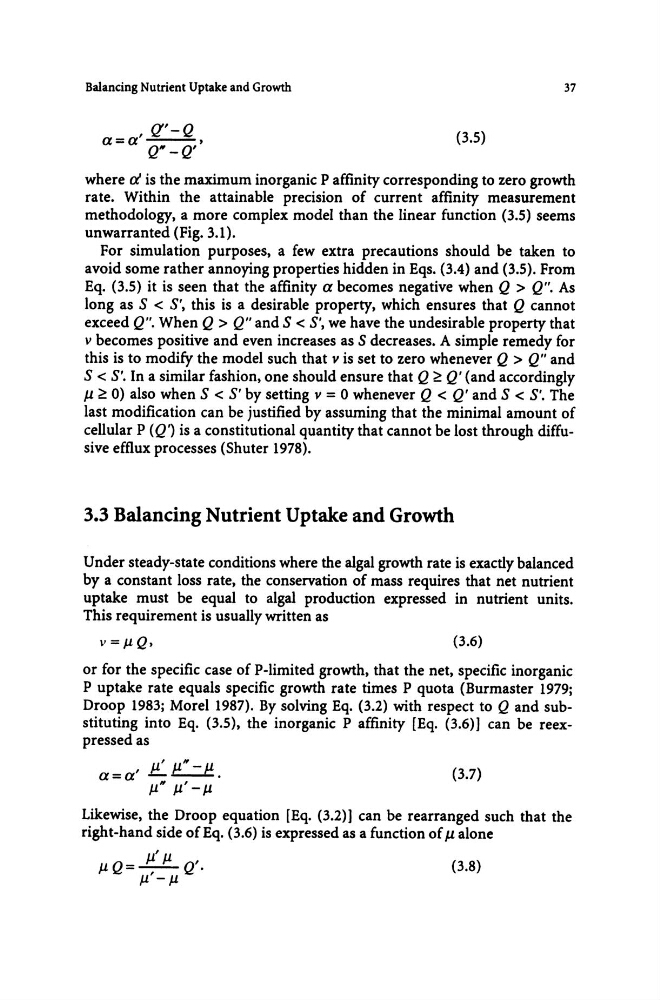
a=a' (!'-Q,
Q" -Q'
37
(3.5)
where ri is the maximum inorganic P affinity corresponding to zero growth
rate. Within the attainable precision of current affinity measurement
methodology, a more complex model than the linear function (3.5) seems
unwarranted (Fig. 3.1).
For simulation purposes, a few extra precautions should be taken to
avoid some rather annoying properties hidden in Eqs. (3.4) and (3.5). From
Eq. (3.5) it is seen that the affinity a becomes negative when Q > Q". As
long as S < S', this is a desirable property, which ensures that Q cannot
exceed Q". When Q > Q" and S < S', we have the undesirable property that
v becomes positive and even increases as S decreases. A simple remedy for
this is to modify the model such that v is set to zero whenever Q > Q" and
S < S'. In a similar fashion, one should ensure that Q ~ Q' (and accordingly
Jl ~ 0) also when S < S' by setting v = 0 whenever Q < Q' and S < S'. The
last modification can be justified by assuming that the minimal amount of
cellular P (Q1 is a constitutional quantity that cannot be lost through diffusive efflux processes (Shuter 1978).
3.3 Balancing Nutrient Uptake and Growth
Under steady-state conditions where the algal growth rate is exactly balanced
by a constant loss rate, the conservation of mass requires that net nutrient
uptake must be equal to algal production expressed in nutrient units.
This requirement is usually written as
v=pQ,
(3.6)
or for the specific case of P-limited growth, that the net, specific inorganic
P uptake rate equals specific growth rate times P quota (Burmaster 1979;
Droop 1983; Morel 1987). By solving Eq. (3.2) with respect to Q and substituting into Eq. (3.5), the inorganic P affinity [Eq. (3.6)] can be reexpressed as
Jl' u" - u
a=a' -~.
JlN Jl' - Jl
(3.7)
Likewise, the Droop equation [Eq. (3.2)] can be rearranged such that the
right-hand side of Eq. (3.6) is expressed as a function of Jl alone
Jl Q = Jl' Jl Q'.
(3.8)
fl.' - J.l
a=a' (!'-Q,
Q" -Q'
37
(3.5)
where ri is the maximum inorganic P affinity corresponding to zero growth
rate. Within the attainable precision of current affinity measurement
methodology, a more complex model than the linear function (3.5) seems
unwarranted (Fig. 3.1).
For simulation purposes, a few extra precautions should be taken to
avoid some rather annoying properties hidden in Eqs. (3.4) and (3.5). From
Eq. (3.5) it is seen that the affinity a becomes negative when Q > Q". As
long as S < S', this is a desirable property, which ensures that Q cannot
exceed Q". When Q > Q" and S < S', we have the undesirable property that
v becomes positive and even increases as S decreases. A simple remedy for
this is to modify the model such that v is set to zero whenever Q > Q" and
S < S'. In a similar fashion, one should ensure that Q ~ Q' (and accordingly
Jl ~ 0) also when S < S' by setting v = 0 whenever Q < Q' and S < S'. The
last modification can be justified by assuming that the minimal amount of
cellular P (Q1 is a constitutional quantity that cannot be lost through diffusive efflux processes (Shuter 1978).
3.3 Balancing Nutrient Uptake and Growth
Under steady-state conditions where the algal growth rate is exactly balanced
by a constant loss rate, the conservation of mass requires that net nutrient
uptake must be equal to algal production expressed in nutrient units.
This requirement is usually written as
v=pQ,
(3.6)
or for the specific case of P-limited growth, that the net, specific inorganic
P uptake rate equals specific growth rate times P quota (Burmaster 1979;
Droop 1983; Morel 1987). By solving Eq. (3.2) with respect to Q and substituting into Eq. (3.5), the inorganic P affinity [Eq. (3.6)] can be reexpressed as
Jl' u" - u
a=a' -~.
JlN Jl' - Jl
(3.7)
Likewise, the Droop equation [Eq. (3.2)] can be rearranged such that the
right-hand side of Eq. (3.6) is expressed as a function of Jl alone
Jl Q = Jl' Jl Q'.
(3.8)
fl.' - J.l