

38
Algae and Nutrients: Uptake and Utilization ofLimiting ...
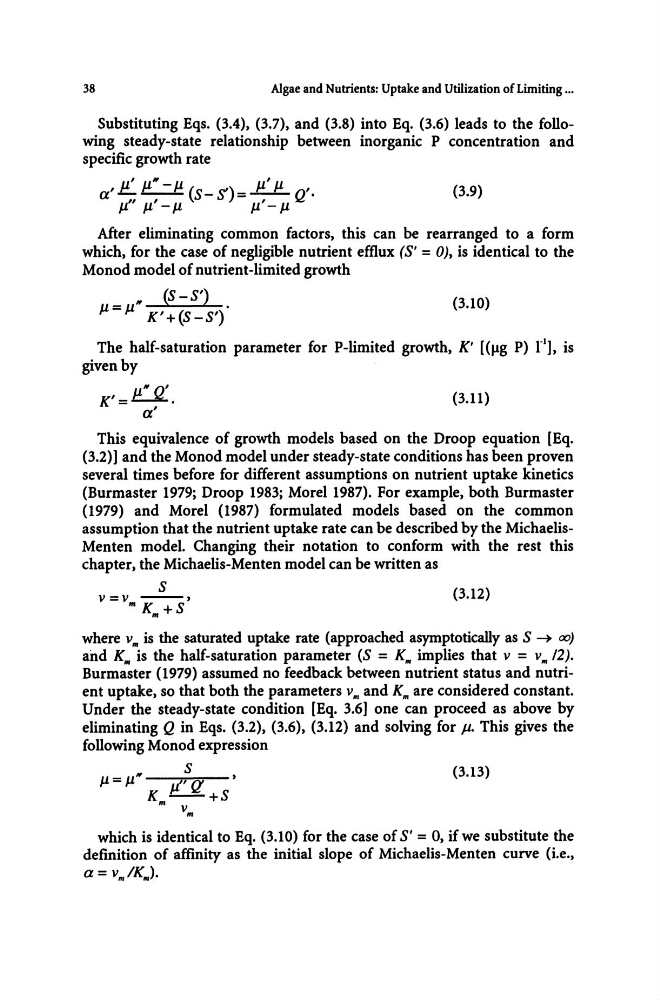
Substituting Eqs. (3.4), (3.7), and (3.8) into Eq. (3.6) leads to the following steady-state relationship between inorganic P concentration and
specific growth rate
a' i£ Jl" - Jl (S _ S') = ..l!...i!:-. Q'.
Jl" Jl' - Jl
Jl' - Jl
(3.9)
After eliminating common factors, this can be rearranged to a form
which, for the case of negligible nutrient efflux (S' = 0), is identical to the
Monod model of nutrient-limited growth
_
N
(S -S')
Jl - Jl K' + (S - S')
(3.10)
The half-saturation parameter for P-limited growth, K' [(JIg P) r J ], is
given by
,," n'
K'=~·
a'
(3.11)
This equivalence of growth models based on the Droop equation [Eq.
(3.2)] and the Monod model under steady-state conditions has been proven
several times before for different assumptions on nutrient uptake kinetics
(Burmaster 1979; Droop 1983; Morel 1987). For example, both Burmaster
(1979) and Morel (1987) formulated models based on the common
assumption that the nutrient uptake rate can be described by the MichaelisMenten model. Changing their notation to conform with the rest this
chapter, the Michaelis-Menten model can be written as
S
v =V - - ,
(3.12)
m Km+ S
where VOl is the saturated uptake rate (approached asymptotically as S ~ 00)
and K". is the half-saturation parameter (S = K". implies that v = v .. 12).
Burmaster (1979) assumed no feedback between nutrient status and nutrient uptake, so that both the parameters v., and K .. are considered constant.
Under the steady-state condition [Eq. 3.6] one can proceed as above by
eliminating Q in Eqs. (3.2), (3.6), (3.12) and solving for /1. This gives the
following Monod expression
H
S
(3.13)
Jl = Jl
Jl" (!
,
K --+S
m v
m
which is identical to Eq. (3.10) for the case of S' = 0, if we substitute the
definition of affinity as the initial slope of Michaelis-Menten curve (i.e.,
a = v.,1K .. ).
Algae and Nutrients: Uptake and Utilization ofLimiting ...
Substituting Eqs. (3.4), (3.7), and (3.8) into Eq. (3.6) leads to the following steady-state relationship between inorganic P concentration and
specific growth rate
a' i£ Jl" - Jl (S _ S') = ..l!...i!:-. Q'.
Jl" Jl' - Jl
Jl' - Jl
(3.9)
After eliminating common factors, this can be rearranged to a form
which, for the case of negligible nutrient efflux (S' = 0), is identical to the
Monod model of nutrient-limited growth
_
N
(S -S')
Jl - Jl K' + (S - S')
(3.10)
The half-saturation parameter for P-limited growth, K' [(JIg P) r J ], is
given by
,," n'
K'=~·
a'
(3.11)
This equivalence of growth models based on the Droop equation [Eq.
(3.2)] and the Monod model under steady-state conditions has been proven
several times before for different assumptions on nutrient uptake kinetics
(Burmaster 1979; Droop 1983; Morel 1987). For example, both Burmaster
(1979) and Morel (1987) formulated models based on the common
assumption that the nutrient uptake rate can be described by the MichaelisMenten model. Changing their notation to conform with the rest this
chapter, the Michaelis-Menten model can be written as
S
v =V - - ,
(3.12)
m Km+ S
where VOl is the saturated uptake rate (approached asymptotically as S ~ 00)
and K". is the half-saturation parameter (S = K". implies that v = v .. 12).
Burmaster (1979) assumed no feedback between nutrient status and nutrient uptake, so that both the parameters v., and K .. are considered constant.
Under the steady-state condition [Eq. 3.6] one can proceed as above by
eliminating Q in Eqs. (3.2), (3.6), (3.12) and solving for /1. This gives the
following Monod expression
H
S
(3.13)
Jl = Jl
Jl" (!
,
K --+S
m v
m
which is identical to Eq. (3.10) for the case of S' = 0, if we substitute the
definition of affinity as the initial slope of Michaelis-Menten curve (i.e.,
a = v.,1K .. ).