

Nutrient Uptake
35
3.2 Nutrient Uptake
Plankton algae generally obtain their constituent mineral nutrients from
the surrounding water. Only in rare cases are all essential nutrients present
in the water in concentrations comparable to those that must be maintained within the cell. This means that nutrients must be actively transported into the cell against a concentration gradient, and that this concentration gradient gives rise to a passive diffusive flux out of the cell. It has
thus been shown that nutrient uptake in microorganisms can be described
as the net result of fast, bidirectional exchange processes across the cell
membrane (Lean 1976; Lean and Nalewajko 1976; Olsen 1989). While some
authors argue that only the net uptake rate is of importance to phytoplankton growth (e.g., Lehman 1984), other studies have shown that the
fast exchange processes can be very important to the outcome of competition under certain modes of nutrient supply (Olsen et al. 1989).
In short-term uptake measurements, it is generally found that the gross
nutrient uptake rate is a non decreasing function of dissolved nutrient concentration, which levels off to a saturated uptake rate at high nutrient
levels. On a longer time scale there is found to be a feedback interaction
between uptake and growth such that general response to nutrient limitation seems to be an increase in the saturated uptake rate (see Turpin 1988
and references therein). While the Michaelis-Menten model of enzyme
kinetics is often used to describe cellular nutrient uptake, it should be
noted that several workers have observed deviations from this model, indicating the existence of two or more uptake systems with different substrate
affinities (Brown et al. 1978; Brown and Button 1979; Olsen 1989). At low
concentrations of dissolved nutrient, the relationship between uptake rate
and external concentration will nevertheless be dominated by the uptake
system with the highest substrate affinity and closely approximated by a
linear function. Olsen (1989) presented evidence that the information contained in such a first-order approximation was sufficient to predict the
outcome of chemostat competition experiments. Apart from the mathematical convenience, it can be argued in defense of using first-order kinetics instead of the more common saturation kinetics, that nutrient concentrations will almost by definition be low as long as there is competition for
nutrients in the plankton community, and that when a nutrient is nonlimiting to all members of the community it does not really matter how the
uptake kinetics are described.
If we consider the case of inorganic phosphorus uptake, the first-order
approximation implies that the net, carbon-specific phosphorus uptake
rate v [(Ilg P) (mg Cr
l dati], which is the difference between an influx rate
(VI) and efflux rate (v.), can be written as
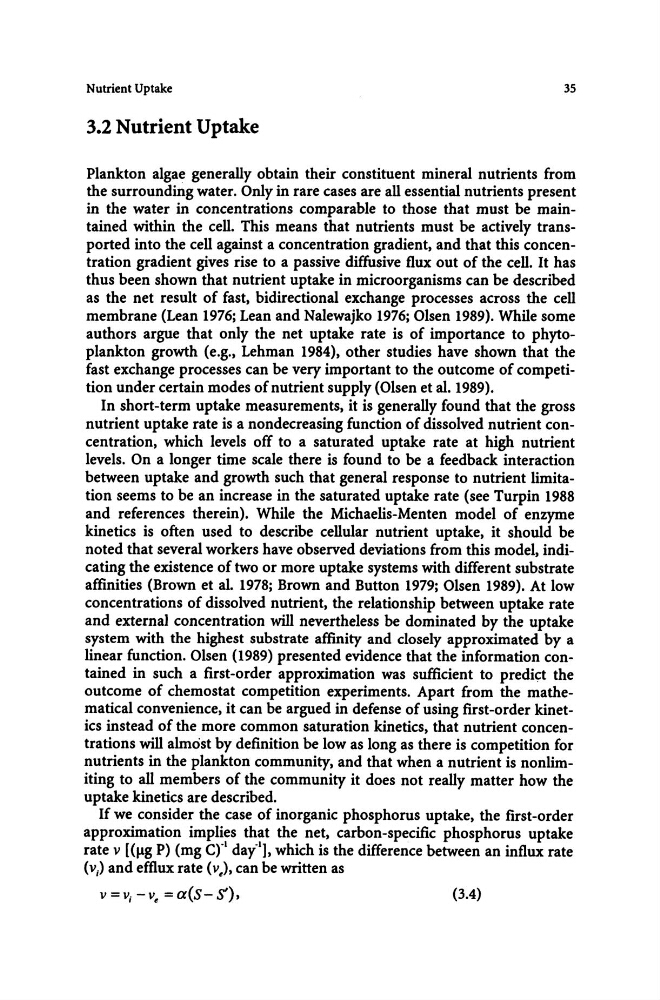
V=Vj -v. =a(S-S'),
(3.4)
35
3.2 Nutrient Uptake
Plankton algae generally obtain their constituent mineral nutrients from
the surrounding water. Only in rare cases are all essential nutrients present
in the water in concentrations comparable to those that must be maintained within the cell. This means that nutrients must be actively transported into the cell against a concentration gradient, and that this concentration gradient gives rise to a passive diffusive flux out of the cell. It has
thus been shown that nutrient uptake in microorganisms can be described
as the net result of fast, bidirectional exchange processes across the cell
membrane (Lean 1976; Lean and Nalewajko 1976; Olsen 1989). While some
authors argue that only the net uptake rate is of importance to phytoplankton growth (e.g., Lehman 1984), other studies have shown that the
fast exchange processes can be very important to the outcome of competition under certain modes of nutrient supply (Olsen et al. 1989).
In short-term uptake measurements, it is generally found that the gross
nutrient uptake rate is a non decreasing function of dissolved nutrient concentration, which levels off to a saturated uptake rate at high nutrient
levels. On a longer time scale there is found to be a feedback interaction
between uptake and growth such that general response to nutrient limitation seems to be an increase in the saturated uptake rate (see Turpin 1988
and references therein). While the Michaelis-Menten model of enzyme
kinetics is often used to describe cellular nutrient uptake, it should be
noted that several workers have observed deviations from this model, indicating the existence of two or more uptake systems with different substrate
affinities (Brown et al. 1978; Brown and Button 1979; Olsen 1989). At low
concentrations of dissolved nutrient, the relationship between uptake rate
and external concentration will nevertheless be dominated by the uptake
system with the highest substrate affinity and closely approximated by a
linear function. Olsen (1989) presented evidence that the information contained in such a first-order approximation was sufficient to predict the
outcome of chemostat competition experiments. Apart from the mathematical convenience, it can be argued in defense of using first-order kinetics instead of the more common saturation kinetics, that nutrient concentrations will almost by definition be low as long as there is competition for
nutrients in the plankton community, and that when a nutrient is nonlimiting to all members of the community it does not really matter how the
uptake kinetics are described.
If we consider the case of inorganic phosphorus uptake, the first-order
approximation implies that the net, carbon-specific phosphorus uptake
rate v [(Ilg P) (mg Cr
l dati], which is the difference between an influx rate
(VI) and efflux rate (v.), can be written as
V=Vj -v. =a(S-S'),
(3.4)