

34
Algae and Nutrients: Uptake and Utilization of Limiting ...
where we have incorporated the steady-state equivalence of dilution rate
(D) and specific growth rate (p; day"I). The parameters of Eq. (3.1) are Y':
the yield at zero growth rate [(mg C) (flg pr l ], and JI': the growth rate
corresponding to zero yield (day"I). It must be noted that both the
parameters of Eq. (3.1) are extrapolations to dilution rates where it is
impossible to operate a chemostat culture.
If we reexpress Eq. (3.1) in terms of Q = Y" the cellular phosphorus
content (or P quota), and solve Eq. (3.1) with respect to p, we obtain the
familiar hyperbolic function introduced by Droop (1968):
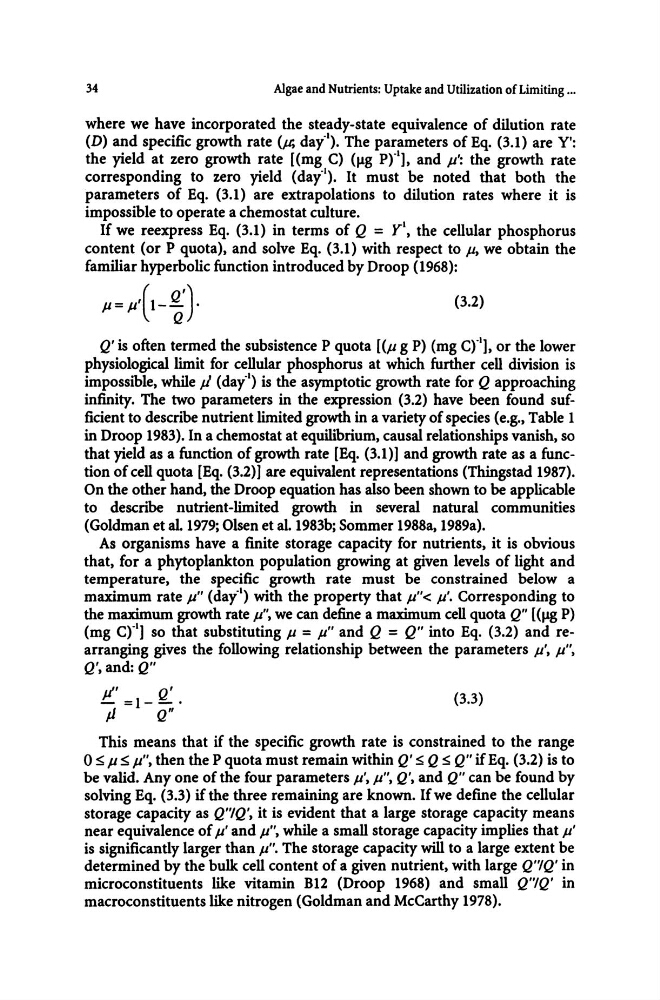
JI = JI{ 1- ~').
(3.2)
Q'is often termed the subsistence P quota [(Jl g P) (mg ct], or the lower
physiological limit for cellular phosphorus at which further cell division is
impossible, while jl (day"l) is the asymptotic growth rate for Q approaching
infinity. The two parameters in the expression (3.2) have been found sufficient to descn"be nutrient limited growth in a variety of species (e.g., Table 1
in Droop 1983). In a chemostat at equilibrium, causal relationships vanish, so
that yield as a function of growth rate [Eq. (3.1)] and growth rate as a function of cell quota [Eq. (3.2)J are equivalent representations (Thingstad 1987).
On the other hand, the Droop equation has also been shown to be applicable
to describe nutrient-limited growth in several natural communities
(Goldman et al.1979; Olsen et al.1983b; Sommer 1988a, 1989a).
As organisms have a finite storage capacity for nutrients, it is obvious
that, for a phytoplankton population growing at given levels of light and
temperature, the specific growth rate must be constrained below a
maximum rate JI" (day"l) with the property that JI"< JI'. Corresponding to
the maximum growth rate JI", we can define a maximum cell quota Q" [(J.l8 P)
(mg CrlJ so that substituting JI = JI" and Q = Q" into Eq. (3.2) and rearranging gives the following relationship between the parameters JI', JI",
Q', and: Q"
Jl"
Q'
- =1--'
J1
Q"
(3.3)
This means that if the specific growth rate is constrained to the range
Os; JI S; Ji", then the P quota must remain within Q' S Q S Q" if Eq. (3.2) is to
be valid. Anyone of the four parameters JI', JI", Q', and Q" can be found by
solving Eq. (3.3) if the three remaining are known. Ifwe define the cellular
storage capacity as Q"IQ', it is evident that a large storage capacity means
near equivalence of JI' and JI", while a small storage capacity implies that JI'
is significantly larger than JI". The storage capacity will to a large extent be
determined by the bulk cell content of a given nutrient, with large Q"IQ' in
microconstituents like vitamin B12 (Droop 1968) and small Q"IQ' in
macroconstituents like nitrogen (Goldman and McCarthy 1978).
Algae and Nutrients: Uptake and Utilization of Limiting ...
where we have incorporated the steady-state equivalence of dilution rate
(D) and specific growth rate (p; day"I). The parameters of Eq. (3.1) are Y':
the yield at zero growth rate [(mg C) (flg pr l ], and JI': the growth rate
corresponding to zero yield (day"I). It must be noted that both the
parameters of Eq. (3.1) are extrapolations to dilution rates where it is
impossible to operate a chemostat culture.
If we reexpress Eq. (3.1) in terms of Q = Y" the cellular phosphorus
content (or P quota), and solve Eq. (3.1) with respect to p, we obtain the
familiar hyperbolic function introduced by Droop (1968):
JI = JI{ 1- ~').
(3.2)
Q'is often termed the subsistence P quota [(Jl g P) (mg ct], or the lower
physiological limit for cellular phosphorus at which further cell division is
impossible, while jl (day"l) is the asymptotic growth rate for Q approaching
infinity. The two parameters in the expression (3.2) have been found sufficient to descn"be nutrient limited growth in a variety of species (e.g., Table 1
in Droop 1983). In a chemostat at equilibrium, causal relationships vanish, so
that yield as a function of growth rate [Eq. (3.1)] and growth rate as a function of cell quota [Eq. (3.2)J are equivalent representations (Thingstad 1987).
On the other hand, the Droop equation has also been shown to be applicable
to describe nutrient-limited growth in several natural communities
(Goldman et al.1979; Olsen et al.1983b; Sommer 1988a, 1989a).
As organisms have a finite storage capacity for nutrients, it is obvious
that, for a phytoplankton population growing at given levels of light and
temperature, the specific growth rate must be constrained below a
maximum rate JI" (day"l) with the property that JI"< JI'. Corresponding to
the maximum growth rate JI", we can define a maximum cell quota Q" [(J.l8 P)
(mg CrlJ so that substituting JI = JI" and Q = Q" into Eq. (3.2) and rearranging gives the following relationship between the parameters JI', JI",
Q', and: Q"
Jl"
Q'
- =1--'
J1
Q"
(3.3)
This means that if the specific growth rate is constrained to the range
Os; JI S; Ji", then the P quota must remain within Q' S Q S Q" if Eq. (3.2) is to
be valid. Anyone of the four parameters JI', JI", Q', and Q" can be found by
solving Eq. (3.3) if the three remaining are known. Ifwe define the cellular
storage capacity as Q"IQ', it is evident that a large storage capacity means
near equivalence of JI' and JI", while a small storage capacity implies that JI'
is significantly larger than JI". The storage capacity will to a large extent be
determined by the bulk cell content of a given nutrient, with large Q"IQ' in
microconstituents like vitamin B12 (Droop 1968) and small Q"IQ' in
macroconstituents like nitrogen (Goldman and McCarthy 1978).