

Partitioning of Phosphorus in the Plankton Community
23
1.0 .---_ _ _ _ _ _ _ _ _ _ _ _ --:::;~~--__,
0.8
>..
u
s::
0.6
Q)
::s
Particulate P
Dissolved
0'"
Q)
organic P
ti::
Q)
0.4
>
..... ......
CI:S
-: :s
S
0.2
::s
U
0.0
0.0
0.2
0.4
0.6
0.8
1.0
Fraction of total phosphorus
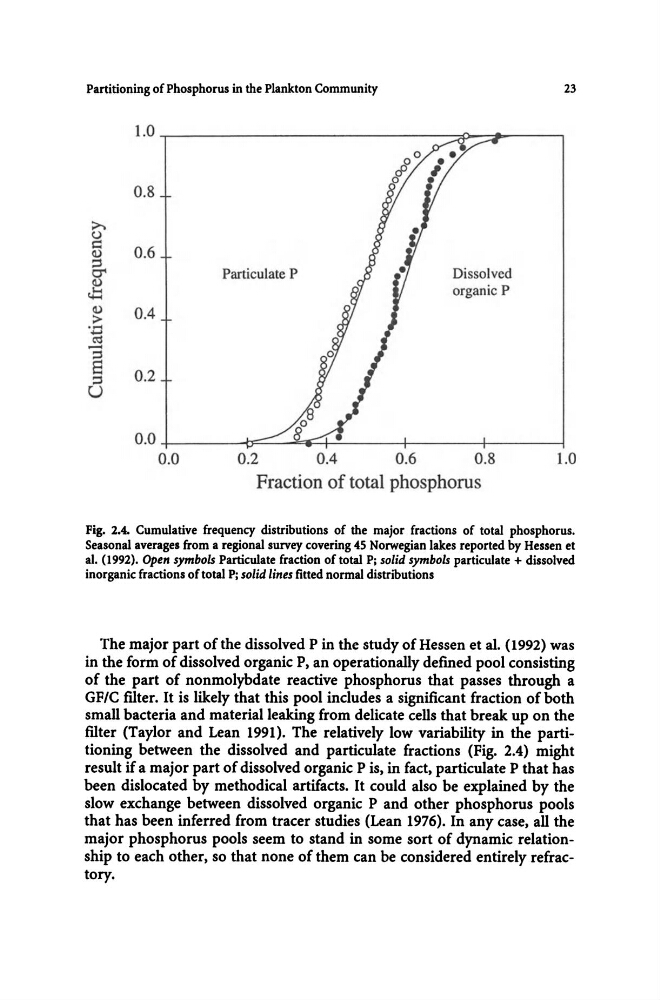
Fig. 2.4. Cumulative frequency distributions of the major fractions of total phosphorus.
Seasonal averages from a regional survey covering 4S Norwegian lakes reported by Hessen et
a1. (1992). Open symbols Particulate fraction of total P; solid symbols particulate + dissolved
inorganic fractions of total P; solid lines fitted normal distributions
The major part of the dissolved P in the study of Hessen et aI. (1992) was
in the form of dissolved organic P, an operationally defmed pool consisting
of the part of nonmolybdate reactive phosphorus that passes through a
GF/C filter. It is likely that this pool includes a significant fraction of both
small bacteria and material leaking from delicate cells that break up on the
filter (Taylor and Lean 1991). The relatively low variability in the partitioning between the dissolved and particulate fractions (Fig. 2.4) might
result if a major part of dissolved organic P is, in fact, particulate P that has
been dislocated by methodical artifacts. It could also be explained by the
slow exchange between dissolved organic P and other phosphorus pools
that has been inferred from tracer studies (Lean 1976). In any case, all the
major phosphorus pools seem to stand in some sort of dynamic relationship to each other, so that none of them can be considered entirely refractory.
23
1.0 .---_ _ _ _ _ _ _ _ _ _ _ _ --:::;~~--__,
0.8
>..
u
s::
0.6
Q)
::s
Particulate P
Dissolved
0'"
Q)
organic P
ti::
Q)
0.4
>
..... ......
CI:S
-: :s
S
0.2
::s
U
0.0
0.0
0.2
0.4
0.6
0.8
1.0
Fraction of total phosphorus
Fig. 2.4. Cumulative frequency distributions of the major fractions of total phosphorus.
Seasonal averages from a regional survey covering 4S Norwegian lakes reported by Hessen et
a1. (1992). Open symbols Particulate fraction of total P; solid symbols particulate + dissolved
inorganic fractions of total P; solid lines fitted normal distributions
The major part of the dissolved P in the study of Hessen et aI. (1992) was
in the form of dissolved organic P, an operationally defmed pool consisting
of the part of nonmolybdate reactive phosphorus that passes through a
GF/C filter. It is likely that this pool includes a significant fraction of both
small bacteria and material leaking from delicate cells that break up on the
filter (Taylor and Lean 1991). The relatively low variability in the partitioning between the dissolved and particulate fractions (Fig. 2.4) might
result if a major part of dissolved organic P is, in fact, particulate P that has
been dislocated by methodical artifacts. It could also be explained by the
slow exchange between dissolved organic P and other phosphorus pools
that has been inferred from tracer studies (Lean 1976). In any case, all the
major phosphorus pools seem to stand in some sort of dynamic relationship to each other, so that none of them can be considered entirely refractory.