

260
Appendices
where the apex of the parabola is below the line parallel to the D axis at
distance p'g", the grazer extinction point will be locally unstable, implying
system persistence for all dilution rates D < p' - cr.
Grazer washout will result if the grazers are unable to compensate for
dilution losses, even when growing at their maximum capacity; that is,
when D > g' - 0. In order to have a persistent system at high dilution rates,
the requirements D'+ < D and D < g' - 0 must therefore both be satisfied.
The existence of any persistent system at high dilution rates thus requires
that D'+ ~ g' - 0. We can proceed by observing that p'g" can be expressed in
terms of the algal growth rate at Q = () [p8J given by Eq. (A6.13)] as
J.L' gil = g' J.L' ~ 18 = g' (p' - J.L9)'
(AS.S)
If we substitute Eq. (AS.5) into (A8.4), we find that the requirement
D'+~ g' - 0 is equivalent to g' - 0 ~ P8 - (j, This means that when the
phosphorus contents of algae and grazers are equal, the grazers must have
a maximum growth rate that is high enough to outgrow their prey in order
to have a persistent system at a dilution rate D > D'+.
We can gain more insight into how parameter changes will affect the
persistence boundary D'. by evaluating the partial derivatives of D'. with
respect to the parameters. As the parameters involved in Eq. (AS.4) can
differ widely in magnitude, it is reasonable to discuss at relative parameter
sensitivities, as introduced in Section 4.7 [the relative sensitivity, or
elasticity, of a function z with respect to a parameter p is defined as
(Plz)lJOop = ~ln z)lln p)] In order to simplify the expressions, we can
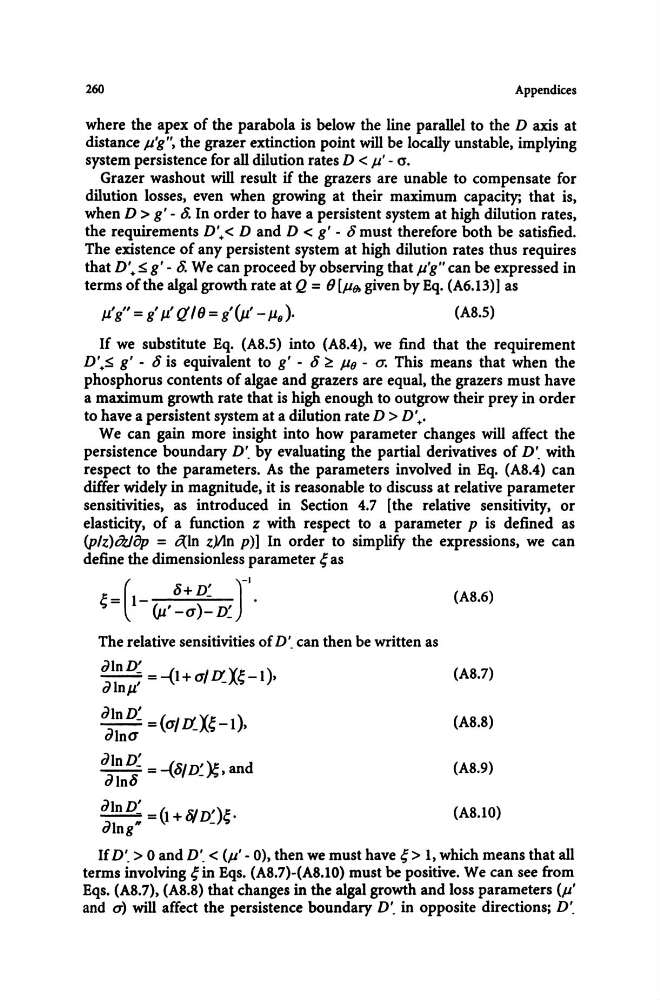
define the dimensionless parameter; as
~ = ( 1 - {J.L' ~: f~ D~ r
(A8.6)
The relative sensitivities of D'. can then be written as
dInD~ =-(I+aILZX~-I),
d InJ.L'
dInD~ =(alD'..X~-I),
dIna
~~n~~ = -(~/D~)l;, and
dIn D~ = (1 + til D')J:.
dIng"
- ~
(A8.7)
(AS.S)
(A8.9)
(AS.I0)
If D'. > 0 and D'. < (p' - 0), then we must have; > 1, which means that all
terms involving; in Eqs. (A8.7)-(A8.10) must be positive. We can see from
Eqs. (A8.7), (A8.S) that changes in the algal growth and loss parameters (p'
and a) will affect the persistence boundary D'. in opposite directions; D'.
Appendices
where the apex of the parabola is below the line parallel to the D axis at
distance p'g", the grazer extinction point will be locally unstable, implying
system persistence for all dilution rates D < p' - cr.
Grazer washout will result if the grazers are unable to compensate for
dilution losses, even when growing at their maximum capacity; that is,
when D > g' - 0. In order to have a persistent system at high dilution rates,
the requirements D'+ < D and D < g' - 0 must therefore both be satisfied.
The existence of any persistent system at high dilution rates thus requires
that D'+ ~ g' - 0. We can proceed by observing that p'g" can be expressed in
terms of the algal growth rate at Q = () [p8J given by Eq. (A6.13)] as
J.L' gil = g' J.L' ~ 18 = g' (p' - J.L9)'
(AS.S)
If we substitute Eq. (AS.5) into (A8.4), we find that the requirement
D'+~ g' - 0 is equivalent to g' - 0 ~ P8 - (j, This means that when the
phosphorus contents of algae and grazers are equal, the grazers must have
a maximum growth rate that is high enough to outgrow their prey in order
to have a persistent system at a dilution rate D > D'+.
We can gain more insight into how parameter changes will affect the
persistence boundary D'. by evaluating the partial derivatives of D'. with
respect to the parameters. As the parameters involved in Eq. (AS.4) can
differ widely in magnitude, it is reasonable to discuss at relative parameter
sensitivities, as introduced in Section 4.7 [the relative sensitivity, or
elasticity, of a function z with respect to a parameter p is defined as
(Plz)lJOop = ~ln z)lln p)] In order to simplify the expressions, we can
define the dimensionless parameter; as
~ = ( 1 - {J.L' ~: f~ D~ r
(A8.6)
The relative sensitivities of D'. can then be written as
dInD~ =-(I+aILZX~-I),
d InJ.L'
dInD~ =(alD'..X~-I),
dIna
~~n~~ = -(~/D~)l;, and
dIn D~ = (1 + til D')J:.
dIng"
- ~
(A8.7)
(AS.S)
(A8.9)
(AS.I0)
If D'. > 0 and D'. < (p' - 0), then we must have; > 1, which means that all
terms involving; in Eqs. (A8.7)-(A8.10) must be positive. We can see from
Eqs. (A8.7), (A8.S) that changes in the algal growth and loss parameters (p'
and a) will affect the persistence boundary D'. in opposite directions; D'.