

The Persistence Boundary
-0 0
D~
Dilution rate D
D' +
Il'g"
11 '-a
259
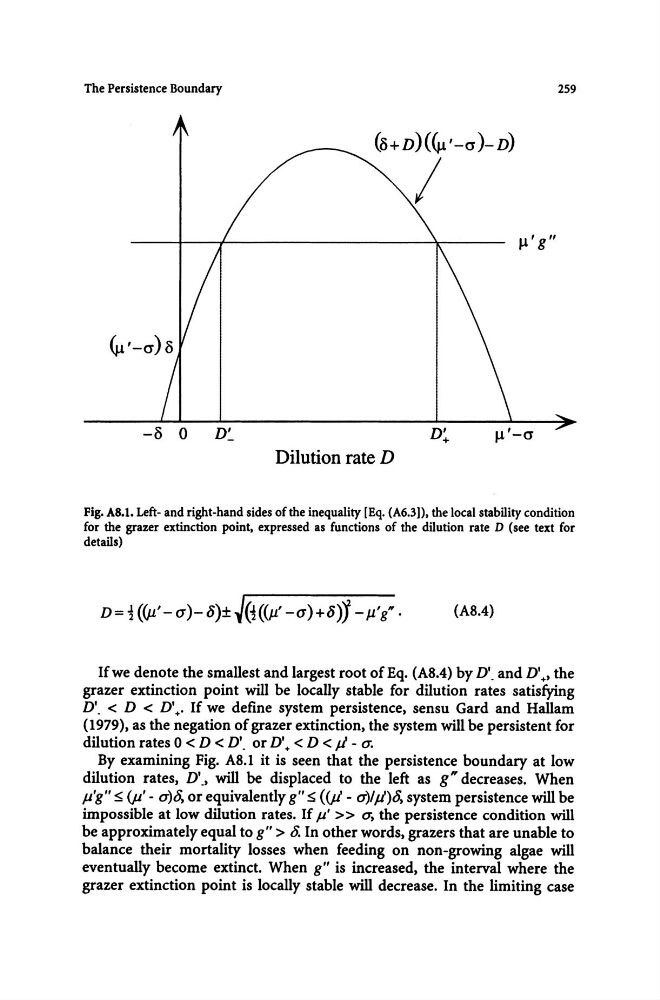
Fig. AS.I. Left- and right-hand sides of the inequality [Eq. (A6.3)). the local stability condition
for the grazer extinction point. expressed as functions of the dilution rate D (see text for
details)
(A8A)
Ifwe denote the smallest and largest root ofEq. (A8A) by DO. and D\. the
grazer extinction point will be locally stable for dilution rates satisfying
DO. < D < D'+. If we define system persistence. sensu Gard and Hallam
(1979). as the negation of grazer extinction. the system will be persistent for
dilution rates 0 < D < DO. or DO+ < D < jI- 0:
By examining Fig. A8.! it is seen that the persistence boundary at low
dilution rates, D'., will be displaced to the left as g" decreases. When
p'g" ~ (P' - 0')8, or equivalently g" ~ ({Jl- 0')/jI)8, system persistence will be
impossible at low dilution rates. If p' » 0', the persistence condition will
be approximately equal to g" > 0. In other words, grazers that are unable to
balance their mortality losses when feeding on non-growing algae will
eventually become extinct. When g" is increased, the interval where the
grazer extinction point is locally stable will decrease. In the limiting case
-0 0
D~
Dilution rate D
D' +
Il'g"
11 '-a
259
Fig. AS.I. Left- and right-hand sides of the inequality [Eq. (A6.3)). the local stability condition
for the grazer extinction point. expressed as functions of the dilution rate D (see text for
details)
(A8A)
Ifwe denote the smallest and largest root ofEq. (A8A) by DO. and D\. the
grazer extinction point will be locally stable for dilution rates satisfying
DO. < D < D'+. If we define system persistence. sensu Gard and Hallam
(1979). as the negation of grazer extinction. the system will be persistent for
dilution rates 0 < D < DO. or DO+ < D < jI- 0:
By examining Fig. A8.! it is seen that the persistence boundary at low
dilution rates, D'., will be displaced to the left as g" decreases. When
p'g" ~ (P' - 0')8, or equivalently g" ~ ({Jl- 0')/jI)8, system persistence will be
impossible at low dilution rates. If p' » 0', the persistence condition will
be approximately equal to g" > 0. In other words, grazers that are unable to
balance their mortality losses when feeding on non-growing algae will
eventually become extinct. When g" is increased, the interval where the
grazer extinction point is locally stable will decrease. In the limiting case