

256
Appendices
Q
Jl' - J.l.
g= K 1- =K I!:....-..!:l..
POP Jl' - Jl
(A7.28)
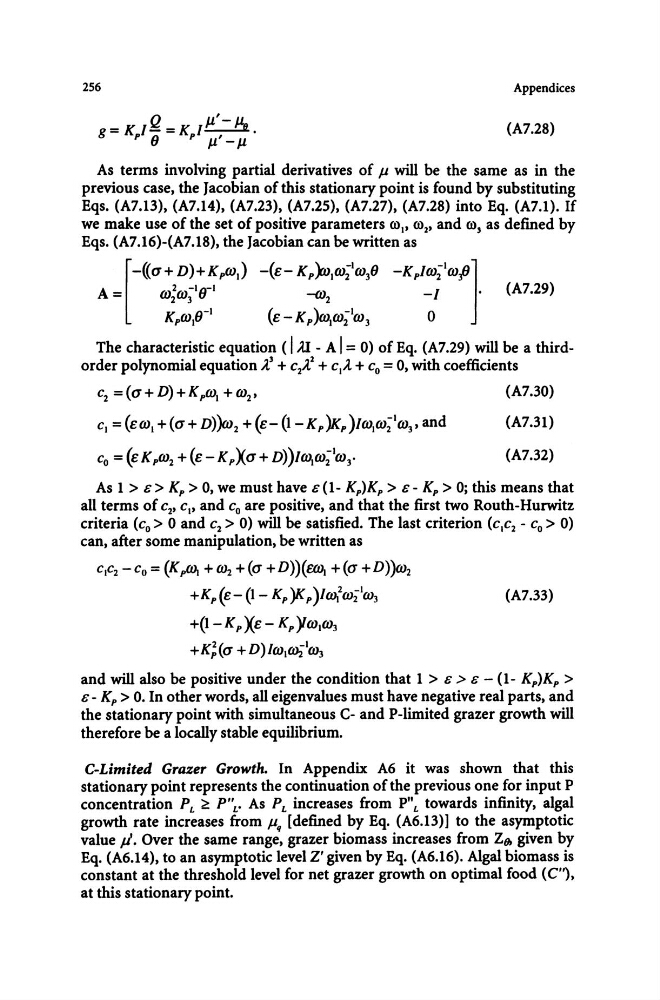
As terms involving partial derivatives of f.J will be the same as in the
previous case, the Jacobian of this stationary point is found by substituting
Eqs. (A7.13), (A7.14), (A7.23), (A7.25), (A7.27), (A7.28) into Eq. (A7.1). If
we make use of the set of positive parameters 00 1 , 00 2 , and 00 3 as defined by
Eqs. (A7.16)-(A7.18), the Jacobian can be written as
[
-«0'+ D)+ KpwJ -(e- KpYnIW;IW30 -KPIW;IWfJ]
A
2 -In-I
= W2W 3 u
-(02
- I '
KpwIO- 1
(e - Kp)wIW;IW3
0
(A7.29)
The characteristic equation ( I Al - A I = 0) of Eq. (A7.29) will be a thirdorder polynomial equation .A.' + C 2 A. 2 + c.A. + Co = 0, with coefficients
C 2 =(0'+ D) + Kpw. +W2'
c. = (ew. +(0'+ D»)w2 + (e- (I-K p)Kp)IW.W;·W 3 , and
Co = (eK pw 2 + (e-KpXO'+ D»)JcO.W;·w 3 ·
(A7.30)
(A7.31)
(A7.32)
As 1 > 8> Kp > 0, we must have 8 (1- Kp)Kp > 8 - Kp> 0; this means that
all terms of C 2 ' C.' and Co are positive, and that the first two Routh-Hurwitz
criteria (co> 0 and c 2 > 0) will be satisfied. The last criterion (c.c 2 - co> 0)
can, after some manipulation, be written as
C.C2 -Co = (Kpco. + w2 + (0' +D»)(ew. +(0' +D»)W2
+Kp(e- (1- Kp)Kp )/co.2Wi·W3
+(I-KpXe- Kp)1WIW3
+K;(O' +D)lw.Wi·W3
(A7.33)
and will also be positive under the condition that 1 > 8> 8 - (1- Kp)Kp >
8 - Kp > O. In other words, all eigenvalues must have negative real parts, and
the stationary point with simultaneous C- and P-limited grazer growth will
therefore be a locally stable equilibrium.
C-Limited Grazer Growth. In Appendix A6 it was shown that this
stationary point represents the continuation of the previous one for input P
concentration P L ~ PIlL' As P L increases from PIlL towards infinity, algal
growth rate increases from f.J q [defined by Eq. (A6.13)] to the asymptotic
value ",. Over the same range, grazer biomass increases from Zo. given by
Eq. (A6.14), to an asymptotic level Z' given by Eq. (A6.16). Algal biomass is
constant at the threshold level for net grazer growth on optimal food (C''),
at this stationary point.
Appendices
Q
Jl' - J.l.
g= K 1- =K I!:....-..!:l..
POP Jl' - Jl
(A7.28)
As terms involving partial derivatives of f.J will be the same as in the
previous case, the Jacobian of this stationary point is found by substituting
Eqs. (A7.13), (A7.14), (A7.23), (A7.25), (A7.27), (A7.28) into Eq. (A7.1). If
we make use of the set of positive parameters 00 1 , 00 2 , and 00 3 as defined by
Eqs. (A7.16)-(A7.18), the Jacobian can be written as
[
-«0'+ D)+ KpwJ -(e- KpYnIW;IW30 -KPIW;IWfJ]
A
2 -In-I
= W2W 3 u
-(02
- I '
KpwIO- 1
(e - Kp)wIW;IW3
0
(A7.29)
The characteristic equation ( I Al - A I = 0) of Eq. (A7.29) will be a thirdorder polynomial equation .A.' + C 2 A. 2 + c.A. + Co = 0, with coefficients
C 2 =(0'+ D) + Kpw. +W2'
c. = (ew. +(0'+ D»)w2 + (e- (I-K p)Kp)IW.W;·W 3 , and
Co = (eK pw 2 + (e-KpXO'+ D»)JcO.W;·w 3 ·
(A7.30)
(A7.31)
(A7.32)
As 1 > 8> Kp > 0, we must have 8 (1- Kp)Kp > 8 - Kp> 0; this means that
all terms of C 2 ' C.' and Co are positive, and that the first two Routh-Hurwitz
criteria (co> 0 and c 2 > 0) will be satisfied. The last criterion (c.c 2 - co> 0)
can, after some manipulation, be written as
C.C2 -Co = (Kpco. + w2 + (0' +D»)(ew. +(0' +D»)W2
+Kp(e- (1- Kp)Kp )/co.2Wi·W3
+(I-KpXe- Kp)1WIW3
+K;(O' +D)lw.Wi·W3
(A7.33)
and will also be positive under the condition that 1 > 8> 8 - (1- Kp)Kp >
8 - Kp > O. In other words, all eigenvalues must have negative real parts, and
the stationary point with simultaneous C- and P-limited grazer growth will
therefore be a locally stable equilibrium.
C-Limited Grazer Growth. In Appendix A6 it was shown that this
stationary point represents the continuation of the previous one for input P
concentration P L ~ PIlL' As P L increases from PIlL towards infinity, algal
growth rate increases from f.J q [defined by Eq. (A6.13)] to the asymptotic
value ",. Over the same range, grazer biomass increases from Zo. given by
Eq. (A6.14), to an asymptotic level Z' given by Eq. (A6.16). Algal biomass is
constant at the threshold level for net grazer growth on optimal food (C''),
at this stationary point.