

Local Stability Analysis of the Nutrients. Algae. and Herbivores Model
257
The terms in Eq. (A7.1) involving partial derivatives of J.l with respect to
e and P can be expressed identically to the previous case by Eqs. (A7.13)
and (A7.14). As the ingestion rate (I) is still controlled by algal biomass (C),
like in the previous case, the term involving the partial derivative of 1 by e
can be expressed by Eq. (A7.23) in this case also. Since grazer growth is
independent of algal P content when Q > 0, all terms involving partial
derivatives of g with respect to P vanish at this stationary point. The grazer
growth rate at this stationary point is expressed as
,e
g =e/--r,
e'
(A7.34)
so that the term involving partial derivatives of g with respect to e becomes
a
I'
!!B.. Z= e- Z =e(p-(O"+ D»).
de
C'
(A7.35)
The second identity in Eq. (A7.35) comes from the same utilization of the
equilibrium condition [Eq. (A6.2)] as in Eqs. (A7.25) and (A7.27). By
noticing that at this stationary point g = e 1- r = ~ + D, we can reexpress
both g and 1 in terms of the constant parameters &,r,~ and D:
g = ~ + D.
(A7.36)
l=e-l(r+~+D)
(A7.37)
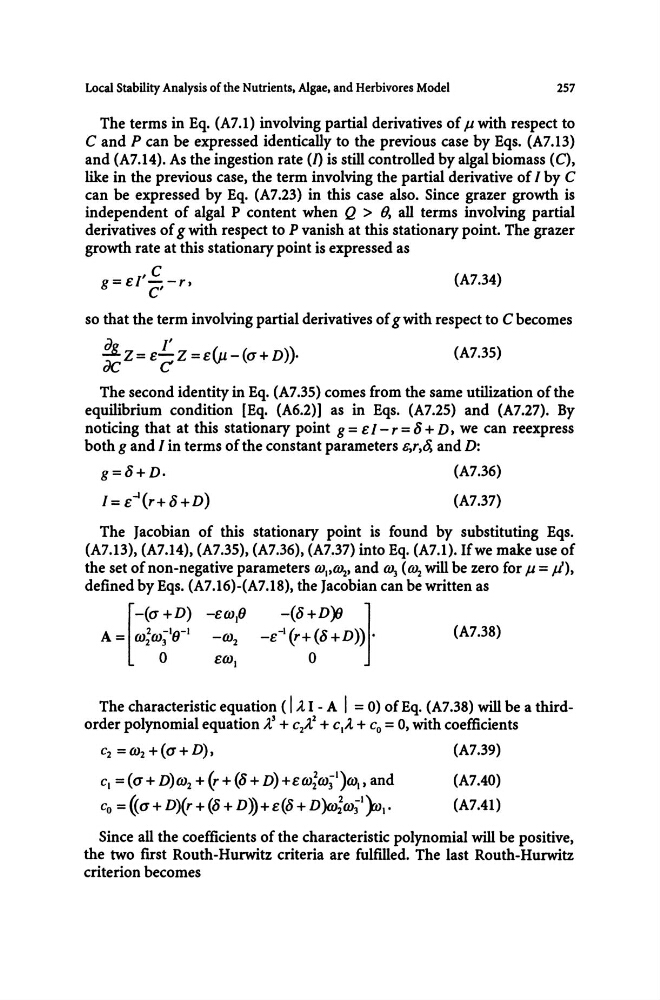
The Jacobian of this stationary point is found by substituting Eqs.
(A7.13), (A7.14), (A7.35), (A7.36), (A7.37) into Eq. (A7.1). Ifwe make use of
the set of non-negative parameters aJ,,~, and ~ (~ will be zero for J.l = tl),
defined by Eqs. (A7.16)-(A7.18), the Jacobian can be written as
[
-(0" +D) -£aJ10
-(~ +D}8 j
A= aJ;aJ;'O-' -aJ 2 -£-'(r+(~+D»)·
o
£aJ 1
0
(A7.38)
The characteristic equation (I A. I - A I = 0) ofEq. (A7.38) will be a thirdorder polynomial equation A. 3 + Ci,,2 + CIA. + Co = 0, with coefficients
C2 = ~ +(0"+ D),
(A7.39)
c, = (0" + D)aJ 2 + (r + (~+ D) +£aJ;aJ;')f»t, and
(A7.40)
CO = «0"+ D)(r+ (~+ D»)+£(~ + D)aJ;aJ;I}o,.
(A7.41)
Since all the coefficients of the characteristic polynomial will be positive,
the two first Routh-Hurwitz criteria are fulfilled. The last Routh-Hurwitz
criterion becomes
257
The terms in Eq. (A7.1) involving partial derivatives of J.l with respect to
e and P can be expressed identically to the previous case by Eqs. (A7.13)
and (A7.14). As the ingestion rate (I) is still controlled by algal biomass (C),
like in the previous case, the term involving the partial derivative of 1 by e
can be expressed by Eq. (A7.23) in this case also. Since grazer growth is
independent of algal P content when Q > 0, all terms involving partial
derivatives of g with respect to P vanish at this stationary point. The grazer
growth rate at this stationary point is expressed as
,e
g =e/--r,
e'
(A7.34)
so that the term involving partial derivatives of g with respect to e becomes
a
I'
!!B.. Z= e- Z =e(p-(O"+ D»).
de
C'
(A7.35)
The second identity in Eq. (A7.35) comes from the same utilization of the
equilibrium condition [Eq. (A6.2)] as in Eqs. (A7.25) and (A7.27). By
noticing that at this stationary point g = e 1- r = ~ + D, we can reexpress
both g and 1 in terms of the constant parameters &,r,~ and D:
g = ~ + D.
(A7.36)
l=e-l(r+~+D)
(A7.37)
The Jacobian of this stationary point is found by substituting Eqs.
(A7.13), (A7.14), (A7.35), (A7.36), (A7.37) into Eq. (A7.1). Ifwe make use of
the set of non-negative parameters aJ,,~, and ~ (~ will be zero for J.l = tl),
defined by Eqs. (A7.16)-(A7.18), the Jacobian can be written as
[
-(0" +D) -£aJ10
-(~ +D}8 j
A= aJ;aJ;'O-' -aJ 2 -£-'(r+(~+D»)·
o
£aJ 1
0
(A7.38)
The characteristic equation (I A. I - A I = 0) ofEq. (A7.38) will be a thirdorder polynomial equation A. 3 + Ci,,2 + CIA. + Co = 0, with coefficients
C2 = ~ +(0"+ D),
(A7.39)
c, = (0" + D)aJ 2 + (r + (~+ D) +£aJ;aJ;')f»t, and
(A7.40)
CO = «0"+ D)(r+ (~+ D»)+£(~ + D)aJ;aJ;I}o,.
(A7.41)
Since all the coefficients of the characteristic polynomial will be positive,
the two first Routh-Hurwitz criteria are fulfilled. The last Routh-Hurwitz
criterion becomes