

Local Stability Analysis of the Nutrients, Algae, and Herbivores Model
255
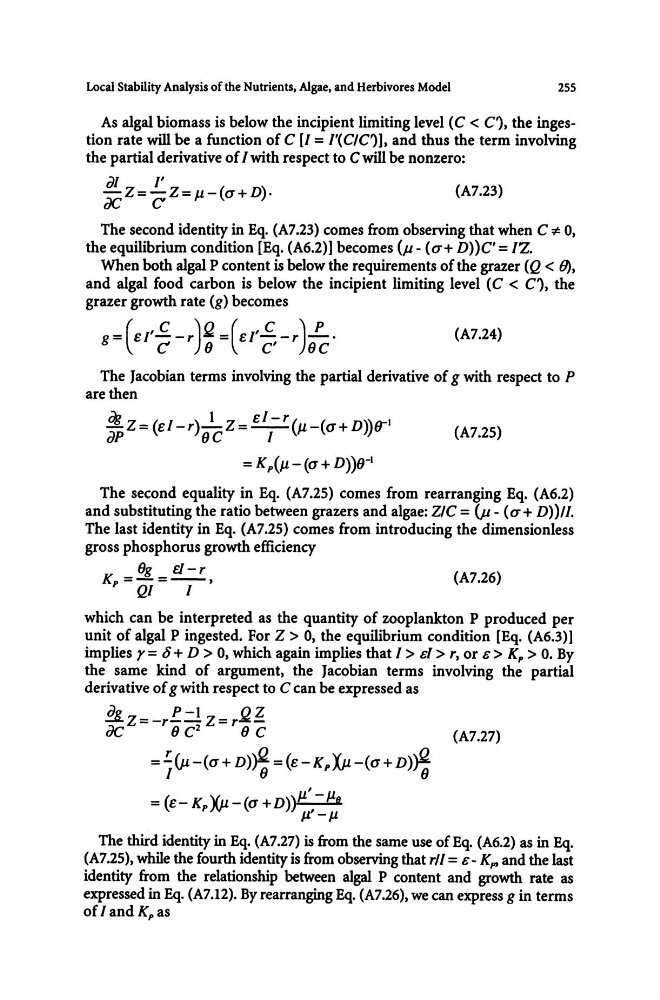
As algal biomass is below the incipient limiting level (C < C~, the ingestion rate will be a function of C [I = I'(CIC~], and thus the term involving
the partial derivative of I with respect to e will be nonzero:
iJl
I'
-Z=-Z=p-(a+D).
(A7.23)
ac c
The second identity in Eq. (A7.23) comes from observing that when C *" 0,
the equilibrium condition [Eq. (A6.2)] becomes (p- (a+ D»C' = IZ.
When both algal P content is below the requirements of the grazer (Q < 0),
and algal food carbon is below the incipient limiting level (C < C~, the
grazer growth rate (g) becomes
g = (e ['.£ - r)~ = (e ['.£ - r)"!".
(A7.24)
C'
8
C'
8e
The Jacobian terms involving the partial derivative of g with respect to P
are then
~ Z = (el_r)_l Z = el-r (J.!-(a+ D»(11
iJP
8C
I
(A7.25)
= K p(p- (a + D»8- 1
The second equality in Eq. (A7.25) comes from rearranging Eq. (A6.2)
and substituting the ratio between grazers and algae: ZIC = (p - (0"+ D»II.
The last identity in Eq. (A7.25) comes from introducing the dimensionless
gross phosphorus growth efficiency
8g Ei-r
K = - = - - ,
p
QI
I
(A7.26)
which can be interpreted as the quantity of zooplankton P produced per
unit of algal P ingested. For Z > 0, the equilibrium condition [Eq. (A6.3)]
implies r = ,5 + D > 0, which again implies that I > &I > r, or & > Kp > O. By
the same kind of argument, the Jacobian terms involving the partial
derivative of gwith respect to C can be expressed as
~Z= -r!. -1 Z= r.Q.~
ac
8 C 2
8 C
(A7.27)
= !(p-(a+ D)~ = (e -Kpw-(a+ D)~
I
8
8
= (e - Kp VII - (a + D»P' - J.!e
N"
P'_P
The third identity in Eq. (A7.27) is from the same use of Eq. (A6.2) as in Eq.
(A7.25), while the fourth identity is from observing that r/l = & - KpJ and the last
identity from the relationship between algal P content and growth rate as
expressed in Eq. (A7.12). By rearranging Eq. (A7.26), we can express g in terms
of land Kpas
255
As algal biomass is below the incipient limiting level (C < C~, the ingestion rate will be a function of C [I = I'(CIC~], and thus the term involving
the partial derivative of I with respect to e will be nonzero:
iJl
I'
-Z=-Z=p-(a+D).
(A7.23)
ac c
The second identity in Eq. (A7.23) comes from observing that when C *" 0,
the equilibrium condition [Eq. (A6.2)] becomes (p- (a+ D»C' = IZ.
When both algal P content is below the requirements of the grazer (Q < 0),
and algal food carbon is below the incipient limiting level (C < C~, the
grazer growth rate (g) becomes
g = (e ['.£ - r)~ = (e ['.£ - r)"!".
(A7.24)
C'
8
C'
8e
The Jacobian terms involving the partial derivative of g with respect to P
are then
~ Z = (el_r)_l Z = el-r (J.!-(a+ D»(11
iJP
8C
I
(A7.25)
= K p(p- (a + D»8- 1
The second equality in Eq. (A7.25) comes from rearranging Eq. (A6.2)
and substituting the ratio between grazers and algae: ZIC = (p - (0"+ D»II.
The last identity in Eq. (A7.25) comes from introducing the dimensionless
gross phosphorus growth efficiency
8g Ei-r
K = - = - - ,
p
QI
I
(A7.26)
which can be interpreted as the quantity of zooplankton P produced per
unit of algal P ingested. For Z > 0, the equilibrium condition [Eq. (A6.3)]
implies r = ,5 + D > 0, which again implies that I > &I > r, or & > Kp > O. By
the same kind of argument, the Jacobian terms involving the partial
derivative of gwith respect to C can be expressed as
~Z= -r!. -1 Z= r.Q.~
ac
8 C 2
8 C
(A7.27)
= !(p-(a+ D)~ = (e -Kpw-(a+ D)~
I
8
8
= (e - Kp VII - (a + D»P' - J.!e
N"
P'_P
The third identity in Eq. (A7.27) is from the same use of Eq. (A6.2) as in Eq.
(A7.25), while the fourth identity is from observing that r/l = & - KpJ and the last
identity from the relationship between algal P content and growth rate as
expressed in Eq. (A7.12). By rearranging Eq. (A7.26), we can express g in terms
of land Kpas