

254
~C = -(p' - J.l).
()C
Appendices
(A7.14)
By substitution of Eq. (A7.12) into (A7.9), we can also reexpress the
grazer growth rate at the stationary point as
g=K'I'~.
J.l' - J.l
(A7.15)
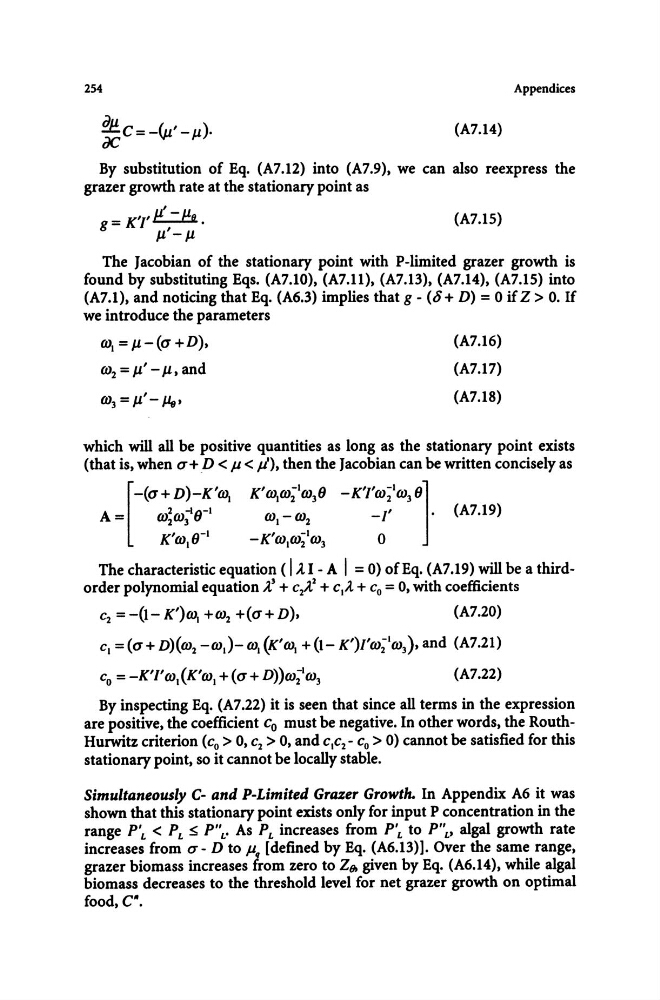
The Jacobian of the stationary point with P-limited grazer growth is
found by substituting Eqs. (A7.10), (A7.11), (A7.13), (A7.14), (A7.15) into
(A7.1), and noticing that Eq. (A6.3) implies that g - (8 + D) = 0 if Z > o. If
we introduce the parameters
WI = J.l-(o- +D),
w 2 = J.l' - J.l, and
W3 = J.l' - Jle,
(A7.16)
(A7.17)
(A7.18)
which will all be positive quantities as long as the stationary point exists
(that is, when 0"+ D < p < p'), then the Jacobian can be written concisely as
[
-(0-+ D)-K'WI K'W I W;IW3 8 -K'I'W;IW38]
A =
W~W;8-1
WI - w 2
- I ' . (A7.19)
K'w 8- 1
-K'w (i)-IW
0
I
I 2
3
The characteristic equation ( I A I - A I = 0) of Eq. (A7.19) will be a thirdorder polynomial equation A' + C 2 A 2 + CIA + Co = 0, with coefficients
C 2 =-(I-K')W I +W2 +(0-+ D),
(A7.20)
C I = (0" + D)(W 2 -wJ- WI (K'W I + (1- K')I'w;IW3 ), and (A7.21)
Co = -K'I'wl(K'w l + (0- + D»)W;IW3
(A7.22)
By inspecting Eq. (A7.22) it is seen that since all terms in the expression
are positive, the coefficient Co must be negative. In other words, the RouthHurwitz criterion (co > 0, c 2 > 0, and C I C 2 - Co > 0) cannot be satisfied for this
stationary point, so it cannot be locally stable.
Simultaneously c- and P-Limited Grazer Growth. In Appendix A6 it was
shown that this stationary point exists only for input P concentration in the
range p
I
L < PL ~ P"L. As P L increases from p
I
L to P"L' algal growth rate
increases from 0" - D to P q [defined by Eq. (A6.13»). Over the same range,
grazer biomass increases from zero to Ze. given by Eq. (A6.14), while algal
biomass decreases to the threshold level for net grazer growth on optimal
food, C·.
~C = -(p' - J.l).
()C
Appendices
(A7.14)
By substitution of Eq. (A7.12) into (A7.9), we can also reexpress the
grazer growth rate at the stationary point as
g=K'I'~.
J.l' - J.l
(A7.15)
The Jacobian of the stationary point with P-limited grazer growth is
found by substituting Eqs. (A7.10), (A7.11), (A7.13), (A7.14), (A7.15) into
(A7.1), and noticing that Eq. (A6.3) implies that g - (8 + D) = 0 if Z > o. If
we introduce the parameters
WI = J.l-(o- +D),
w 2 = J.l' - J.l, and
W3 = J.l' - Jle,
(A7.16)
(A7.17)
(A7.18)
which will all be positive quantities as long as the stationary point exists
(that is, when 0"+ D < p < p'), then the Jacobian can be written concisely as
[
-(0-+ D)-K'WI K'W I W;IW3 8 -K'I'W;IW38]
A =
W~W;8-1
WI - w 2
- I ' . (A7.19)
K'w 8- 1
-K'w (i)-IW
0
I
I 2
3
The characteristic equation ( I A I - A I = 0) of Eq. (A7.19) will be a thirdorder polynomial equation A' + C 2 A 2 + CIA + Co = 0, with coefficients
C 2 =-(I-K')W I +W2 +(0-+ D),
(A7.20)
C I = (0" + D)(W 2 -wJ- WI (K'W I + (1- K')I'w;IW3 ), and (A7.21)
Co = -K'I'wl(K'w l + (0- + D»)W;IW3
(A7.22)
By inspecting Eq. (A7.22) it is seen that since all terms in the expression
are positive, the coefficient Co must be negative. In other words, the RouthHurwitz criterion (co > 0, c 2 > 0, and C I C 2 - Co > 0) cannot be satisfied for this
stationary point, so it cannot be locally stable.
Simultaneously c- and P-Limited Grazer Growth. In Appendix A6 it was
shown that this stationary point exists only for input P concentration in the
range p
I
L < PL ~ P"L. As P L increases from p
I
L to P"L' algal growth rate
increases from 0" - D to P q [defined by Eq. (A6.13»). Over the same range,
grazer biomass increases from zero to Ze. given by Eq. (A6.14), while algal
biomass decreases to the threshold level for net grazer growth on optimal
food, C·.