

Local Stability Analysis of the Nutrients, Algae, and Herbivores Model
253
P-Limited Grazer Growth. In Appendix A6 it was shown that this stationary
point has the property that both algal and grazer biomasses are nonzero (C
> 0 and Z > 0) and proportional to the input P concentration (P t ), while the
algal growth rate (p) is a constant given by Eq. (A6.7), independent of Pt' It
was further shown that the existence of this stationary point (that is, with Z
> 0) requires that p > 0"+ D.
In contrast to the previous two cases, the presence of a nonzero grazer
population means that terms in Eq. (A7.1) involving partial derivatives of g
and I must be evaluated. As food carbon concentration is by definition
nonlimiting to grazer growth at this stationary point, we must have that
C ~ C' and thus I = 1', which means that the partial derivative of I with
respect to C is zero. If we express the grazer growth rate as
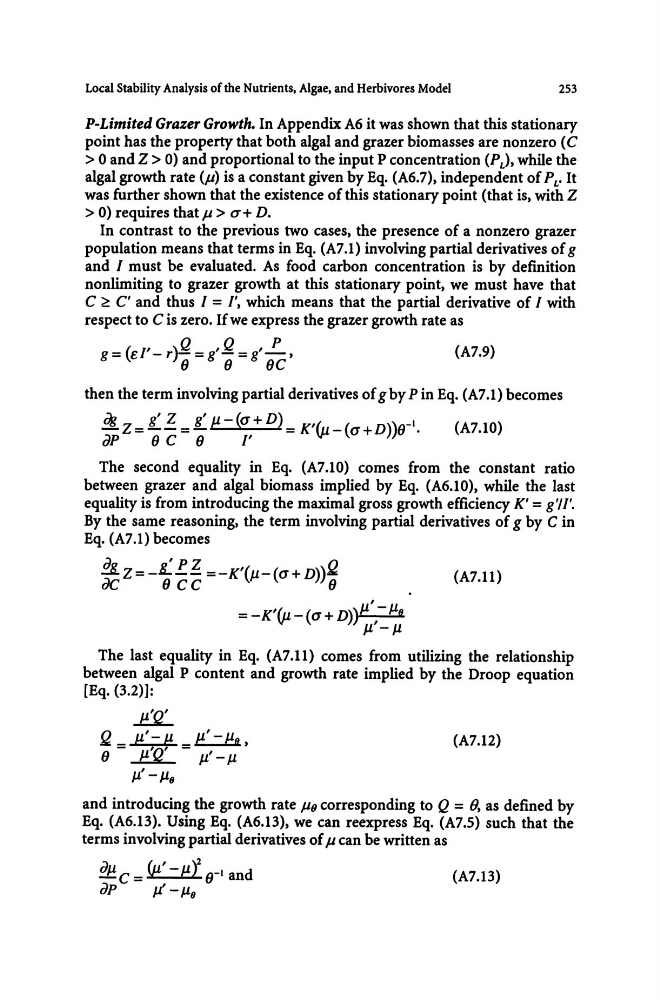
g = (el' - r)Q = g' Q = g'~'
(A7.9)
(J
(J
(JC
then the term involving partial derivatives of g by Pin Eq. (A7.1) becomes
~ z= g' Z = g' J.l-(O"+D)= K'(j1-(O'+D»)(J-l.
(A7.10)
dP
(J C (J
I'
The second equality in Eq. (A7.10) comes from the constant ratio
between grazer and algal biomass implied by Eq. (A6.10), while the last
equality is from introducing the maximal gross growth efficiency K' = g'll'.
By the same reasoning, the term involving partial derivatives of g by C in
Eq. (A7.1) becomes
d
' PZ
~
~Z=-~ CC =-K'(J.l-(O'+D»)(J
(A7.11)
= -K'(}t - (0'+ D»)~,~~
The last equality in Eq. (A7.11) comes from utilizing the relationship
between algal P content and growth rate implied by the Droop equation
[Eq. (3.2)]:
.J!.Q'.....
n '
,
~_ 1l-1l_J.l-J.lI!,
(J - ~ - J.l'-J.l
(A7.12)
J.l' - J.ls
and introducing the growth rate P8 corresponding to Q = 0, as defined by
Eq. (A6.13). Using Eq. (A6.13), we can reexpress Eq. (A7.5) such that the
terms involving partial derivatives of p can be written as
dJ.l C = Cu' - J.lt (J-l and
(A7.13)
dP
J.l' - J.ls
253
P-Limited Grazer Growth. In Appendix A6 it was shown that this stationary
point has the property that both algal and grazer biomasses are nonzero (C
> 0 and Z > 0) and proportional to the input P concentration (P t ), while the
algal growth rate (p) is a constant given by Eq. (A6.7), independent of Pt' It
was further shown that the existence of this stationary point (that is, with Z
> 0) requires that p > 0"+ D.
In contrast to the previous two cases, the presence of a nonzero grazer
population means that terms in Eq. (A7.1) involving partial derivatives of g
and I must be evaluated. As food carbon concentration is by definition
nonlimiting to grazer growth at this stationary point, we must have that
C ~ C' and thus I = 1', which means that the partial derivative of I with
respect to C is zero. If we express the grazer growth rate as
g = (el' - r)Q = g' Q = g'~'
(A7.9)
(J
(J
(JC
then the term involving partial derivatives of g by Pin Eq. (A7.1) becomes
~ z= g' Z = g' J.l-(O"+D)= K'(j1-(O'+D»)(J-l.
(A7.10)
dP
(J C (J
I'
The second equality in Eq. (A7.10) comes from the constant ratio
between grazer and algal biomass implied by Eq. (A6.10), while the last
equality is from introducing the maximal gross growth efficiency K' = g'll'.
By the same reasoning, the term involving partial derivatives of g by C in
Eq. (A7.1) becomes
d
' PZ
~
~Z=-~ CC =-K'(J.l-(O'+D»)(J
(A7.11)
= -K'(}t - (0'+ D»)~,~~
The last equality in Eq. (A7.11) comes from utilizing the relationship
between algal P content and growth rate implied by the Droop equation
[Eq. (3.2)]:
.J!.Q'.....
n '
,
~_ 1l-1l_J.l-J.lI!,
(J - ~ - J.l'-J.l
(A7.12)
J.l' - J.ls
and introducing the growth rate P8 corresponding to Q = 0, as defined by
Eq. (A6.13). Using Eq. (A6.13), we can reexpress Eq. (A7.5) such that the
terms involving partial derivatives of p can be written as
dJ.l C = Cu' - J.lt (J-l and
(A7.13)
dP
J.l' - J.ls