

252
Appendices
therefore be locally unstable. On the other hand, when D > Ii - 0; all
eigenvalues will be negative, so that the washout condition will be locally
stable, as can be expected. This means that a small inoculum of algae and
grazers will be able to invade a sterile system, unless the dilution rate is so
high that the algae are unable to balance the losses through the outflow.
The Grazer Extinction Point. This stationary point has the property that grazer
biomass is zero (Z = 0), which means that all terms involving Z in Eq. (A7.1) will
also be zero. Since algal biomass is non-zero (C * 0), Eq. (A6.2) implies that
algal growth must be equal to dilution and sedimentation losses (JJ = u + D).
Nonzero algal biomass (C) means that we cannot eliminate the partial
derivatives of J.I as in the previous case. If the Droop equation [Eq. (3.2)J is
written as
Jl= Jl{I-Q'~}
(A7.4)
then the terms in Eq. (A7.1) involving the partial derivatives of J.I with
respect to P and C can be expressed as
~C = 'Q,(C)2 =_1_( '(1 C)2 = VI -Jlt
(A7.5)
iJP
Jl
P
Jl'Q' Jl P
Jl'Q'
~C= -Jl'Q,f = -(p' -Jl).
iJC
P
(A7.6)
The right most identities in Eqs. (A7.5), (A7.6) comes from solving Eq.
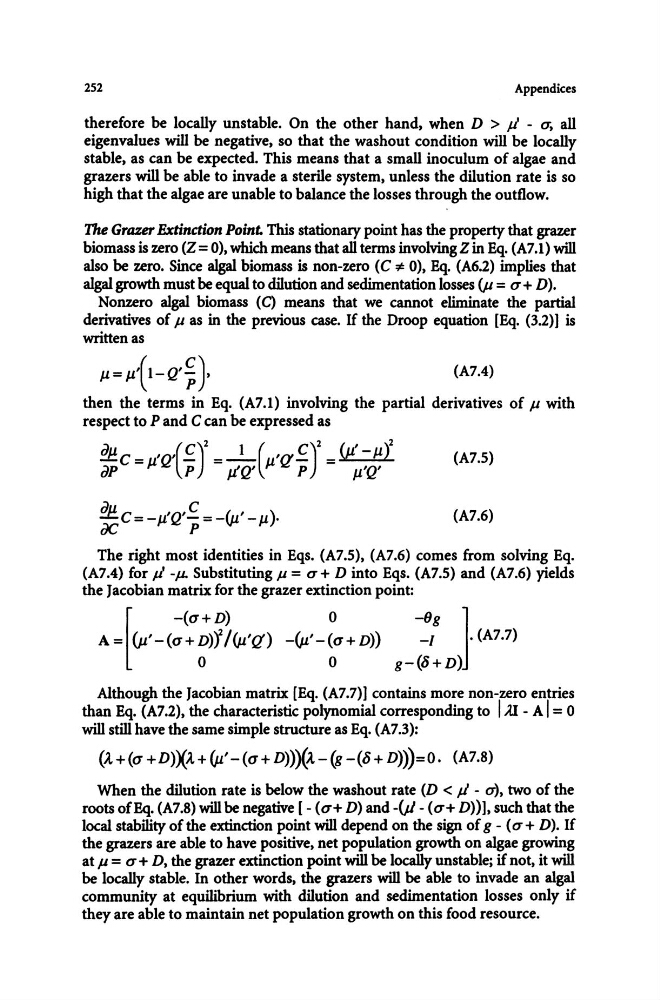
(A7.4) for Ii -p. Substituting J..l = u + D into Eqs. (A7.5) and (A7.6) yields
the Jacobian matrix for the grazer extinction point:
[
~a+~
0
~g ]
A= (p.'-(a+D)t/(p'Q') -(p'-(a+D»
-/
. (A7.7)
o
0
g-(~+D)
Although the Jacobian matrix [Eq. (A7.7)J contains more non-zero entries
than Eq. (A7.2), the characteristic polynomial corresponding to IAI -A I = 0
will still have the same simple structure as Eq. (A7.3):
(A.+(a +D)XA.+ (p' -(a+D»)(A.-(g -(~+ D»)=O. (A7.8)
When the dilution rate is below the washout rate (D < Ii - en, two of the
roots ofEq. (A7.8) will be negative [ - (u+ D) and -{J1- (u+ D)}J, such that the
local stability of the extinction point will depend on the sign of g - (u + D). If
the grazers are able to have positive, net population growth on algae growing
at J.I = a + D, the grazer extinction point will be locally unstable; if not, it will
be locally stable. In other words, the grazers will be able to invade an algal
community at equilibrium with dilution and sedimentation losses only if
they are able to maintain net population growth on this food resource.
Appendices
therefore be locally unstable. On the other hand, when D > Ii - 0; all
eigenvalues will be negative, so that the washout condition will be locally
stable, as can be expected. This means that a small inoculum of algae and
grazers will be able to invade a sterile system, unless the dilution rate is so
high that the algae are unable to balance the losses through the outflow.
The Grazer Extinction Point. This stationary point has the property that grazer
biomass is zero (Z = 0), which means that all terms involving Z in Eq. (A7.1) will
also be zero. Since algal biomass is non-zero (C * 0), Eq. (A6.2) implies that
algal growth must be equal to dilution and sedimentation losses (JJ = u + D).
Nonzero algal biomass (C) means that we cannot eliminate the partial
derivatives of J.I as in the previous case. If the Droop equation [Eq. (3.2)J is
written as
Jl= Jl{I-Q'~}
(A7.4)
then the terms in Eq. (A7.1) involving the partial derivatives of J.I with
respect to P and C can be expressed as
~C = 'Q,(C)2 =_1_( '(1 C)2 = VI -Jlt
(A7.5)
iJP
Jl
P
Jl'Q' Jl P
Jl'Q'
~C= -Jl'Q,f = -(p' -Jl).
iJC
P
(A7.6)
The right most identities in Eqs. (A7.5), (A7.6) comes from solving Eq.
(A7.4) for Ii -p. Substituting J..l = u + D into Eqs. (A7.5) and (A7.6) yields
the Jacobian matrix for the grazer extinction point:
[
~a+~
0
~g ]
A= (p.'-(a+D)t/(p'Q') -(p'-(a+D»
-/
. (A7.7)
o
0
g-(~+D)
Although the Jacobian matrix [Eq. (A7.7)J contains more non-zero entries
than Eq. (A7.2), the characteristic polynomial corresponding to IAI -A I = 0
will still have the same simple structure as Eq. (A7.3):
(A.+(a +D)XA.+ (p' -(a+D»)(A.-(g -(~+ D»)=O. (A7.8)
When the dilution rate is below the washout rate (D < Ii - en, two of the
roots ofEq. (A7.8) will be negative [ - (u+ D) and -{J1- (u+ D)}J, such that the
local stability of the extinction point will depend on the sign of g - (u + D). If
the grazers are able to have positive, net population growth on algae growing
at J.I = a + D, the grazer extinction point will be locally unstable; if not, it will
be locally stable. In other words, the grazers will be able to invade an algal
community at equilibrium with dilution and sedimentation losses only if
they are able to maintain net population growth on this food resource.