

Local Stability Analysis of the Nutrients. Algae. and Herbivores Model
251
possible in only very special cases for n > 3, and usually leads to very complex expressions, even for n > 2). The Routh-Hurwitz criterion (see
Luenberger 1979) gives information on the signs of the roots of a polynomial just from relations between the coefficients of the polynomial. For the
third-order equation that will appear repeatedly in the forthcoming sections, the Routh-Hurwitz criterion can be stated as: the roots of the characteristic polynomial A,' + C 2 A,2 + CIA, + Co = 0 will all have negative real parts,
if the coefficients are such that Co > 0, C 2 > 0, and CoC2 - co> o.
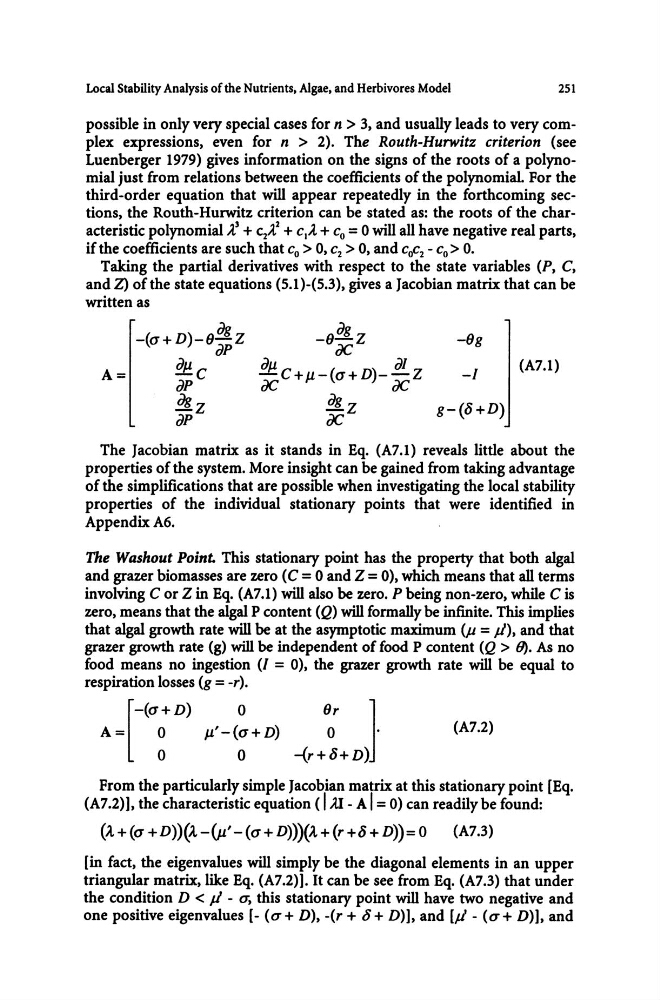
Taking the partial derivatives with respect to the state variables (P, C,
and Z) of the state equations (5.1)-(5.3), gives a Jacobian matrix that can be
written as
dg
dg
-8g
-«(1+ D)-8-Z
-8-Z
ap
ac
A=
!!l!:.c
ap,
aJ
-J
(A7.1)
-C+p,-«(1+D)--Z
ap
ac
ac
dgz
ap
dgz
ac
g-(8+D)
The Jacobian matrix as it stands in Eq. (A7.1) reveals little about the
properties of the system. More insight can be gained from taking advantage
of the simplifications that are possible when investigating the local stability
properties of the individual stationary points that were identified in
Appendix A6.
The Washout Point. This stationary point has the property that both algal
and grazer biomasses are zero (C = 0 and Z = 0), which means that all terms
involving Cor Z in Eq. (A7.1) will also be zero. P being non-zero, while Cis
zero, means that the algal P content (Q) will formally be infinite. This implies
that algal growth rate will be at the asymptotic maximum (p = Ji), and that
grazer growth rate (g) will be independent of food P content (Q > (/). As no
food means no ingestion (I = 0), the grazer growth rate will be equal to
respiration losses (g = -r).
[
-«(1+ D)
0
8 r ]
A=
0
p,'-«(1+D)
0
.
o
0
-(r+8+D)
(A7.2)
From the particularly simple Jacobian matrix at this stationary point [Eq.
(A7.2»), the characteristic equation (I AI - A 1= 0) can readily be found:
(.t +«(1 +D»(.t -(p,' -«(1+ D»)(.t+(r +8 + D» = 0 (A7.3)
[in fact, the eigenvalues will simply be the diagonal elements in an upper
triangular matrix, like Eq. (A7.2»). It can be see from Eq. (A7.3) that under
the condition D < Ji - 0; this stationary point will have two negative and
one positive eigenvalues [- (0'+ D), -(r + 6 + D»), and [Ji - (0'+ D»), and
251
possible in only very special cases for n > 3, and usually leads to very complex expressions, even for n > 2). The Routh-Hurwitz criterion (see
Luenberger 1979) gives information on the signs of the roots of a polynomial just from relations between the coefficients of the polynomial. For the
third-order equation that will appear repeatedly in the forthcoming sections, the Routh-Hurwitz criterion can be stated as: the roots of the characteristic polynomial A,' + C 2 A,2 + CIA, + Co = 0 will all have negative real parts,
if the coefficients are such that Co > 0, C 2 > 0, and CoC2 - co> o.
Taking the partial derivatives with respect to the state variables (P, C,
and Z) of the state equations (5.1)-(5.3), gives a Jacobian matrix that can be
written as
dg
dg
-8g
-«(1+ D)-8-Z
-8-Z
ap
ac
A=
!!l!:.c
ap,
aJ
-J
(A7.1)
-C+p,-«(1+D)--Z
ap
ac
ac
dgz
ap
dgz
ac
g-(8+D)
The Jacobian matrix as it stands in Eq. (A7.1) reveals little about the
properties of the system. More insight can be gained from taking advantage
of the simplifications that are possible when investigating the local stability
properties of the individual stationary points that were identified in
Appendix A6.
The Washout Point. This stationary point has the property that both algal
and grazer biomasses are zero (C = 0 and Z = 0), which means that all terms
involving Cor Z in Eq. (A7.1) will also be zero. P being non-zero, while Cis
zero, means that the algal P content (Q) will formally be infinite. This implies
that algal growth rate will be at the asymptotic maximum (p = Ji), and that
grazer growth rate (g) will be independent of food P content (Q > (/). As no
food means no ingestion (I = 0), the grazer growth rate will be equal to
respiration losses (g = -r).
[
-«(1+ D)
0
8 r ]
A=
0
p,'-«(1+D)
0
.
o
0
-(r+8+D)
(A7.2)
From the particularly simple Jacobian matrix at this stationary point [Eq.
(A7.2»), the characteristic equation (I AI - A 1= 0) can readily be found:
(.t +«(1 +D»(.t -(p,' -«(1+ D»)(.t+(r +8 + D» = 0 (A7.3)
[in fact, the eigenvalues will simply be the diagonal elements in an upper
triangular matrix, like Eq. (A7.2»). It can be see from Eq. (A7.3) that under
the condition D < Ji - 0; this stationary point will have two negative and
one positive eigenvalues [- (0'+ D), -(r + 6 + D»), and [Ji - (0'+ D»), and