

mements of Age Distribution Theory
243
-
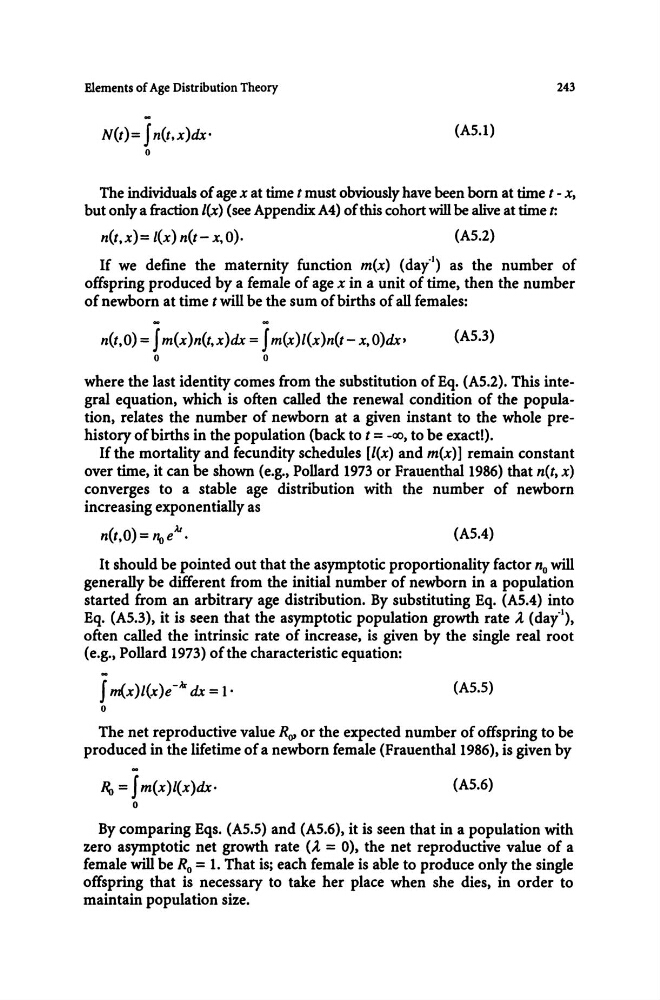
N(t) = J n(t,x)dx'
(AS. I)
o
The individuals of age x at time t must obviously have been born at time t - x,
but only a fraction lex) (see Appendix A4) of this cohort will be alive at time t:
n(t,x)= l(x) n(t- x, 0).
(AS.2)
If we define the maternity function m(x) (day"l) as the number of
offspring produced by a female of age x in a unit of time, then the number
of newborn at time t will be the sum of births of all females:
-
-
n(t,O) = J m(x)n(t,x)dx = J m(x)l(x)n(t- x,O)dx,
(AS.3)
o
0
where the last identity comes from the substitution of Eq. (AS.2). This integral equation, which is often called the renewal condition of the population, relates the number of newborn at a given instant to the whole prehistory of births in the population (back to t = -00, to be exact!).
If the mortality and fecundity schedules [lex) and m(x)] remain constant
over time, it can be shown (e.g., Pollard 1973 or Frauenthall986) that net, x)
converges to a stable age distribution with the number of newborn
increasing exponentially as
n(t,O) = 110 i ' .
(AS.4)
It should be pointed out that the asymptotic proportionality factor no will
generally be different from the initial number of newborn in a population
started from an arbitrary age distribution. By substituting Eq. (AS.4) into
Eq. (AS.3), it is seen that the asymptotic population growth rate A. (day"I),
often called the intrinsic rate of increase, is given by the single real root
(e.g., Pollard 1973) of the characteristic equation:
-
J m(x)l(x)e- k dx = 1·
(AS.S)
o
The net reproductive value Rot or the expected number of offspring to be
produced in the lifetime of a newborn female (FrauenthalI986), is given by
-
~ = J m(x)l(x)dx·
(AS.6)
o
By comparing Eqs. (AS.5) and (AS.6), it is seen that in a population with
zero asymptotic net growth rate (A. = 0), the net reproductive value of a
female will be Ro = 1. That is; each female is able to produce only the single
offspring that is necessary to take her place when she dies, in order to
maintain population size.
243
-
N(t) = J n(t,x)dx'
(AS. I)
o
The individuals of age x at time t must obviously have been born at time t - x,
but only a fraction lex) (see Appendix A4) of this cohort will be alive at time t:
n(t,x)= l(x) n(t- x, 0).
(AS.2)
If we define the maternity function m(x) (day"l) as the number of
offspring produced by a female of age x in a unit of time, then the number
of newborn at time t will be the sum of births of all females:
-
-
n(t,O) = J m(x)n(t,x)dx = J m(x)l(x)n(t- x,O)dx,
(AS.3)
o
0
where the last identity comes from the substitution of Eq. (AS.2). This integral equation, which is often called the renewal condition of the population, relates the number of newborn at a given instant to the whole prehistory of births in the population (back to t = -00, to be exact!).
If the mortality and fecundity schedules [lex) and m(x)] remain constant
over time, it can be shown (e.g., Pollard 1973 or Frauenthall986) that net, x)
converges to a stable age distribution with the number of newborn
increasing exponentially as
n(t,O) = 110 i ' .
(AS.4)
It should be pointed out that the asymptotic proportionality factor no will
generally be different from the initial number of newborn in a population
started from an arbitrary age distribution. By substituting Eq. (AS.4) into
Eq. (AS.3), it is seen that the asymptotic population growth rate A. (day"I),
often called the intrinsic rate of increase, is given by the single real root
(e.g., Pollard 1973) of the characteristic equation:
-
J m(x)l(x)e- k dx = 1·
(AS.S)
o
The net reproductive value Rot or the expected number of offspring to be
produced in the lifetime of a newborn female (FrauenthalI986), is given by
-
~ = J m(x)l(x)dx·
(AS.6)
o
By comparing Eqs. (AS.5) and (AS.6), it is seen that in a population with
zero asymptotic net growth rate (A. = 0), the net reproductive value of a
female will be Ro = 1. That is; each female is able to produce only the single
offspring that is necessary to take her place when she dies, in order to
maintain population size.