

Elemental Composition and Allocation Constraints
235
(A3.3)
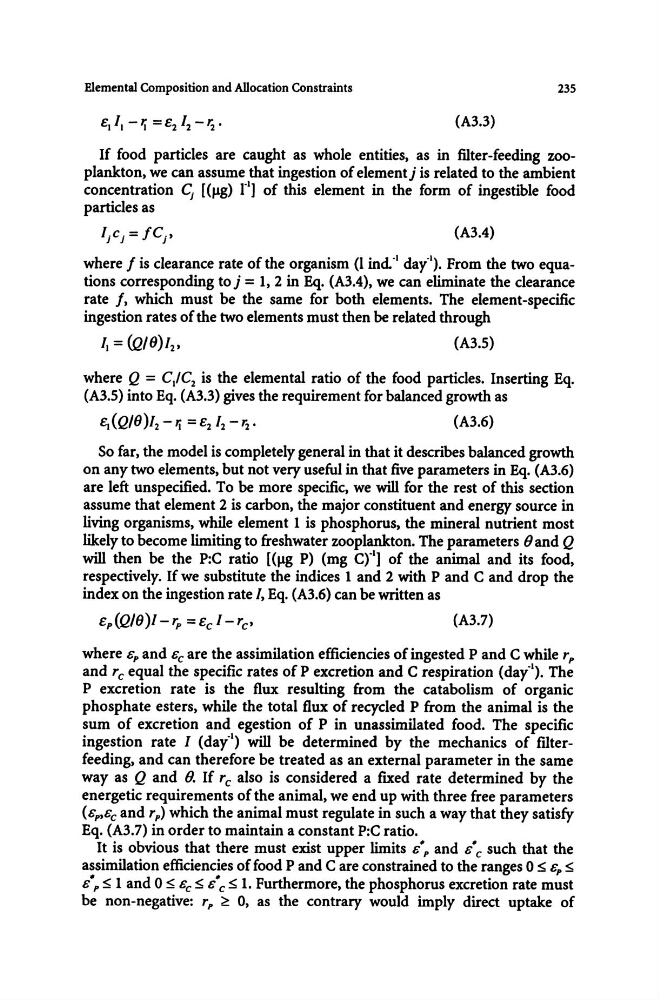
If food particles are caught as whole entities, as in filter-feeding zooplankton, we can assume that ingestion of elementj is related to the ambient
concentration ~ [(1lS) rl] of this element in the form of ingestible food
particles as
Ijc j = jC j ,
(A3.4)
where j is clearance rate of the organism (1 ind.-I day"l). From the two equations corresponding to j = 1, 2 in Eq. (A3.4), we can eliminate the clearance
rate j, which must be the same for both elements. The element-specific
ingestion rates of the two elements must then be related through
I( = (Q/6)/ 2 ,
(A3.5)
where Q = C/C 2 is the elemental ratio of the food particles. Inserting Eq.
(A3.5) into Eq. (A3.3) gives the requirement for balanced growth as
£( (Q/6 )1 2 -1j = £2 12 - '2 •
(A3.6)
So far, the model is completely general in that it describes balanced growth
on any two elements, but not very useful in that five parameters in Eq. (A3.6)
are left unspecified. To be more specific, we will for the rest of this section
assume that element 2 is carbon, the major constituent and energy source in
living organisms, while element 1 is phosphorus, the mineral nutrient most
likely to become limiting to freshwater zooplankton. The parameters (J and Q
will then be the P:C ratio [(~g P) (mg ct] of the animal and its food,
respectively. If we substitute the indices 1 and 2 with P and C and drop the
index on the ingestion rate I, Eq. (A3.6) can be written as
£p (Q/6)1 - rp = Ee 1- r e ,
(A3.7)
where Cp and c e are the assimilation efficiencies of ingested P and C while rp
and rc equal the specific rates of P excretion and C respiration (day"I). The
P excretion rate is the flux resulting from the catabolism of organic
phosphate esters, while the total flux of recycled P from the animal is the
sum of excretion and egestion of P in unassimilated food. The specific
ingestion rate I (day"l) will be determined by the mechanics of filterfeeding, and can therefore be treated as an external parameter in the same
way as Q and (J. If re also is considered a fixed rate determined by the
energetic requirements of the animal, we end up with three free parameters
(cp,c e and rp) which the animal must regulate in such a way that they satisfy
Eq. (A3.7) in order to maintain a constant P:C ratio.
It is obvious that there must exist upper limits c~p and c~c such that the
assimilation efficiencies of food P and C are constrained to the ranges 0 ~ cp ~
c·p ~ 1 and 0 ~ Cc ~ c~e ~ 1. Furthermore, the phosphorus excretion rate must
be non-negative: rp ~ 0, as the contrary would imply direct uptake of
235
(A3.3)
If food particles are caught as whole entities, as in filter-feeding zooplankton, we can assume that ingestion of elementj is related to the ambient
concentration ~ [(1lS) rl] of this element in the form of ingestible food
particles as
Ijc j = jC j ,
(A3.4)
where j is clearance rate of the organism (1 ind.-I day"l). From the two equations corresponding to j = 1, 2 in Eq. (A3.4), we can eliminate the clearance
rate j, which must be the same for both elements. The element-specific
ingestion rates of the two elements must then be related through
I( = (Q/6)/ 2 ,
(A3.5)
where Q = C/C 2 is the elemental ratio of the food particles. Inserting Eq.
(A3.5) into Eq. (A3.3) gives the requirement for balanced growth as
£( (Q/6 )1 2 -1j = £2 12 - '2 •
(A3.6)
So far, the model is completely general in that it describes balanced growth
on any two elements, but not very useful in that five parameters in Eq. (A3.6)
are left unspecified. To be more specific, we will for the rest of this section
assume that element 2 is carbon, the major constituent and energy source in
living organisms, while element 1 is phosphorus, the mineral nutrient most
likely to become limiting to freshwater zooplankton. The parameters (J and Q
will then be the P:C ratio [(~g P) (mg ct] of the animal and its food,
respectively. If we substitute the indices 1 and 2 with P and C and drop the
index on the ingestion rate I, Eq. (A3.6) can be written as
£p (Q/6)1 - rp = Ee 1- r e ,
(A3.7)
where Cp and c e are the assimilation efficiencies of ingested P and C while rp
and rc equal the specific rates of P excretion and C respiration (day"I). The
P excretion rate is the flux resulting from the catabolism of organic
phosphate esters, while the total flux of recycled P from the animal is the
sum of excretion and egestion of P in unassimilated food. The specific
ingestion rate I (day"l) will be determined by the mechanics of filterfeeding, and can therefore be treated as an external parameter in the same
way as Q and (J. If re also is considered a fixed rate determined by the
energetic requirements of the animal, we end up with three free parameters
(cp,c e and rp) which the animal must regulate in such a way that they satisfy
Eq. (A3.7) in order to maintain a constant P:C ratio.
It is obvious that there must exist upper limits c~p and c~c such that the
assimilation efficiencies of food P and C are constrained to the ranges 0 ~ cp ~
c·p ~ 1 and 0 ~ Cc ~ c~e ~ 1. Furthermore, the phosphorus excretion rate must
be non-negative: rp ~ 0, as the contrary would imply direct uptake of