

236
Appendices
dissolved P from the water phase. Within these constraints, there are still
infinitely many ways in which animals may adjust the free parameters to
conform with Eq. (A3.7).
It is also reasonable that there should be an optimal food composition Q.
that allows maximum utilization of both P and C in the food; that is, &, = &-,
and &c = &-c when Q = Q*. Among possible models describing adjustment to
non-optimal food composition, a particularly simple formulation results
from assuming a switching mechanism similar to the Liebig law of the
minimum: assimilation efficiency is maximal for the element least in supply.
This can be stated more formally as: Q ~ Q* implies that &,!:O &-, and &c = &-0
while Q!:O Q* implies that &, = &*, and &c!:O &-c
If we focus on the effects on zooplankton growth of a suboptimal food P
content, we need only to consider the case Q !:O Q*. Under the assumption that P
assimilation is maximal when P is least in supply, Eq. (A3.7) can be written as
e c 1- rc = e;(QIO)/- rp!:O e;(Q*/O)/- rp'
(A3.8)
O+-------~~~~~------~~----~
o
ec
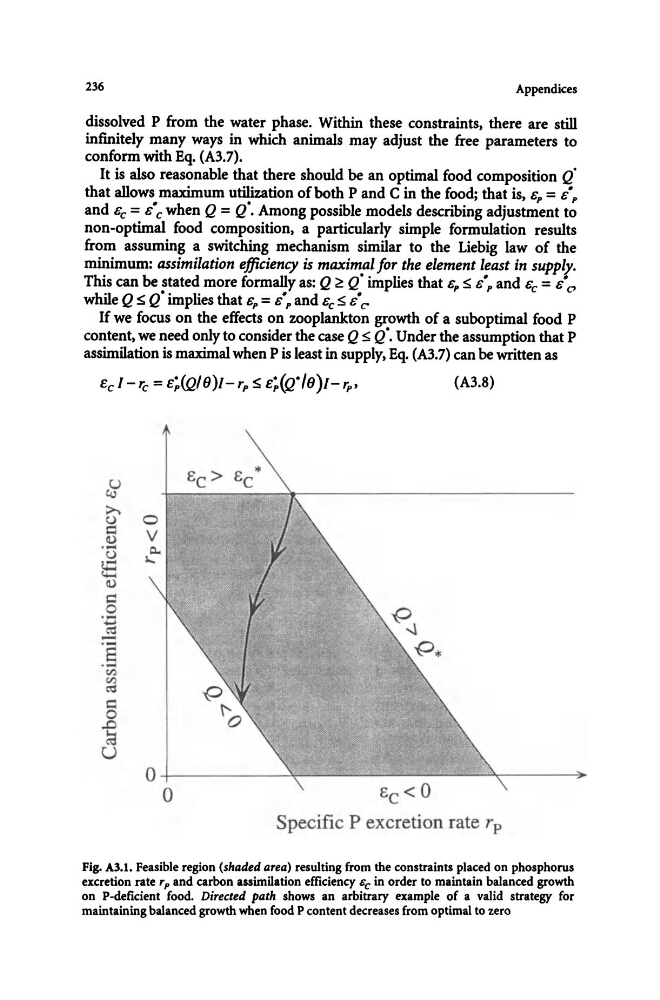
Fig. A3.1. Feasible region (shaded area) resulting from the constraints placed on phosphorus
excretion rate r, and carbon assimilation efficiency &c in order to maintain balanced growth
on P-deficient food. Directed path shows an arbitrary example of a valid strategy for
maintaining balanced growth when food P content decreases from optimal to zero
Appendices
dissolved P from the water phase. Within these constraints, there are still
infinitely many ways in which animals may adjust the free parameters to
conform with Eq. (A3.7).
It is also reasonable that there should be an optimal food composition Q.
that allows maximum utilization of both P and C in the food; that is, &, = &-,
and &c = &-c when Q = Q*. Among possible models describing adjustment to
non-optimal food composition, a particularly simple formulation results
from assuming a switching mechanism similar to the Liebig law of the
minimum: assimilation efficiency is maximal for the element least in supply.
This can be stated more formally as: Q ~ Q* implies that &,!:O &-, and &c = &-0
while Q!:O Q* implies that &, = &*, and &c!:O &-c
If we focus on the effects on zooplankton growth of a suboptimal food P
content, we need only to consider the case Q !:O Q*. Under the assumption that P
assimilation is maximal when P is least in supply, Eq. (A3.7) can be written as
e c 1- rc = e;(QIO)/- rp!:O e;(Q*/O)/- rp'
(A3.8)
O+-------~~~~~------~~----~
o
ec
Fig. A3.1. Feasible region (shaded area) resulting from the constraints placed on phosphorus
excretion rate r, and carbon assimilation efficiency &c in order to maintain balanced growth
on P-deficient food. Directed path shows an arbitrary example of a valid strategy for
maintaining balanced growth when food P content decreases from optimal to zero