

234
Appendices
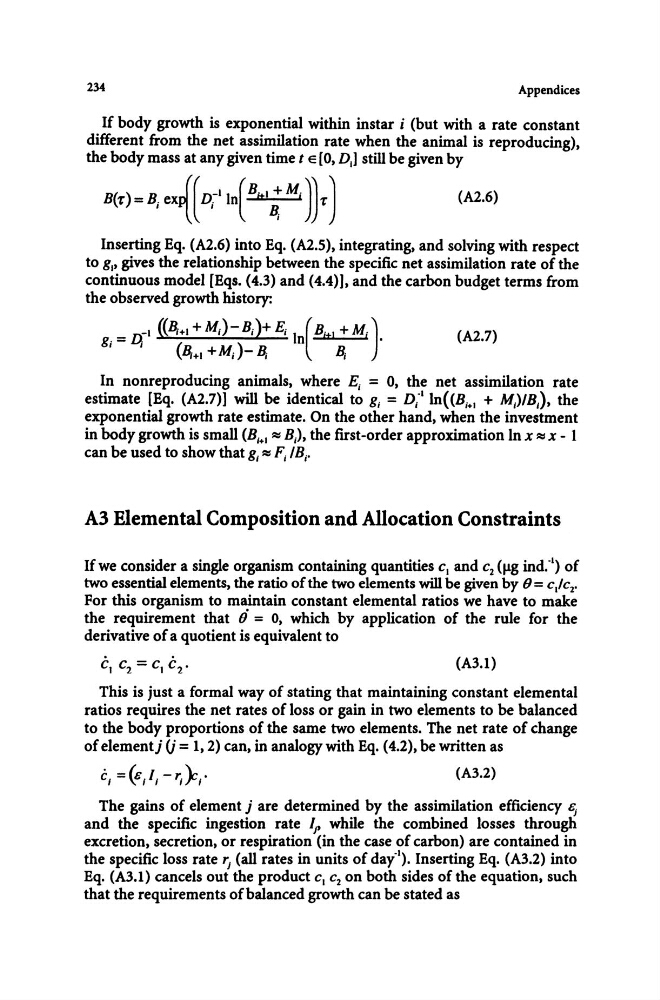
If body growth is exponential within instar i (but with a rate constant
different from the net assimilation rate when the animal is reproducing),
the body mass at any given time t E [0, DJ still be given by
(A2.6)
Inserting Eq. (A2.6) into Eq. (A2.5), integrating, and solving with respect
to g., gives the relationship between the specific net assimilation rate of the
continuous model [Eqs. (4.3) and (4.4»), and the carbon budget terms from
the observed growth history:
g;=~-l «(~+l+M;)-~)+E; In(Bi±!+Mt).
(A2.7)
(~+l +M;) ~
~
In nonreproducing animals, where E; = 0, the net assimilation rate
estimate [Eq. (A2.7») will be identical to gj = D;t In(B;+. + Mt)/BJ, the
exponential growth rate estimate. On the other hand, when the investment
in body growth is small (BI+ I ~ B), the first-order approximation In x ~ x-I
can be used to show that gl ~ F; / B;.
A3 Elemental Composition and Allocation Constraints
If we consider a single organism containing quantities c i and c 2 (J.1g ind: l ) of
two essential elements, the ratio of the two elements will be given by 0= c/c r
For this organism to maintain constant elemental ratios we have to make
the requirement that ti = 0, which by application of the rule for the
derivative of a quotient is equivalent to
(A3.1)
This is just a formal way of stating that maintaining constant elemental
ratios requires the net rates of loss or gain in two elements to be balanced
to the body proportions of the same two elements. The net rate of change
of elementj (j = 1,2) can, in analogy with Eq. (4.2), be written as
(;/ = (&J/ - rJc;.
(A3.2)
The gains of element j are determined by the assimilation efficiency ~
and the specific ingestion rate 11' while the combined losses through
excretion, secretion, or respiration (in the case of carbon) are contained in
the specific loss rate r J (all rates in units of day"I). Inserting Eq. (A3.2) into
Eq. (A3.1) cancels out the product c. C 2 on both sides of the equation, such
that the requirements of balanced growth can be stated as
Appendices
If body growth is exponential within instar i (but with a rate constant
different from the net assimilation rate when the animal is reproducing),
the body mass at any given time t E [0, DJ still be given by
(A2.6)
Inserting Eq. (A2.6) into Eq. (A2.5), integrating, and solving with respect
to g., gives the relationship between the specific net assimilation rate of the
continuous model [Eqs. (4.3) and (4.4»), and the carbon budget terms from
the observed growth history:
g;=~-l «(~+l+M;)-~)+E; In(Bi±!+Mt).
(A2.7)
(~+l +M;) ~
~
In nonreproducing animals, where E; = 0, the net assimilation rate
estimate [Eq. (A2.7») will be identical to gj = D;t In(B;+. + Mt)/BJ, the
exponential growth rate estimate. On the other hand, when the investment
in body growth is small (BI+ I ~ B), the first-order approximation In x ~ x-I
can be used to show that gl ~ F; / B;.
A3 Elemental Composition and Allocation Constraints
If we consider a single organism containing quantities c i and c 2 (J.1g ind: l ) of
two essential elements, the ratio of the two elements will be given by 0= c/c r
For this organism to maintain constant elemental ratios we have to make
the requirement that ti = 0, which by application of the rule for the
derivative of a quotient is equivalent to
(A3.1)
This is just a formal way of stating that maintaining constant elemental
ratios requires the net rates of loss or gain in two elements to be balanced
to the body proportions of the same two elements. The net rate of change
of elementj (j = 1,2) can, in analogy with Eq. (4.2), be written as
(;/ = (&J/ - rJc;.
(A3.2)
The gains of element j are determined by the assimilation efficiency ~
and the specific ingestion rate 11' while the combined losses through
excretion, secretion, or respiration (in the case of carbon) are contained in
the specific loss rate r J (all rates in units of day"I). Inserting Eq. (A3.2) into
Eq. (A3.1) cancels out the product c. C 2 on both sides of the equation, such
that the requirements of balanced growth can be stated as