

Allocation Rates and Growth History Data
233
A2 Allocation Rates and Growth History Data
In a typical Daphnia life table experiment, a cohort of animals are reared in
separate vessels, and individual growth and reproduction are monitored
from birth to death. While reproduction can be quantified directly by
collecting produced offspring, body growth can only be measured nondestructively by indirect methods, such as carapace length measurements and
length-weight regressions. As eggs are extruded and carapace is expanded
simultaneously at molt time in cladocerans, neither reproduction nor
somatic growth can be observed between instar transitions.
The growth history of a single cohort member in a life table experiment
can be represented by a sequence of instar durations (D!, D 2 , ••• ) and the
corresponding sequences of carbon budget terms for each instar:
B!, B 2 ,...
body mass at the start of each instar.
E!, E 2 ,...
egg mass produced during each instar.
M!, M 2 ,...
body mass lost by molting at the end of each instar.
While the molting losses in principle could be observed directly be
collecting cast-off exuviae, practice has been to estimate molt size indirectly
from carapace length [Eqs. (4.6), (4.7)].
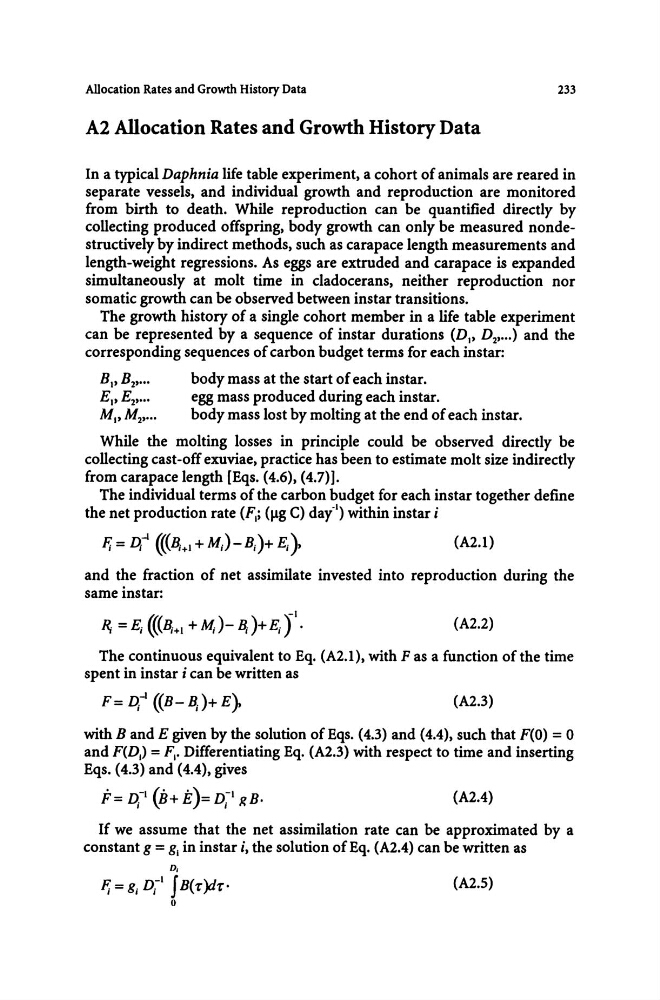
The individual terms of the carbon budget for each instar together define
the net production rate (FI; (Ilg C) day·!) within instar i
(A2.I)
and the fraction of net assimilate invested into reproduction during the
same instar:
(A2.2)
The continuous equivalent to Eq. (A2.I), with F as a function of the time
spent in instar i can be written as
F= ~-1 (B-B;)+E}
(A2.3)
with Band E given by the solution of Eqs. (4.3) and (4.4), such that F(O) = 0
and F(D I ) = Fl' Differentiating Eq. (A2.3) with respect to time and inserting
Eqs. (4.3) and (4.4), gives
F= ~-I (iJ+E)=D;' KB.
(A2.4)
If we assume that the net assimilation rate can be approximated by a
constant g = gl in instar i, the solution ofEq. (A2.4) can be written as
D,
F; = gj Dj - ' f B(r}d-r·
(A2.S)
o
233
A2 Allocation Rates and Growth History Data
In a typical Daphnia life table experiment, a cohort of animals are reared in
separate vessels, and individual growth and reproduction are monitored
from birth to death. While reproduction can be quantified directly by
collecting produced offspring, body growth can only be measured nondestructively by indirect methods, such as carapace length measurements and
length-weight regressions. As eggs are extruded and carapace is expanded
simultaneously at molt time in cladocerans, neither reproduction nor
somatic growth can be observed between instar transitions.
The growth history of a single cohort member in a life table experiment
can be represented by a sequence of instar durations (D!, D 2 , ••• ) and the
corresponding sequences of carbon budget terms for each instar:
B!, B 2 ,...
body mass at the start of each instar.
E!, E 2 ,...
egg mass produced during each instar.
M!, M 2 ,...
body mass lost by molting at the end of each instar.
While the molting losses in principle could be observed directly be
collecting cast-off exuviae, practice has been to estimate molt size indirectly
from carapace length [Eqs. (4.6), (4.7)].
The individual terms of the carbon budget for each instar together define
the net production rate (FI; (Ilg C) day·!) within instar i
(A2.I)
and the fraction of net assimilate invested into reproduction during the
same instar:
(A2.2)
The continuous equivalent to Eq. (A2.I), with F as a function of the time
spent in instar i can be written as
F= ~-1 (B-B;)+E}
(A2.3)
with Band E given by the solution of Eqs. (4.3) and (4.4), such that F(O) = 0
and F(D I ) = Fl' Differentiating Eq. (A2.3) with respect to time and inserting
Eqs. (4.3) and (4.4), gives
F= ~-I (iJ+E)=D;' KB.
(A2.4)
If we assume that the net assimilation rate can be approximated by a
constant g = gl in instar i, the solution ofEq. (A2.4) can be written as
D,
F; = gj Dj - ' f B(r}d-r·
(A2.S)
o