

232
Appendices
a'
Q'
--I!..l. >~.
a~.1 Q~.1
(A1.2)
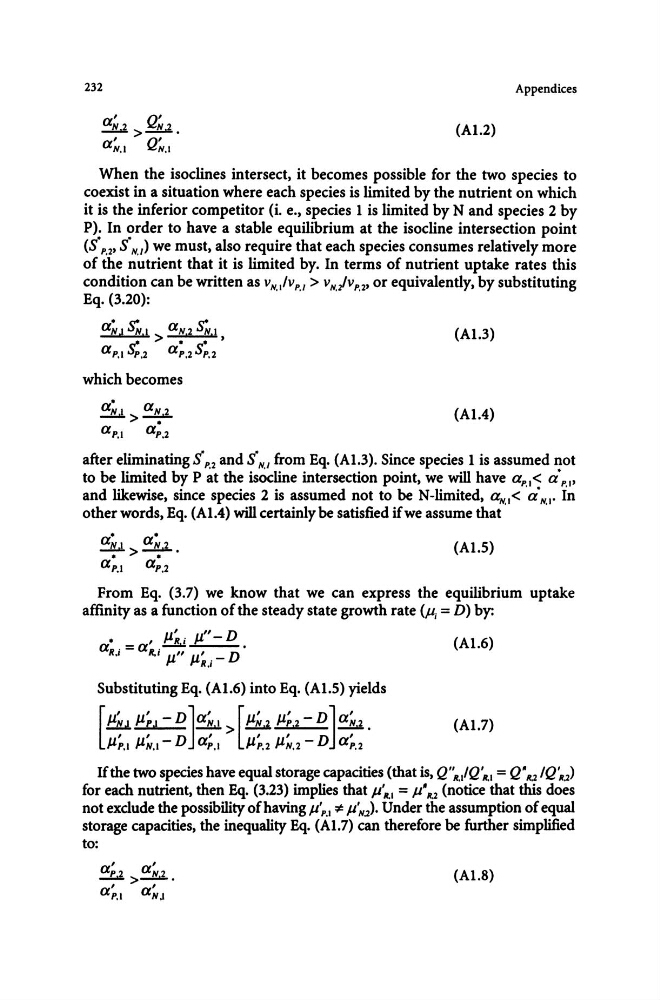
When the isoclines intersect, it becomes possible for the two species to
coexist in a situation where each species is limited by the nutrient on which
it is the inferior competitor (i. e., species I is limited by N and species 2 by
Pl. In order to have a stable equilibrium at the isocline intersection point
(S P,2' S N) we must, also require that each species consumes relatively more
of the nutrient that it is limited by. In terms of nutrient uptake rates this
condition can be written as VN)Vp,1 > V N '/Vp,2' or equivalently, by substituting
Eq. (3.20):
(A1.3)
which becomes
(AlA)
after eliminating S P.2 and S N,I from Eq. (AI.3). Since species I is assumed not
to be limited by P at the isocline intersection point, we will have ap,l< a'p,.,
and likewise, since species 2 is assumed not to be N-limited, a N ,.< a'N,.' In
other words, Eq. (A1.4) will certainly be satisfied if we assume that
(A1.5)
From Eq. (3.7) we know that we can express the equilibrium uptake
affinity as a function of the steady state growth rate (II; = D) by:
• _
' Jl~,i JI'-D .
a RJ - aR.i Jl" Jl' . - D
R.,
Substituting Eq. (A1.6) into Eq. (A1.5) yields
[ ' , D]' [, , D]'
J.l.NJ JlPJ -
aN,1 > JlN.2 Jlp,2 -
aN,2 •
,
,
D a'
Jl' Jl'
D a'
Jlp,l JlN.1 -
P.I
P,2 N.2 -
P.2
(A1.6)
(A1.7)
If the two species have equal storage capacities (that is, Q'~./Q'1I.1 = Q·R.2IQ~;J.)
for each nutrient, then Eq. (3.23) implies that 1.1' 11.1 = 1I'R.2 (notice that this does
not exclude the possibility of having lI'p,. :F-II~;J.)' Under the assumption of equal
storage capacities, the inequality Eq. (AI.7) can therefore be further simplified
to:
(Al.8)
Appendices
a'
Q'
--I!..l. >~.
a~.1 Q~.1
(A1.2)
When the isoclines intersect, it becomes possible for the two species to
coexist in a situation where each species is limited by the nutrient on which
it is the inferior competitor (i. e., species I is limited by N and species 2 by
Pl. In order to have a stable equilibrium at the isocline intersection point
(S P,2' S N) we must, also require that each species consumes relatively more
of the nutrient that it is limited by. In terms of nutrient uptake rates this
condition can be written as VN)Vp,1 > V N '/Vp,2' or equivalently, by substituting
Eq. (3.20):
(A1.3)
which becomes
(AlA)
after eliminating S P.2 and S N,I from Eq. (AI.3). Since species I is assumed not
to be limited by P at the isocline intersection point, we will have ap,l< a'p,.,
and likewise, since species 2 is assumed not to be N-limited, a N ,.< a'N,.' In
other words, Eq. (A1.4) will certainly be satisfied if we assume that
(A1.5)
From Eq. (3.7) we know that we can express the equilibrium uptake
affinity as a function of the steady state growth rate (II; = D) by:
• _
' Jl~,i JI'-D .
a RJ - aR.i Jl" Jl' . - D
R.,
Substituting Eq. (A1.6) into Eq. (A1.5) yields
[ ' , D]' [, , D]'
J.l.NJ JlPJ -
aN,1 > JlN.2 Jlp,2 -
aN,2 •
,
,
D a'
Jl' Jl'
D a'
Jlp,l JlN.1 -
P.I
P,2 N.2 -
P.2
(A1.6)
(A1.7)
If the two species have equal storage capacities (that is, Q'~./Q'1I.1 = Q·R.2IQ~;J.)
for each nutrient, then Eq. (3.23) implies that 1.1' 11.1 = 1I'R.2 (notice that this does
not exclude the possibility of having lI'p,. :F-II~;J.)' Under the assumption of equal
storage capacities, the inequality Eq. (AI.7) can therefore be further simplified
to:
(Al.8)