

The Fate of Zooplankton Egesta: Carbon Cycling and Chaos
195
0.2.,.---- - - - -- - - - - - - - - - - - - - - - - ,
--"7
' "'
QJ
.';:;
........
U
01)
..§.
'-"
c 0.1
0
.0
~
(.)
c
0
....
~
ell
0.
0
0
N
0.0
0.0
0.2
0.4
0.6
0.8
Food carbon ([mg C] liter - I)
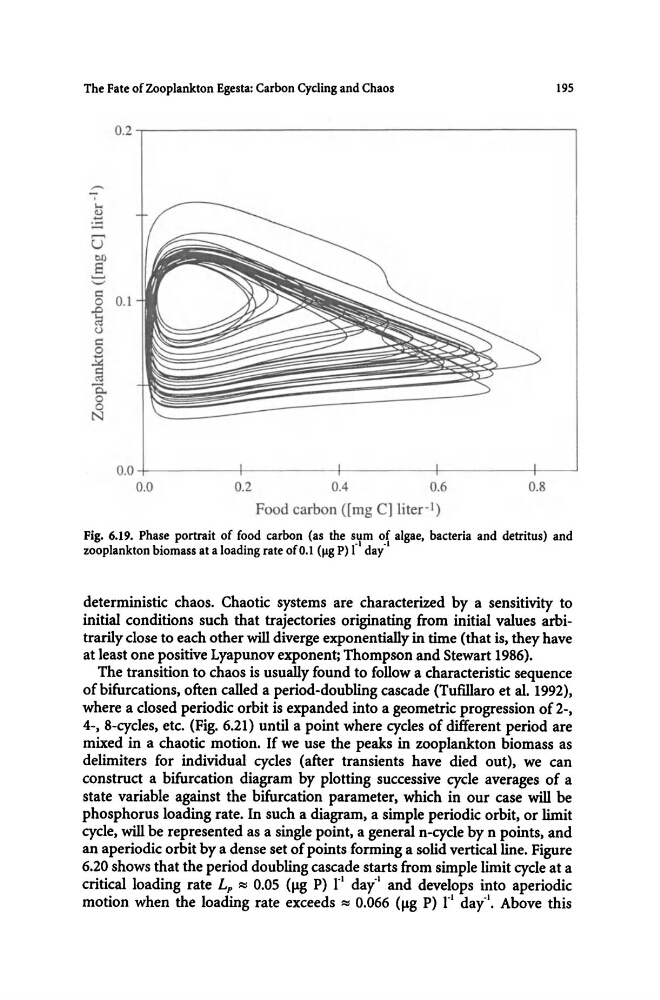
Fig. 6.19. Phase portrait of food carbon (as the sHm o{ algae. bacteria and detritus) and
zooplankton biomass at a loading rate ofO.} (Ilg P) I day
deterministic chaos. Chaotic systems are characterized by a sensitivity to
initial conditions such that trajectories originating from initial values arbitrarily close to each other will diverge exponentially in time (that is, they have
at least one positive Lyapunov exponent; Thompson and Stewart 1986).
The transition to chaos is usually found to follow a characteristic sequence
of bifurcations, often called a period-doubling cascade (Tufillaro et al. 1992),
where a closed periodic orbit is expanded into a geometric progression of 2-,
4-, 8-cycles, etc. (Fig. 6.21) until a point where cycles of different period are
mixed in a chaotic motion. If we use the peaks in zooplankton biomass as
delimiters for individual cycles (after transients have died out), we can
construct a bifurcation diagram by plotting successive cycle averages of a
state variable against the bifurcation parameter, which in our case will be
phosphorus loading rate. In such a diagram, a simple periodic orbit, or limit
cycle, will be represented as a single point, a general n-cycle by n points, and
an aperiodic orbit by a dense set of points forming a solid vertical line. Figure
6.20 shows that the period doubling cascade starts from simple limit cycle at a
critical loading rate Lp : : : : : : 0.05 (llg P) r l day"1 and develops into aperiodic
motion when the loading rate exceeds:::::: 0.066 (Ilg P) r l day"l. Above this
195
0.2.,.---- - - - -- - - - - - - - - - - - - - - - - ,
--"7
' "'
QJ
.';:;
........
U
01)
..§.
'-"
c 0.1
0
.0
~
(.)
c
0
....
~
ell
0.
0
0
N
0.0
0.0
0.2
0.4
0.6
0.8
Food carbon ([mg C] liter - I)
Fig. 6.19. Phase portrait of food carbon (as the sHm o{ algae. bacteria and detritus) and
zooplankton biomass at a loading rate ofO.} (Ilg P) I day
deterministic chaos. Chaotic systems are characterized by a sensitivity to
initial conditions such that trajectories originating from initial values arbitrarily close to each other will diverge exponentially in time (that is, they have
at least one positive Lyapunov exponent; Thompson and Stewart 1986).
The transition to chaos is usually found to follow a characteristic sequence
of bifurcations, often called a period-doubling cascade (Tufillaro et al. 1992),
where a closed periodic orbit is expanded into a geometric progression of 2-,
4-, 8-cycles, etc. (Fig. 6.21) until a point where cycles of different period are
mixed in a chaotic motion. If we use the peaks in zooplankton biomass as
delimiters for individual cycles (after transients have died out), we can
construct a bifurcation diagram by plotting successive cycle averages of a
state variable against the bifurcation parameter, which in our case will be
phosphorus loading rate. In such a diagram, a simple periodic orbit, or limit
cycle, will be represented as a single point, a general n-cycle by n points, and
an aperiodic orbit by a dense set of points forming a solid vertical line. Figure
6.20 shows that the period doubling cascade starts from simple limit cycle at a
critical loading rate Lp : : : : : : 0.05 (llg P) r l day"1 and develops into aperiodic
motion when the loading rate exceeds:::::: 0.066 (Ilg P) r l day"l. Above this