

194
Approaching Planktonic Food Webs: Competition, Coexistence, and Chaos
Bacterioplankton
1.0 1==----==~2~~======~ Dissolved
s::
0.8
o
~ u
u
'§ 0.6
e!l
o
'3 .8 0.4
~
o
d
o
',0 0.2
~
~
Phytoplankton
Detritus
Zooplankton
0.0~------+-------4-------4-------4-------~
0.0
0.1
0.2
0.3
0.4
0.5
P loading rate ([J.lg P] liter -1 d -I)
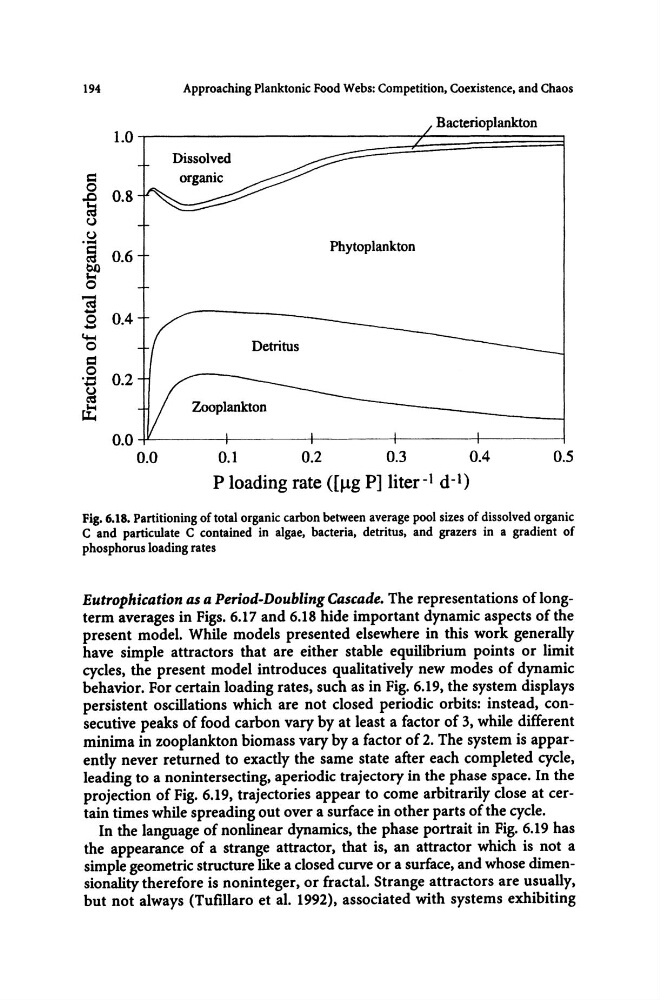
Fig. 6.18. Partitioning of total organic carbon between average pool sizes of dissolved organic
C and particulate C contained in algae, bacteria, detritus, and grazers in a gradient of
phosphorus loading rates
Eutrophication as a Period-Doubling Cascade. The representations of longterm averages in Figs. 6.17 and 6.18 hide important dynamic aspects of the
present model. While models presented elsewhere in this work generally
have simple attractors that are either stable equilibrium points or limit
cycles, the present model introduces qualitatively new modes of dynamic
behavior. For certain loading rates, such as in Fig. 6.19, the system displays
persistent oscillations which are not closed periodic orbits: instead, consecutive peaks of food carbon vary by at least a factor of 3, while different
minima in zooplankton biomass vary by a factor of 2. The system is apparently never returned to exactly the same state after each completed cycle,
leading to a nonintersecting, aperiodic trajectory in the phase space. In the
projection of Fig. 6.19, trajectories appear to come arbitrarily close at certain times while spreading out over a surface in other parts of the cycle.
In the language of nonlinear dynamics, the phase portrait in Fig. 6.19 has
the appearance of a strange attractor, that is, an attractor which is not a
simple geometric structure like a closed curve or a surface, and whose dimensionality therefore is noninteger, or fractal. Strange attractors are usually,
but not always (Tufillaro et al. 1992), associated with systems exhibiting
Approaching Planktonic Food Webs: Competition, Coexistence, and Chaos
Bacterioplankton
1.0 1==----==~2~~======~ Dissolved
s::
0.8
o
~ u
u
'§ 0.6
e!l
o
'3 .8 0.4
~
o
d
o
',0 0.2
~
~
Phytoplankton
Detritus
Zooplankton
0.0~------+-------4-------4-------4-------~
0.0
0.1
0.2
0.3
0.4
0.5
P loading rate ([J.lg P] liter -1 d -I)
Fig. 6.18. Partitioning of total organic carbon between average pool sizes of dissolved organic
C and particulate C contained in algae, bacteria, detritus, and grazers in a gradient of
phosphorus loading rates
Eutrophication as a Period-Doubling Cascade. The representations of longterm averages in Figs. 6.17 and 6.18 hide important dynamic aspects of the
present model. While models presented elsewhere in this work generally
have simple attractors that are either stable equilibrium points or limit
cycles, the present model introduces qualitatively new modes of dynamic
behavior. For certain loading rates, such as in Fig. 6.19, the system displays
persistent oscillations which are not closed periodic orbits: instead, consecutive peaks of food carbon vary by at least a factor of 3, while different
minima in zooplankton biomass vary by a factor of 2. The system is apparently never returned to exactly the same state after each completed cycle,
leading to a nonintersecting, aperiodic trajectory in the phase space. In the
projection of Fig. 6.19, trajectories appear to come arbitrarily close at certain times while spreading out over a surface in other parts of the cycle.
In the language of nonlinear dynamics, the phase portrait in Fig. 6.19 has
the appearance of a strange attractor, that is, an attractor which is not a
simple geometric structure like a closed curve or a surface, and whose dimensionality therefore is noninteger, or fractal. Strange attractors are usually,
but not always (Tufillaro et al. 1992), associated with systems exhibiting