

192
Approaching Planktonic Food Webs: Competition, Coexistence, and Chaos
Eq. (6.27) would be in excess of the needs for balanced growth. In the
model, this situation is dealt with by simply setting U b = &-1 b (Pb + r b )
whenever Pb = PP,b < PC,b'
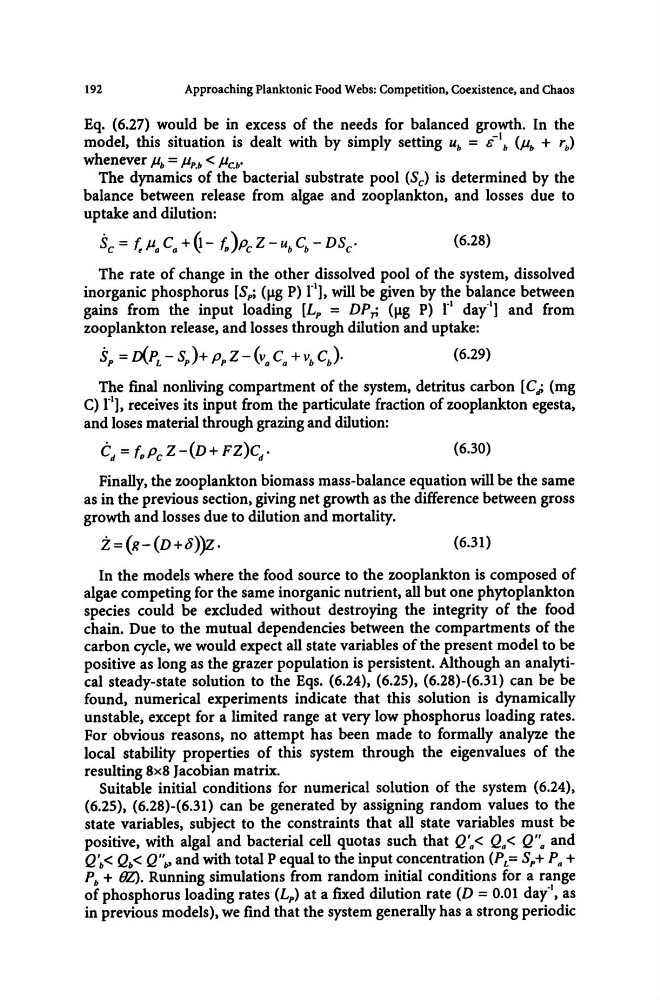
The dynamics of the bacterial substrate pool (Sc) is determined by the
balance between release from algae and zooplankton, and losses due to
uptake and dilution:
(6.28)
The rate of change in the other dissolved pool of the system, dissolved
inorganic phosphorus [Sp; (~g p) rl], will be given by the balance between
gains from the input loading [Lp = DP ~ (~g P) r l day"I] and from
zooplankton release, and losses through dilution and uptake:
Sp = ri .. ..P L - Sp)+ Pp Z - (va C a + Vb CJ
(6.29)
The final nonliving compartment of the system, detritus carbon [C; (mg
C) rl], receives its input from the particulate fraction of zooplankton egesta,
and loses material through grazing and dilution:
Cd = fDPcZ-(D+FZ)C d •
(6.30)
Finally, the zooplankton biomass mass-balance equation will be the same
as in the previous section, giving net growth as the difference between gross
growth and losses due to dilution and mortality.
Z=(.~-(D+o))z .
(6.31)
In the models where the food source to the zooplankton is composed of
algae competing for the same inorganic nutrient, all but one phytoplankton
species could be excluded without destroying the integrity of the food
chain. Due to the mutual dependencies between the compartments of the
carbon cycle, we would expect all state variables of the present model to be
positive as long as the grazer population is persistent. Although an analytical steady-state solution to the Eqs. (6.24), (6.25), (6.28)-(6.31) can be be
found, numerical experiments indicate that this solution is dynamically
unstable, except for a limited range at very low phosphorus loading rates.
For obvious reasons, no attempt has been made to formally analyze the
local stability properties of this system through the eigenvalues of the
resulting 8x8 Jacobian matrix.
Suitable initial conditions for numerical solution of the system (6.24),
(6.25), (6.28)-(6.31) can be generated by assigning random values to the
state variables, subject to the constraints that all state variables must be
positive, with algal and bacterial cell quotas such that Q'.< Q.< Q"a and
Q'b< Q b < Q"b> and with total P equal to the input concentration (PL= Sp+ p. +
P b + 8Z). Running simulations from random initial conditions for a range
of phosphorus loading rates (Lp) at a fixed dilution rate (D = 0.01 day"l, as
in previous models), we find that the system generally has a strong periodic
Approaching Planktonic Food Webs: Competition, Coexistence, and Chaos
Eq. (6.27) would be in excess of the needs for balanced growth. In the
model, this situation is dealt with by simply setting U b = &-1 b (Pb + r b )
whenever Pb = PP,b < PC,b'
The dynamics of the bacterial substrate pool (Sc) is determined by the
balance between release from algae and zooplankton, and losses due to
uptake and dilution:
(6.28)
The rate of change in the other dissolved pool of the system, dissolved
inorganic phosphorus [Sp; (~g p) rl], will be given by the balance between
gains from the input loading [Lp = DP ~ (~g P) r l day"I] and from
zooplankton release, and losses through dilution and uptake:
Sp = ri .. ..P L - Sp)+ Pp Z - (va C a + Vb CJ
(6.29)
The final nonliving compartment of the system, detritus carbon [C; (mg
C) rl], receives its input from the particulate fraction of zooplankton egesta,
and loses material through grazing and dilution:
Cd = fDPcZ-(D+FZ)C d •
(6.30)
Finally, the zooplankton biomass mass-balance equation will be the same
as in the previous section, giving net growth as the difference between gross
growth and losses due to dilution and mortality.
Z=(.~-(D+o))z .
(6.31)
In the models where the food source to the zooplankton is composed of
algae competing for the same inorganic nutrient, all but one phytoplankton
species could be excluded without destroying the integrity of the food
chain. Due to the mutual dependencies between the compartments of the
carbon cycle, we would expect all state variables of the present model to be
positive as long as the grazer population is persistent. Although an analytical steady-state solution to the Eqs. (6.24), (6.25), (6.28)-(6.31) can be be
found, numerical experiments indicate that this solution is dynamically
unstable, except for a limited range at very low phosphorus loading rates.
For obvious reasons, no attempt has been made to formally analyze the
local stability properties of this system through the eigenvalues of the
resulting 8x8 Jacobian matrix.
Suitable initial conditions for numerical solution of the system (6.24),
(6.25), (6.28)-(6.31) can be generated by assigning random values to the
state variables, subject to the constraints that all state variables must be
positive, with algal and bacterial cell quotas such that Q'.< Q.< Q"a and
Q'b< Q b < Q"b> and with total P equal to the input concentration (PL= Sp+ p. +
P b + 8Z). Running simulations from random initial conditions for a range
of phosphorus loading rates (Lp) at a fixed dilution rate (D = 0.01 day"l, as
in previous models), we find that the system generally has a strong periodic