

The Fate of Zooplankton Egesta: Carbon Cycling and Chaos
191
Bacterial growth rate (p,; day"l) is assumed to be controlled by the availability of P and C according to a threshold model; that is, if we use symbols PP.b
and PC,b for the potential P- and C-limited growth rates, then ~ = Min{p.P.b> I1cb)'
The potential P-limited growth rate, )Jp.b' is given by the Droop model [Eq.
(3.2)] with the parameters in Table 3.3, as with the algal compartment. The
potential C-limited growth rate, PC.b' is determined by the carbon assimilation rate and the efficiency with which assimilated carbon can be converted
into new biomass.
Carbon-specific growth efficiencies in bacteria have been found to be
quite variable, with strong indications of modulation by the mineral nutrient supply. In nutrient-sufficient systems, maximum growth yields around
50-60% of assimilated carbon have been reported, while 40-90% of assimilated carbon might be lost as respiration in nutrient-limited systems (Azam
et al. 1983). Respiratory losses can be considered as the sum of maintenance metabolism and the costs of synthesizing new biomass from simple
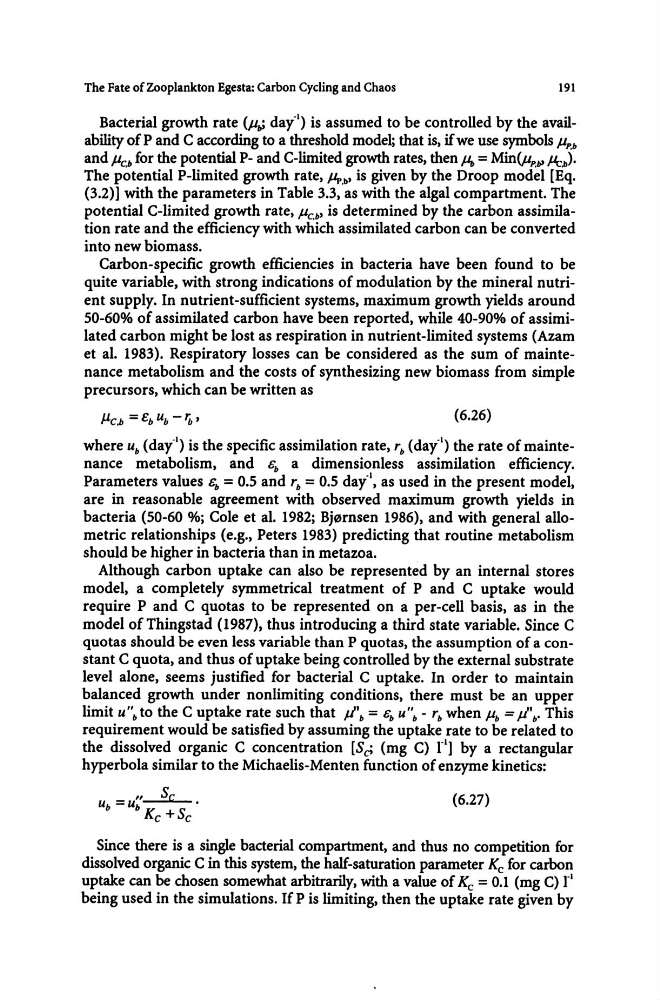
precursors, which can be written as
(6.26)
where U b (day"l) is the specific assimilation rate, rb (day"l) the rate of maintenance metabolism, and &b a dimensionless assimilation efficiency.
Parameters values &b = 0.5 and rb = 0.5 day·l, as used in the present model,
are in reasonable agreement with observed maximum growth yields in
bacteria (50-60 %; Cole et al. 1982; Bj0rnsen 1986), and with general allometric relationships (e.g., Peters 1983) predicting that routine metabolism
should be higher in bacteria than in metazoa.
Although carbon uptake can also be represented by an internal stores
model, a completely symmetrical treatment of P and C uptake would
require P and C quotas to be represented on a per-cell basis, as in the
model of Thingstad (1987), thus introducing a third state variable. Since C
quotas should be even less variable than P quotas, the assumption of a constant C quota, and thus of uptake being controlled by the external substrate
level alone, seems justified for bacterial C uptake. In order to maintain
balanced growth under nonlimiting conditions, there must be an upper
limit U"b to the C uptake rate such that P"b = &b U"b - rb when Pb = Ji'b' This
requirement would be satisfied by assuming the uptake rate to be related to
the dissolved organic C concentration [Sci (mg C) rl] by a rectangular
hyperbola similar to the Michaelis-Menten function of enzyme kinetics:
" S,
U b =U b
Kc +Sc
(6.27)
Since there is a single bacterial compartment, and thus no competition for
dissolved organic C in this system, the half-saturation parameter Kc for carbon
uptake can be chosen somewhat arbitrarily, with a value of Kc = 0.1 (mg C) r l
being used in the simulations. If P is limiting, then the uptake rate given by
191
Bacterial growth rate (p,; day"l) is assumed to be controlled by the availability of P and C according to a threshold model; that is, if we use symbols PP.b
and PC,b for the potential P- and C-limited growth rates, then ~ = Min{p.P.b> I1cb)'
The potential P-limited growth rate, )Jp.b' is given by the Droop model [Eq.
(3.2)] with the parameters in Table 3.3, as with the algal compartment. The
potential C-limited growth rate, PC.b' is determined by the carbon assimilation rate and the efficiency with which assimilated carbon can be converted
into new biomass.
Carbon-specific growth efficiencies in bacteria have been found to be
quite variable, with strong indications of modulation by the mineral nutrient supply. In nutrient-sufficient systems, maximum growth yields around
50-60% of assimilated carbon have been reported, while 40-90% of assimilated carbon might be lost as respiration in nutrient-limited systems (Azam
et al. 1983). Respiratory losses can be considered as the sum of maintenance metabolism and the costs of synthesizing new biomass from simple
precursors, which can be written as
(6.26)
where U b (day"l) is the specific assimilation rate, rb (day"l) the rate of maintenance metabolism, and &b a dimensionless assimilation efficiency.
Parameters values &b = 0.5 and rb = 0.5 day·l, as used in the present model,
are in reasonable agreement with observed maximum growth yields in
bacteria (50-60 %; Cole et al. 1982; Bj0rnsen 1986), and with general allometric relationships (e.g., Peters 1983) predicting that routine metabolism
should be higher in bacteria than in metazoa.
Although carbon uptake can also be represented by an internal stores
model, a completely symmetrical treatment of P and C uptake would
require P and C quotas to be represented on a per-cell basis, as in the
model of Thingstad (1987), thus introducing a third state variable. Since C
quotas should be even less variable than P quotas, the assumption of a constant C quota, and thus of uptake being controlled by the external substrate
level alone, seems justified for bacterial C uptake. In order to maintain
balanced growth under nonlimiting conditions, there must be an upper
limit U"b to the C uptake rate such that P"b = &b U"b - rb when Pb = Ji'b' This
requirement would be satisfied by assuming the uptake rate to be related to
the dissolved organic C concentration [Sci (mg C) rl] by a rectangular
hyperbola similar to the Michaelis-Menten function of enzyme kinetics:
" S,
U b =U b
Kc +Sc
(6.27)
Since there is a single bacterial compartment, and thus no competition for
dissolved organic C in this system, the half-saturation parameter Kc for carbon
uptake can be chosen somewhat arbitrarily, with a value of Kc = 0.1 (mg C) r l
being used in the simulations. If P is limiting, then the uptake rate given by