

184
Approaching Planktonic Food Webs: Competition, Coexistence, and Chaos
50.-------------------------------------~
-- ..0 40
- I
B
....
- ,......., 30
Z
CO
:::s.
'--J
"-"
z
20
10
0_--·······---'
_. __ . __ .. ...---. __ . ....-._ ... _-_ .. _ ....... .
_.------0+=~------_+----------r_--------~--------_1
0.0
0.5
1.0
1.5
2.0
P supply rate ([I-lg P] liter -1 d- 1 )
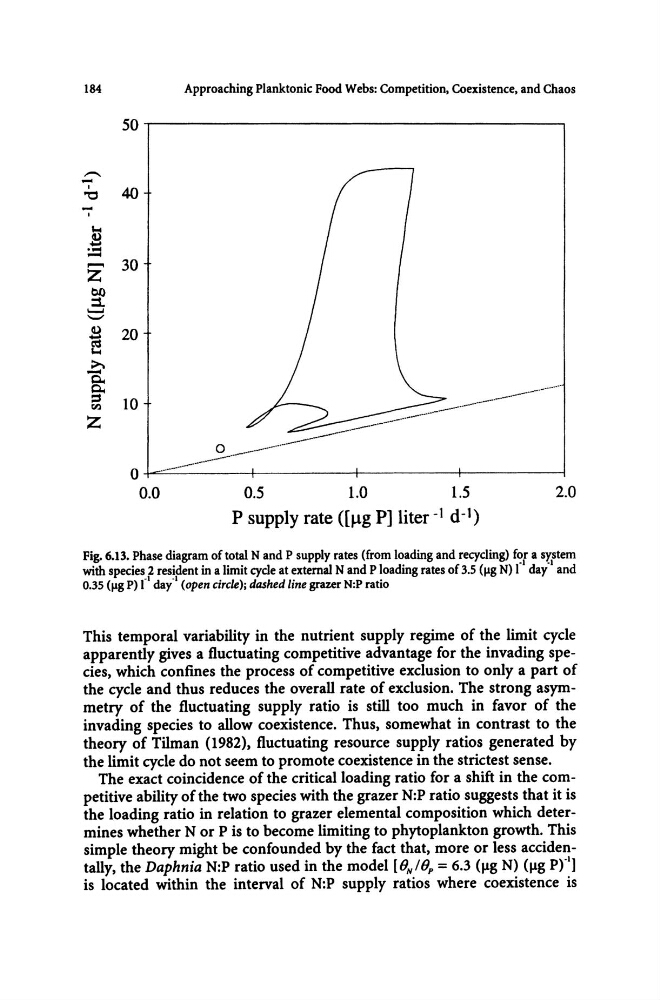
Fig. 6.13. Phase diagram of total N and P supply rates (from loading and recycling) for a sy'stem
with species 2 resident in a limit cycle at external Nand P loading rates of 3.5 (l1g N) fl day·1 and
0.35 (l1g P) 1' 1 day·1 (open circle); dashed line grazer N:P ratio
This temporal variability in the nutrient supply regime of the limit cycle
apparently gives a fluctuating competitive advantage for the invading species, which confines the process of competitive exclusion to only a part of
the cycle and thus reduces the overall rate of exclusion. The strong asymmetry of the fluctuating supply ratio is still too much in favor of the
invading species to allow coexistence. Thus, somewhat in contrast to the
theory of Tilman (1982), fluctuating resource supply ratios generated by
the limit cycle do not seem to promote coexistence in the strictest sense.
The exact coincidence of the critical loading ratio for a shift in the competitive ability of the two species with the grazer N:P ratio suggests that it is
the loading ratio in relation to grazer elemental composition which determines whether N or P is to become limiting to phytoplankton growth. This
simple theory might be confounded by the fact that, more or less accidentally, the Daphnia N:P ratio used in the model llVOp = 6.3 (Ilg N) (Ilg prl]
is located within the interval of N:P supply ratios where coexistence is
Approaching Planktonic Food Webs: Competition, Coexistence, and Chaos
50.-------------------------------------~
-- ..0 40
- I
B
....
- ,......., 30
Z
CO
:::s.
'--J
"-"
z
20
10
0_--·······---'
_. __ . __ .. ...---. __ . ....-._ ... _-_ .. _ ....... .
_.------0+=~------_+----------r_--------~--------_1
0.0
0.5
1.0
1.5
2.0
P supply rate ([I-lg P] liter -1 d- 1 )
Fig. 6.13. Phase diagram of total N and P supply rates (from loading and recycling) for a sy'stem
with species 2 resident in a limit cycle at external Nand P loading rates of 3.5 (l1g N) fl day·1 and
0.35 (l1g P) 1' 1 day·1 (open circle); dashed line grazer N:P ratio
This temporal variability in the nutrient supply regime of the limit cycle
apparently gives a fluctuating competitive advantage for the invading species, which confines the process of competitive exclusion to only a part of
the cycle and thus reduces the overall rate of exclusion. The strong asymmetry of the fluctuating supply ratio is still too much in favor of the
invading species to allow coexistence. Thus, somewhat in contrast to the
theory of Tilman (1982), fluctuating resource supply ratios generated by
the limit cycle do not seem to promote coexistence in the strictest sense.
The exact coincidence of the critical loading ratio for a shift in the competitive ability of the two species with the grazer N:P ratio suggests that it is
the loading ratio in relation to grazer elemental composition which determines whether N or P is to become limiting to phytoplankton growth. This
simple theory might be confounded by the fact that, more or less accidentally, the Daphnia N:P ratio used in the model llVOp = 6.3 (Ilg N) (Ilg prl]
is located within the interval of N:P supply ratios where coexistence is