

164
Approaching Planktonic Food Webs: Competition, Coexistence, and Chaos
1.0 ""'1::'""--------------------.
rIJ
0.8
2
3
.,g
c..
rIJ
0.6
.,g
Zooplankton
c..
- t'd
...
B 0.4
4-<
0
s::
0
.... 0.2
...
~
d:
0.0 - t ' - - - - - - - - I - - - - - - - - - - + - - - - - - - l
o
0.2
0.4
0.6
Phosphorus loading rate ([Jlg P] liter- 1 d- 1 )
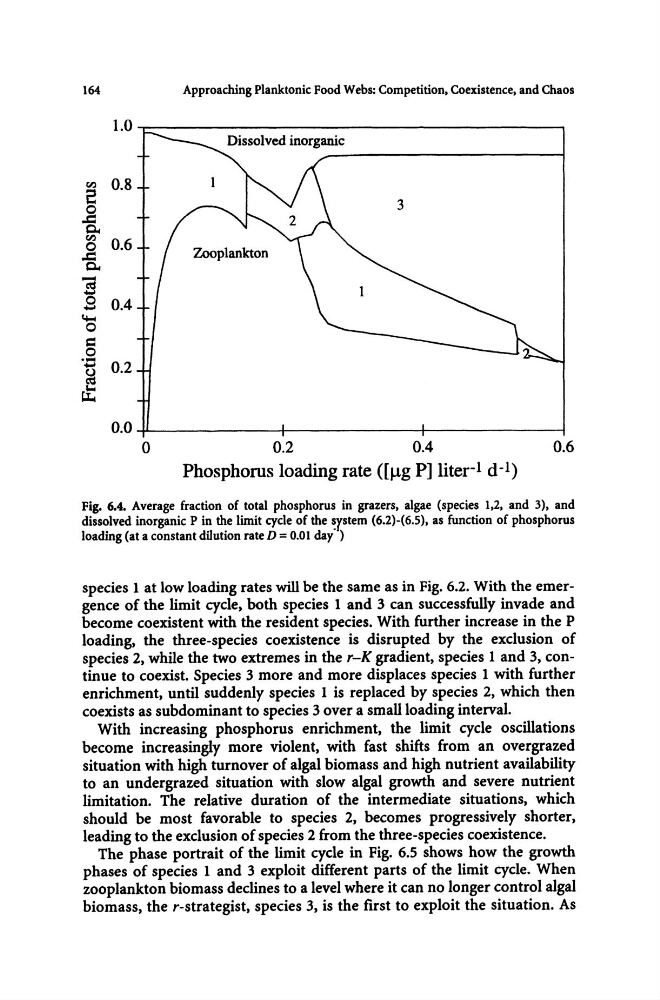
Fig. 6.4. Average fraction of total phosphorus in grazers, algae (species 1,2, and 3), and
dissolved inorganic P in the limit cycle of the ~r.stem (6.2)-(6.5), as function of phosphorus
loading (at a constant dilution rate D = 0.01 day )
species 1 at low loading rates will be the same as in Fig. 6.2. With the emergence of the limit cycle, both species 1 and 3 can successfully invade and
become coexistent with the resident species. With further increase in the P
loading, the three-species coexistence is disrupted by the exclusion of
species 2, while the two extremes in the r-K gradient, species 1 and 3, continue to coexist. Species 3 more and more displaces species 1 with further
enrichment, until suddenly species 1 is replaced by species 2, which then
coexists as subdominant to species 3 over a small loading interval.
With increasing phosphorus enrichment, the limit cycle oscillations
become increasingly more violent, with fast shifts from an overgrazed
situation with high turnover of algal biomass and high nutrient availability
to an undergrazed situation with slow algal growth and severe nutrient
limitation. The relative duration of the intermediate situations, which
should be most favorable to species 2, becomes progressively shorter,
leading to the exclusion of species 2 from the three-species coexistence.
The phase portrait of the limit cycle in Fig. 6.5 shows how the growth
phases of species 1 and 3 exploit different parts of the limit cycle. When
zooplankton biomass declines to a level where it can no longer control algal
biomass, the r-strategist, species 3, is the first to exploit the situation. As
Approaching Planktonic Food Webs: Competition, Coexistence, and Chaos
1.0 ""'1::'""--------------------.
rIJ
0.8
2
3
.,g
c..
rIJ
0.6
.,g
Zooplankton
c..
- t'd
...
B 0.4
4-<
0
s::
0
.... 0.2
...
~
d:
0.0 - t ' - - - - - - - - I - - - - - - - - - - + - - - - - - - l
o
0.2
0.4
0.6
Phosphorus loading rate ([Jlg P] liter- 1 d- 1 )
Fig. 6.4. Average fraction of total phosphorus in grazers, algae (species 1,2, and 3), and
dissolved inorganic P in the limit cycle of the ~r.stem (6.2)-(6.5), as function of phosphorus
loading (at a constant dilution rate D = 0.01 day )
species 1 at low loading rates will be the same as in Fig. 6.2. With the emergence of the limit cycle, both species 1 and 3 can successfully invade and
become coexistent with the resident species. With further increase in the P
loading, the three-species coexistence is disrupted by the exclusion of
species 2, while the two extremes in the r-K gradient, species 1 and 3, continue to coexist. Species 3 more and more displaces species 1 with further
enrichment, until suddenly species 1 is replaced by species 2, which then
coexists as subdominant to species 3 over a small loading interval.
With increasing phosphorus enrichment, the limit cycle oscillations
become increasingly more violent, with fast shifts from an overgrazed
situation with high turnover of algal biomass and high nutrient availability
to an undergrazed situation with slow algal growth and severe nutrient
limitation. The relative duration of the intermediate situations, which
should be most favorable to species 2, becomes progressively shorter,
leading to the exclusion of species 2 from the three-species coexistence.
The phase portrait of the limit cycle in Fig. 6.5 shows how the growth
phases of species 1 and 3 exploit different parts of the limit cycle. When
zooplankton biomass declines to a level where it can no longer control algal
biomass, the r-strategist, species 3, is the first to exploit the situation. As