

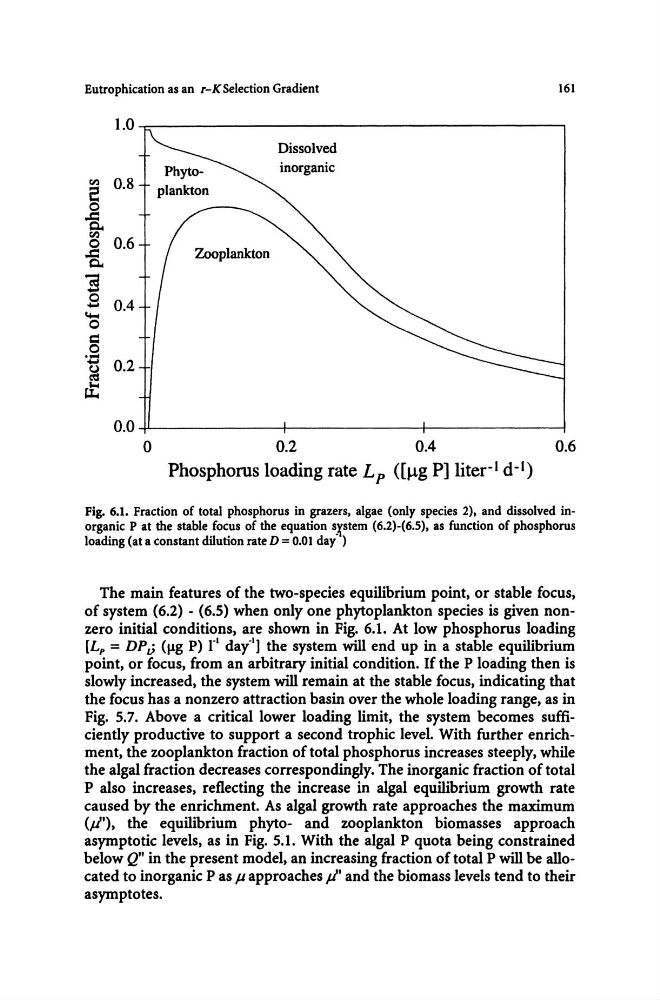
Fig. 6.1. Fraction of total phosphorus in grazers, algae (only species 2), and dissolved inorganic P at the stable focus of the equation ~tem (6.2)-(6.5), as function of phosphorus
loading (at a constant dilution rate D = 0.01 day )
The main features of the two-species equilibrium point. or stable focus.
of system (6.2) - (6.5) when only one phytoplankton species is given nonzero initial conditions, are shown in Fig. 6.1. At low phosphorus loading
[Lp = DP,; (llg P) r l dati] the system will end up in a stable eqUilibrium
point, or focus, from an arbitrary initial condition. If the P loading then is
slowly increased, the system will remain at the stable focus, indicating that
the focus has a nonzero attraction basin over the whole loading range, as in
Fig. 5.7. Above a critical lower loading limit, the system becomes sufficiently productive to support a second trophic level. With further enrichment, the zooplankton fraction of total phosphorus increases steeply, while
the algal fraction decreases correspondingly. The inorganic fraction of total
P also increases, reflecting the increase in algal equilibrium growth rate
caused by the enrichment. As algal growth rate approaches the maximum
(Ji'), the equilibrium phyto- and zooplankton biomasses approach
asymptotic levels, as in Fig. 5.1. With the algal P quota being constrained
below Q" in the present model, an increasing fraction of total P will be allocated to inorganic P as JI approaches Ji' and the biomass levels tend to their
asymptotes.
loading (at a constant dilution rate D = 0.01 day )
The main features of the two-species equilibrium point. or stable focus.
of system (6.2) - (6.5) when only one phytoplankton species is given nonzero initial conditions, are shown in Fig. 6.1. At low phosphorus loading
[Lp = DP,; (llg P) r l dati] the system will end up in a stable eqUilibrium
point, or focus, from an arbitrary initial condition. If the P loading then is
slowly increased, the system will remain at the stable focus, indicating that
the focus has a nonzero attraction basin over the whole loading range, as in
Fig. 5.7. Above a critical lower loading limit, the system becomes sufficiently productive to support a second trophic level. With further enrichment, the zooplankton fraction of total phosphorus increases steeply, while
the algal fraction decreases correspondingly. The inorganic fraction of total
P also increases, reflecting the increase in algal equilibrium growth rate
caused by the enrichment. As algal growth rate approaches the maximum
(Ji'), the equilibrium phyto- and zooplankton biomasses approach
asymptotic levels, as in Fig. 5.1. With the algal P quota being constrained
below Q" in the present model, an increasing fraction of total P will be allocated to inorganic P as JI approaches Ji' and the biomass levels tend to their
asymptotes.