

160
Approaching Planktonic Food Webs: Competition, Coexistence, and Chaos
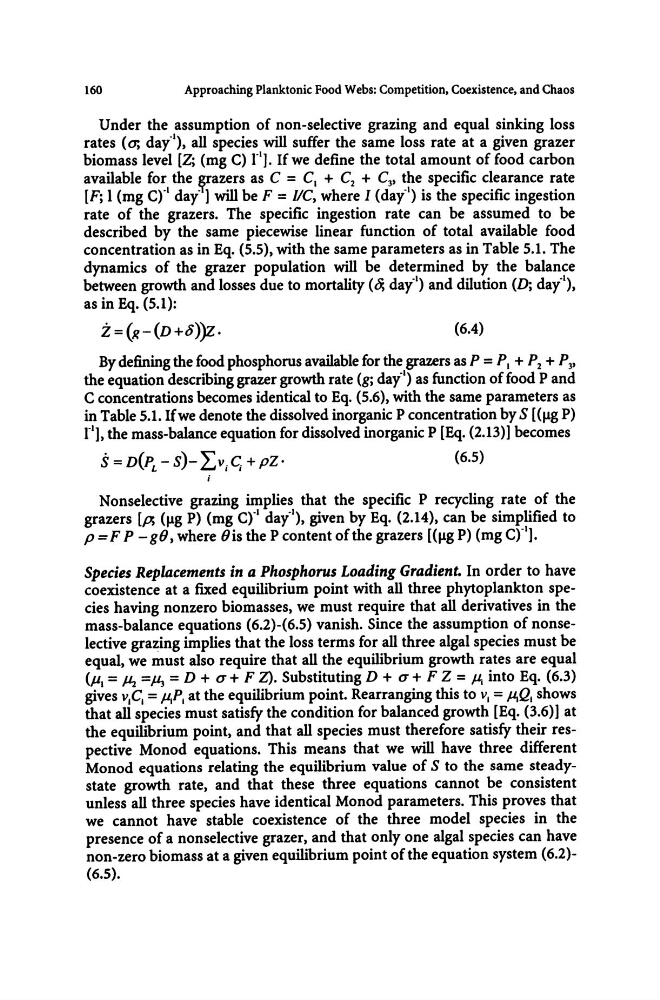
Under the assumption of non-selective grazing and equal sinking loss
rates (0; day"\ all species will suffer the same loss rate at a given grazer
biomass level [Z; (mg C) n. If we define the total amount of food carbon
available for the ~razers as e = e l + e 2 + e l , the specific clearance rate
[F; I (mg Cyt day" ] will be F = lie, where I (day"l) is the specific ingestion
rate of the grazers. The specific ingestion rate can be assumed to be
described by the same piecewise linear function of total available food
concentration as in Eq. (5.5), with the same parameters as in Table 5.1. The
dynamics of the grazer population will be determined by the balance
between growth and losses due to mortality (~day"l) and dilution (D; day"I),
as in Eq. (5.1):
Z = (R- (D +o))z.
(6.4)
By defining the food phosphorus available for the grazers as P = PI + P 2 + P l ,
the equation describing grazer growth rate (g; day"l) as function of food P and
C concentrations becomes identical to Eq. (5.6), with the same parameters as
in Table 5.1. Ifwe denote the dissolved inorganic P concentration by S [(~g P)
rl], the mass-balance equation for dissolved inorganic P [Eq. (2.13)] becomes
S = D(P L - S)- LV;C; + pZ·
(6.5)
Nonselective grazing implies that the specific P recycling rate of the
grazers [,0; (~g P) (mg ct day"I), given by Eq. (2.14), can be simplified to
p = F P - gB, where Bis the P content of the grazers [(~g P) (mg ct].
Species Replacements in a Phosphorus Loading Gradient. In order to have
coexistence at a fixed equilibrium point with all three phytoplankton species having nonzero biomasses, we must require that all derivatives in the
mass-balance equations (6.2)-(6.5) vanish. Since the assumption of nonselective grazing implies that the loss terms for all three algal species must be
equal, we must also require that all the equilibrium growth rates are equal
(PI = P7 =IJJ = D + (J + F Z). Substituting D + (J + F Z = Pi into Eq. (6.3)
gives V.cl = PiP I at the equilibrium point. Rearranging this to VI = PiQI shows
that all species must satisfy the condition for balanced growth [Eq. (3.6)] at
the eqUilibrium point, and that all species must therefore satisfy their respective Monod equations. This means that we will have three different
Monod equations relating the equilibrium value of S to the same steadystate growth rate, and that these three equations cannot be consistent
unless all three species have identical Monod parameters. This proves that
we cannot have stable coexistence of the three model species in the
presence of a nonselective grazer, and that only one algal species can have
non-zero biomass at a given equilibrium point of the equation system (6.2)(6.5).
Approaching Planktonic Food Webs: Competition, Coexistence, and Chaos
Under the assumption of non-selective grazing and equal sinking loss
rates (0; day"\ all species will suffer the same loss rate at a given grazer
biomass level [Z; (mg C) n. If we define the total amount of food carbon
available for the ~razers as e = e l + e 2 + e l , the specific clearance rate
[F; I (mg Cyt day" ] will be F = lie, where I (day"l) is the specific ingestion
rate of the grazers. The specific ingestion rate can be assumed to be
described by the same piecewise linear function of total available food
concentration as in Eq. (5.5), with the same parameters as in Table 5.1. The
dynamics of the grazer population will be determined by the balance
between growth and losses due to mortality (~day"l) and dilution (D; day"I),
as in Eq. (5.1):
Z = (R- (D +o))z.
(6.4)
By defining the food phosphorus available for the grazers as P = PI + P 2 + P l ,
the equation describing grazer growth rate (g; day"l) as function of food P and
C concentrations becomes identical to Eq. (5.6), with the same parameters as
in Table 5.1. Ifwe denote the dissolved inorganic P concentration by S [(~g P)
rl], the mass-balance equation for dissolved inorganic P [Eq. (2.13)] becomes
S = D(P L - S)- LV;C; + pZ·
(6.5)
Nonselective grazing implies that the specific P recycling rate of the
grazers [,0; (~g P) (mg ct day"I), given by Eq. (2.14), can be simplified to
p = F P - gB, where Bis the P content of the grazers [(~g P) (mg ct].
Species Replacements in a Phosphorus Loading Gradient. In order to have
coexistence at a fixed equilibrium point with all three phytoplankton species having nonzero biomasses, we must require that all derivatives in the
mass-balance equations (6.2)-(6.5) vanish. Since the assumption of nonselective grazing implies that the loss terms for all three algal species must be
equal, we must also require that all the equilibrium growth rates are equal
(PI = P7 =IJJ = D + (J + F Z). Substituting D + (J + F Z = Pi into Eq. (6.3)
gives V.cl = PiP I at the equilibrium point. Rearranging this to VI = PiQI shows
that all species must satisfy the condition for balanced growth [Eq. (3.6)] at
the eqUilibrium point, and that all species must therefore satisfy their respective Monod equations. This means that we will have three different
Monod equations relating the equilibrium value of S to the same steadystate growth rate, and that these three equations cannot be consistent
unless all three species have identical Monod parameters. This proves that
we cannot have stable coexistence of the three model species in the
presence of a nonselective grazer, and that only one algal species can have
non-zero biomass at a given equilibrium point of the equation system (6.2)(6.5).