

140
Nutrients, Algae and Herbivores - the Paradox of Enrichment Revisited
grazers are restored to a biomass level where they can exert an appreciable
grazing pressure. When algal biomass is close to the carrying capacity, it will
be so nutrient-poor that it will constitute a very low-quality food source for
the grazers. Grazers will thus maintain a low growth rate despite the abundance of algal food carbon, leading to a very slow buildup of grazer biomass
before it can again constitute a significant loss factor to the phytoplankton.
5.5 Bifurcations and Long-Term Averages
The analysis in the previous section indicates that when the phosphorus
loading is sufficiently high, a trajectory originating from a random initial
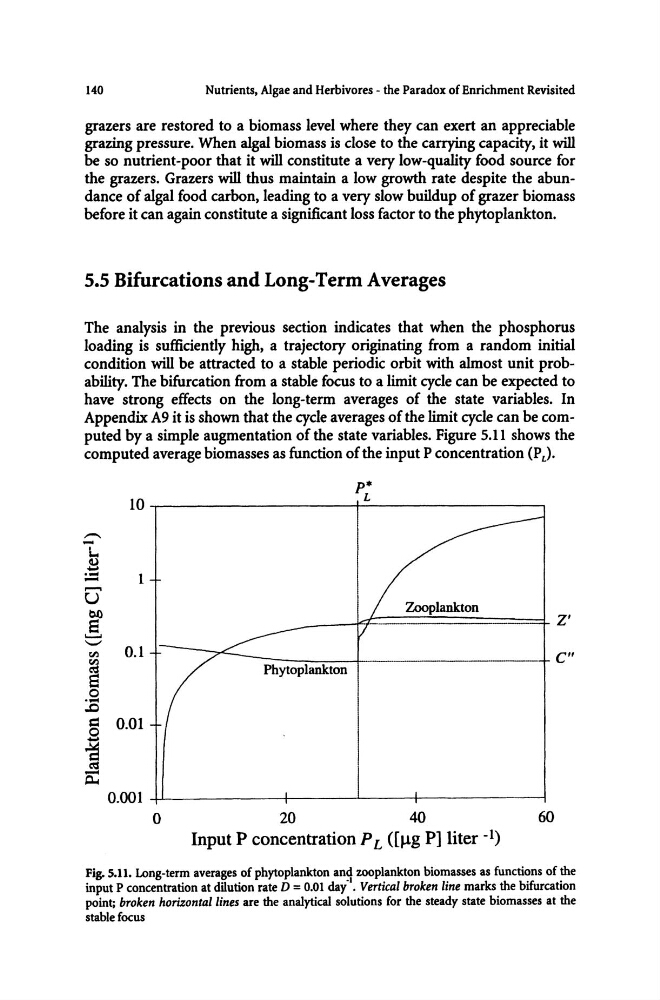
condition will be attracted to a stable periodic orbit with almost unit probability. The bifurcation from a stable focus to a limit cycle can be expected to
have strong effects on the long-term averages of the state variables. In
Appendix A9 it is shown that the cycle averages of the limit cycle can be computed by a simple augmentation of the state variables. Figure 5.11 shows the
computed average biomasses as function of the input P concentration (P L).
p*
10~ ______________________ ~L ____________________ ~
-
~
;.::::
1
z'
U
bJ)
8
Zooplankton
.......
'-"
~
0.1
~
-:::---:--;:----+ ... _ - - - - - - - - -
Phytoplankton
C"
o
....
.c
d
0.01
J
0.001 + ' - - - - - - - - ! - - - - - - ' ' - - - - - + - - - - - - - - I
o
20
40
60
Input P concentration P L ([flg P] liter -1)
Fig. 5.11. Long-term averages of phytoplankton and zooplankton biomasses as functions of the
input P concentration at dilution rate D = 0.01 day·l. Vertical broken line marks the bifurcation
point; broken horizontal lines are the analytical solutions for the steady state biomasses at the
stable focus
Nutrients, Algae and Herbivores - the Paradox of Enrichment Revisited
grazers are restored to a biomass level where they can exert an appreciable
grazing pressure. When algal biomass is close to the carrying capacity, it will
be so nutrient-poor that it will constitute a very low-quality food source for
the grazers. Grazers will thus maintain a low growth rate despite the abundance of algal food carbon, leading to a very slow buildup of grazer biomass
before it can again constitute a significant loss factor to the phytoplankton.
5.5 Bifurcations and Long-Term Averages
The analysis in the previous section indicates that when the phosphorus
loading is sufficiently high, a trajectory originating from a random initial
condition will be attracted to a stable periodic orbit with almost unit probability. The bifurcation from a stable focus to a limit cycle can be expected to
have strong effects on the long-term averages of the state variables. In
Appendix A9 it is shown that the cycle averages of the limit cycle can be computed by a simple augmentation of the state variables. Figure 5.11 shows the
computed average biomasses as function of the input P concentration (P L).
p*
10~ ______________________ ~L ____________________ ~
-
~
;.::::
1
z'
U
bJ)
8
Zooplankton
.......
'-"
~
0.1
~
-:::---:--;:----+ ... _ - - - - - - - - -
Phytoplankton
C"
o
....
.c
d
0.01
J
0.001 + ' - - - - - - - - ! - - - - - - ' ' - - - - - + - - - - - - - - I
o
20
40
60
Input P concentration P L ([flg P] liter -1)
Fig. 5.11. Long-term averages of phytoplankton and zooplankton biomasses as functions of the
input P concentration at dilution rate D = 0.01 day·l. Vertical broken line marks the bifurcation
point; broken horizontal lines are the analytical solutions for the steady state biomasses at the
stable focus